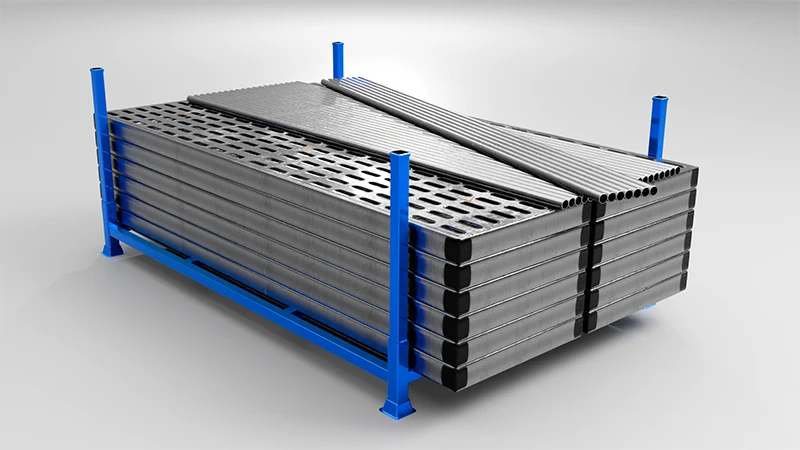

Industrial molds are the heart of your production line—they are heavy, expensive, and uniquely shaped. Storing them on the floor creates a hazardous, inefficient, and costly environment. Discover how a modular stacking system transforms your mold storage from a chaotic liability into a streamlined, protected asset.
Beyond Simple Storage: Transforming Molds from Liabilities to Managed Assets
The core challenge with heavy-duty industrial molds isn’t just finding space for them; it’s managing them as critical, high-value assets. Traditional floor storage or inadequate racking solutions expose these tools to damage, make retrieval a time-consuming ordeal, and waste vast amounts of vertical warehouse space. Post pallet stacking racks fundamentally change this dynamic by creating a system where each mold is protected, accessible, and efficiently stored.
Eliminating Product Damage with Structural Load Bearing
The primary failure of conventional storage is that the items at the bottom bear the weight of everything above. For industrial molds, this is unacceptable. A post pallet system introduces a “structural skeleton.” The weight of a stacked rack is transferred through its four robust steel posts directly to the cup feet of the unit below and ultimately to the floor. The mold inside bears zero weight from the units above it. This design creates an individual protective cell for each mold, safeguarding it from the crushing and impact damage common in block stacking environments.
From Floor Space to Cubic Volume: A Revolution in Density
Manufacturing facilities are defined by their floor space, but their true potential lies in their vertical volume. Industrial molds stored on the ground occupy a massive footprint for a single layer of storage. Industrial stacking racks allow you to safely stack molds 4 to 5 units high, effectively multiplying your storage capacity by 400-500% without increasing your warehouse footprint. This transition from an area-based storage model to a volume-based one unlocks immense density and frees up valuable floor space for production or other value-added activities.

Unlocking Operational Agility with a Modular, Portable System
Your production needs are not static, so your storage system shouldn’t be either. Unlike traditional pallet racking that is bolted to the floor, creating permanent aisles and a fixed layout, portable stack racks offer unparalleled flexibility. This modularity is key to adapting your facility to changing operational demands.
The ‘Mobile Warehouse’: Adapting to Production Demands
A system of post pallets creates a “mobile warehouse.” Molds required for an upcoming production run can be staged near the assembly line. Molds needing maintenance can be moved to a dedicated service area. Long-term storage can be consolidated in a separate zone. This ability to reconfigure your storage layout on the fly, using only a forklift, eliminates the constraints of fixed infrastructure and allows your storage to serve your production schedule, not dictate it.
Streamlined Inventory and Faster Changeovers
Assigning one mold to one specific stack rack transforms it into a trackable inventory unit. Instead of a chaotic search for “the tool for part number X,” your team can locate “rack number 157.” This one-to-one relationship simplifies integration with your Warehouse Management System (WMS), boosts inventory accuracy to near 100%, and dramatically reduces the time required for production line changeovers. Less time spent searching for a mold means more time producing parts.
| Challenge | Before: Traditional Storage | After: Post Pallet Stacking Racks |
| Asset Protection | Molds on the floor are exposed to forklift impacts, dust, and moisture. Stacking risks crushing damage. | Each mold is secured within a steel frame. Vertical stacking load is on the rack posts, not the mold. Damage risk is virtually eliminated. |
| Space Utilization | Only uses floor space (1-level storage). Vast vertical warehouse height is wasted. | Utilizes full warehouse height (4-5 levels). Multiplies storage capacity on the same footprint. |
| Retrieval Efficiency | “Treasure hunt” to find the correct mold, leading to significant production downtime during changeovers. | Each mold is a discrete, easily identifiable unit. Forklift provides 100% selectivity to any rack, speeding up changeovers. |
| Flexibility | Layout is fixed and difficult to change. Floor clutter creates permanent obstacles. | Fully mobile system. Warehouse layout can be reconfigured in hours to adapt to changing production needs. |
The Tangible Returns of a Superior Storage System
Adopting heavy duty stack racks is not an expense; it is a direct investment in operational efficiency and asset preservation. The returns are measured in reduced costs and increased output.
Reducing Downtime and Labor Costs
Every minute your team spends searching for a mold is a minute your machines are not running. By making every mold immediately accessible, you minimize costly downtime between production runs. Furthermore, you replace slow, manual searching with the swift, efficient work of a single forklift operator, optimizing your labor resources.
Protecting High-Value Assets and Lowering Total Cost of Ownership
A single industrial mold can be worth thousands, or even tens of thousands, of dollars. Preventing just one instance of damage from a forklift collision or improper stacking can pay for an entire system of racks. Constructed from Q235 steel and built for industrial environments, these racks have a service life spanning decades, offering a significantly lower total cost of ownership (TCO) compared to the constant risk and replacement costs associated with inadequate storage methods.
Frequently Asked Questions
1. What is the typical weight capacity of these racks for industrial molds?
Standard heavy-duty stack racks are commonly engineered to hold between 1,000 kg (2,200 lbs) and 2,000 kg (4,400 lbs). However, they are highly customizable, and capacities can be increased with reinforced base structures and larger-gauge steel to safely handle even the heaviest industrial molds.
2. Can the racks be customized for uniquely shaped or oversized molds?
Absolutely. The base dimensions, post height, and internal fittings of post pallets are fully customizable. For odd-shaped molds, features like custom cradles, support beams, or protective linings can be integrated to ensure a secure and stable fit.
3. How do these racks improve warehouse safety compared to floor storage?
They improve safety dramatically by eliminating floor clutter, which is a primary cause of trip-and-fall incidents and forklift accidents. Securely stacking molds vertically prevents unstable piles from collapsing, creating a much safer and more organized environment for personnel.
4. Are these stacking racks difficult for forklift operators to handle?
No, they are designed for ease of use. Key features like four-way forklift entry pockets provide access from any side. Most importantly, the “cup feet” design on the posts acts as a self-guiding mechanism, allowing operators to align and stack racks quickly and safely without needing perfect precision.
5. What happens to the racks when they are not being used to store molds?
This is a key advantage. The posts are removable. When not in use, the posts can be detached and the empty bases can be nested or stacked together. This reduces their storage footprint by up to 80%, freeing up valuable floor space for other operations, a feature impossible with fixed racking.
Need a Custom Storage Solution?
Speak directly with our technical engineers. We offer free structural designs, heavy-duty catalog evaluations, and quick B2B price quotations.
Request a Quote Now →