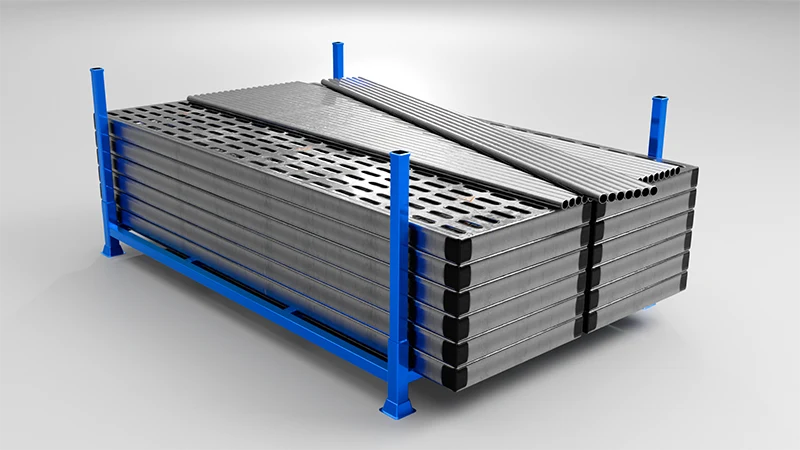

Unlock the hidden potential in your warehouse. Traditional storage methods often force a choice between high density and easy access, creating bottlenecks and limiting growth. Nestable portable stack racks eliminate this compromise, offering a flexible, high-density storage solution that adapts to your inventory flow, protects your products, and drastically cuts operational costs. Discover how to transform your warehouse from a static cost center into a dynamic, efficient asset.
The Hidden Cost of Inefficient Warehouse Space
Every warehouse manager faces a fundamental conflict: the battle between storage density and product selectivity. Fixed pallet racking offers perfect selectivity—you can access any pallet at any time—but permanently sacrifices up to 60% of your floor space to fixed aisles. On the other hand, block stacking products directly on the floor maximizes density but creates significant problems. It limits stack height based on product integrity, leads to crushing damage on lower layers, and enforces a rigid “Last-In, First-Out” (LIFO) retrieval system, making it nearly impossible to access specific SKUs buried in a stack.
Shifting the Load: From Product to Structure
The core innovation of a portable stack rack is its simple yet revolutionary design: it is essentially a pallet with its own structural skeleton. By adding removable steel posts, the weight of stacked loads is transferred through the rack’s frame directly to the floor. The products inside—whether they are bags of flour, rolls of fabric, or tires—bear zero weight from the layers above. This single change fundamentally alters what is possible within your facility.
Multiply Your Storage Capacity, Not Your Footprint
Once your products are protected from compression, you can safely utilize the full vertical height of your warehouse. Heavy duty stack racks allow you to stack loads 4 or 5 tiers high, instantly converting unused overhead air into valuable storage space. This can increase your total storage capacity by 400-500% without the need for expensive facility expansion or off-site storage. The system transforms your warehouse from a measure of square footage to a measure of cubic volume.

Dynamic Aisles for a Flexible Warehouse
Unlike fixed racking that is bolted to the floor, portable stack racks are completely mobile. This gives you the power to redesign your warehouse layout on demand. During peak season, you can create dense storage blocks to accommodate incoming inventory. In the off-season, you can clear entire sections by nesting the empty racks, freeing up floor space for maintenance, kitting, or cross-docking operations. Your warehouse layout can now adapt to business fluctuations, not dictate them.
The Nesting Advantage: Slashing Return Logistics Costs
One of the most significant financial benefits of this system comes from its “nestable” design. The corner posts can be easily removed, allowing the empty bases to be nested into one another. This simple feature is a game-changer for any company using them as returnable transport packaging (RTP). A single truckload that would carry 50 assembled (empty) racks can now transport 200-300 nested bases. This reduction in return shipping volume by 75-80% makes closed-loop supply chains economically viable, drastically lowering the cost-per-trip and eliminating the waste of single-use packaging like wooden pallets.

A Practical Look at Workflow Transformation
Implementing a metal post pallet system does more than just save space; it fundamentally streamlines your entire material handling process from receiving to shipping. The efficiency gains are immediate and measurable.
| Warehouse Stage | Process Before Stack Racks | Process After Stack Racks |
| Inbound Receiving | Manual unloading of loose items from a container. Time-consuming, high risk of labor injury and product damage. Requires re-palletizing. | Forklift unloads entire pre-loaded racks directly from the truck. Unloading time is cut by up to 80%. No manual handling. |
| Storage & Putaway | Goods are stacked on the floor, risking damage, or placed in fixed racks, limiting layout flexibility and density. | Forklift driver places the rack in any available space, stacking vertically to maximize cube utilization. Warehouse layout is fluid. |
| Order Picking & Outbound | Workers de-stack items manually or retrieve pallets from fixed racking. Often involves multiple handling steps. | Forklift picks the entire rack as a single unit and moves it directly to the staging area or loads it onto an outbound truck. Product damage rates fall to near zero. |
| Reverse Logistics | Disposable packaging is discarded. Empty wooden pallets are costly and bulky to return. | Empty racks are nested at the destination, dramatically reducing return freight costs and creating a sustainable, closed-loop system. |
Frequently Asked Questions
1. What exactly is a nestable portable stack rack?
It is a modular, free-standing steel rack, also known as a post pallet or stillage, consisting of a base and removable corner posts. It’s designed to hold goods and be stacked on top of other identical racks, creating a dense and flexible storage system without the need for traditional shelving.
2. How do stack racks increase warehouse space?
They leverage vertical space. Instead of being limited by how high you can stack your product without causing damage, you can stack the racks themselves 4-5 units high. This effectively multiplies your storage capacity within the same warehouse footprint.
3. Are portable stack racks safe to stack?
Yes. They are engineered for stability. The corner posts of the lower rack fit into specially designed “cup feet” or sockets on the base of the rack above it. This creates a secure, interlocking connection that prevents shifting and ensures stability when stacked correctly by a trained forklift operator.
4. What does “nestable” mean and why is it important for warehouse optimization?
“Nestable” refers to the ability to remove the posts and stack the empty bases into each other, much like shopping carts. This is critically important for optimizing space when the racks are not in use and for dramatically reducing transportation costs when returning empty racks, saving up to 80% on shipping volume.
5. Can these racks be used for different types of products?
Absolutely. Their versatility is a key advantage. They are ideal for items that are difficult to stack, such as tires, textile rolls, pipes, bagged goods, and bulky items. Many models can be customized with different base options like steel decking, wire mesh, or specific cradles to suit a wide variety of industrial applications.
Need a Custom Storage Solution?
Speak directly with our technical engineers. We offer free structural designs, heavy-duty catalog evaluations, and quick B2B price quotations.
Request a Quote Now →