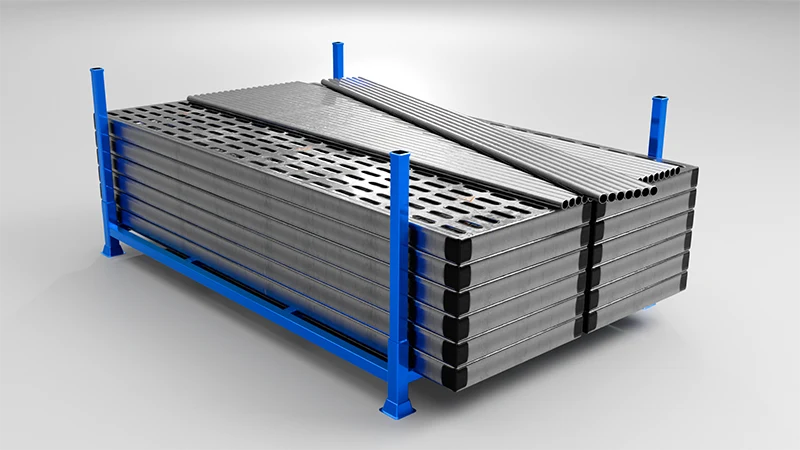

When selecting industrial storage, the choice between a painted or a galvanized finish on a post pallet seems like a simple cost decision. Painted racks are cheaper upfront. But does that initial saving translate to long-term value? The answer lies in understanding the total cost of ownership (TCO) and the hidden operational risks that a simple coat of paint can’t protect you from, especially in demanding environments.
The Deceptive Simplicity of Painted Racks
Powder-coated or painted post pallet stacking racks are the most common choice for general-purpose, dry indoor warehousing. Their primary advantage is a lower initial purchase price (CAPEX), making them an attractive option for budget-conscious projects. The finish provides a basic barrier against corrosion and can be color-coded for inventory management.
However, this protective layer is only skin-deep. In any active warehouse environment, paint is susceptible to failure:
- Mechanical Damage: Forklift impacts, shifting loads, and general handling inevitably lead to scratches, chips, and scrapes. Each point of damage exposes the raw steel underneath.
- Corrosion Creep: Once the steel is exposed, rust begins to form. This rust then creeps underneath the surrounding paint, causing it to bubble and peel, compromising an even larger area.
- High Maintenance: To maintain their integrity and appearance, painted racks require periodic downtime for sanding, priming, and repainting—a recurring operational expense in both labor and lost productivity. Their effective lifespan, especially in imperfect conditions, is often limited to just 3-5 years.
Hot-Dip Galvanization: A Deeper Look into Long-Term Protection
Hot-dip galvanization is not just a coating; it’s a metallurgical transformation. During this process, the entire steel rack is submerged in a bath of molten zinc. This creates a series of zinc-iron alloy layers, metallurgically bonded to the steel, topped with a pure zinc layer. This process provides a level of protection that paint simply cannot match.
How It Works: More Than Just a Barrier
Unlike paint, which is just a surface layer, the galvanized finish becomes an integral part of the steel. This robust, bonded coating is highly resistant to abrasion and impact. Even if a significant gouge occurs, the protection doesn’t stop.
The “Self-Healing” Advantage
The most critical benefit of galvanization is its ability to provide cathodic, or “sacrificial,” protection. Zinc is more reactive than steel. If the coating is scratched deep enough to expose the base metal, the surrounding zinc will corrode first, “sacrificing” itself to protect the steel from rusting. This self-healing mechanism prevents rust from forming and creeping, ensuring the structural integrity of the rack for decades. A hot-dip galvanized finish, with a typical thickness of over 60μm, can easily last over 20 years, even in harsh conditions.

The True Cost: A Head-to-Head Comparison
When viewed through the lens of Total Cost of Ownership (TCO), the financial argument shifts dramatically in favor of galvanization. While the initial investment is higher, the long-term savings are substantial.
| Attribute | Painted Racks | Hot-Dip Galvanized Racks |
|---|---|---|
| Initial Investment | Low | Moderate |
| Asset Lifespan | 3-5 years | 20+ years |
| Maintenance Requirement | Regular touch-ups, full repainting | Virtually zero |
| Risk of Contamination | High (rust flakes, peeling paint) | Extremely Low |
| Total Cost of Ownership (TCO) | High (due to replacement and maintenance) | Low (due to longevity and no maintenance) |
Critical Environments Where Galvanization Is the Only Choice
For certain industries, the choice is not just about economics but about compliance and safety. In these scenarios, galvanized post pallets are the only viable option.
Cold Storage & Food Processing
In cold storage facilities, constant condensation and freeze-thaw cycles accelerate the failure of painted surfaces. Rust flakes can contaminate food products, leading to costly recalls and violating HACCP and GMP standards. Galvanized racks are impervious to this moisture, are easy to clean with high-pressure water, and pose no contamination risk.
Outdoor Operations & Coastal Areas
Racks used for outdoor storage are constantly exposed to rain, snow, and UV rays. In coastal regions, salty air is highly corrosive. A painted finish will quickly break down in these conditions, whereas a galvanized rack will withstand the elements for years without degradation.
Chemical and Heavy Industrial Use
Facilities that handle chemicals or have corrosive atmospheres require a storage solution that can resist chemical attack. The robust, non-reactive surface of galvanized steel provides superior protection where paint would quickly fail.

The Verdict: An Investment, Not an Expense
So, are galvanized post pallet stacking racks better than painted ones? For any application that involves moisture, temperature fluctuations, outdoor exposure, or strict hygiene standards, the answer is an unequivocal yes. While painted racks may save you money on day one, a hot-dip galvanized rack saves you money every day for the next two decades. It’s a strategic investment in operational continuity, product safety, and long-term financial health.
Frequently Asked Questions
1. Can I use painted racks in a cold storage facility to save money?
It is strongly discouraged. The constant condensation will cause the paint to fail quickly, leading to rust contamination of your products and potential health code violations. The cost of a single product recall would far exceed any initial savings on the racks.
2. What exactly is the “self-healing” property of galvanized steel?
It refers to cathodic protection. Zinc is more electrochemically active than steel. If a scratch exposes the steel, the surrounding zinc coating will corrode first, forming a protective layer over the scratch and preventing the steel itself from rusting.
3. How much more do galvanized racks cost upfront compared to painted ones?
Typically, the initial cost for hot-dip galvanized racks can be 20-40% higher than for standard painted racks. However, this premium is quickly recovered through the elimination of maintenance costs and a 4-5 times longer asset lifespan.
4. If a galvanized rack is heavily damaged, can it be repaired?
Yes. Structural damage can be repaired by welding. After the repair, the affected area can be protected using a zinc-rich paint or spray to restore its corrosion resistance, maintaining the integrity of the rack.
5. Is the galvanization process safe for storing food and agricultural products?
Absolutely. The stable, inert zinc coating is non-toxic and does not leach into the environment or products. It is a widely accepted and preferred finish for equipment used in food processing, agriculture, and pharmaceutical storage due to its cleanability and resistance to bacterial growth.
Need a Custom Storage Solution?
Speak directly with our technical engineers. We offer free structural designs, heavy-duty catalog evaluations, and quick B2B price quotations.
Request a Quote Now →