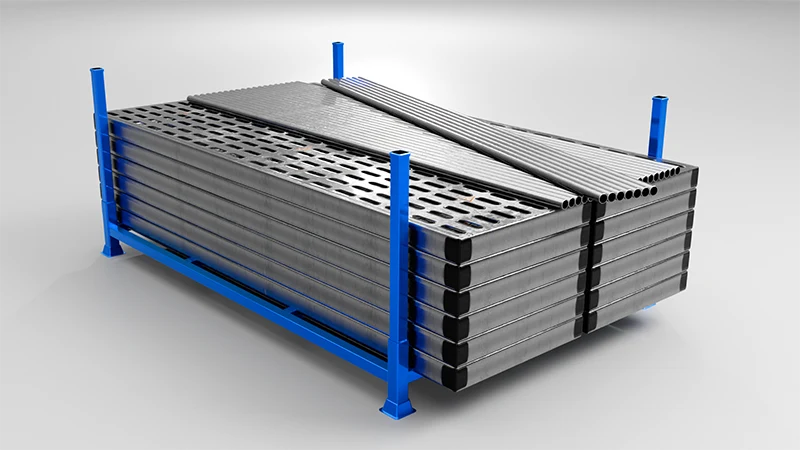

Understanding Post Pallet Capacity: It’s More Than Just a Number
When sourcing industrial storage solutions, one of the most common questions is, “What is the maximum weight capacity of a standard post pallet?” The direct answer is: there is no single “standard” capacity. The capacity is an engineered variable determined by its design, materials, and intended application. A more productive question for any operations or warehouse manager is, “What capacity do I need, and what factors ensure it is safe and reliable?”
The load capacity of a portable stack rack is not an arbitrary figure. It is the result of careful engineering calculations considering three critical elements: the base construction, the post design, and the type of load it will be subjected to. Misunderstanding this can lead to equipment failure, product damage, and serious safety hazards.
The Core Factors That Define Load Capacity
The final certified weight limit of a post pallet, often called a pallet stillage, is a function of its structural integrity. This integrity is built upon the quality of its components and manufacturing process.
Base Construction and Steel Specification
The foundation of any stack rack is its base. The capacity is heavily influenced by the grade and thickness of the steel used, typically high-quality Q235 structural steel. The design of the base frame—whether it features a simple perimeter, cross-bracing, or a full “井” shaped reinforcement—dictates how weight is distributed. The quality of the welding at each joint is paramount, as these are the points where stress is concentrated. A robustly constructed base prevents bowing or deformation under heavy loads, ensuring stability both on the ground and when stacked.

Post Design: The Pillars of Strength
The removable posts are what enable vertical stacking. Their strength is critical because they transfer the entire weight of the upper racks down to the base. The posts’ capacity is determined by the diameter and wall thickness of the steel tubing. For standard loads like bagged goods or finished products in cartons, four posts are sufficient. However, for specialized applications like storing long, flexible materials such as PVC pipes or steel tubing, an 8-post design may be implemented. This adds intermediate support points, shortens the unsupported span, and prevents the goods from sagging or bending under their own weight.
Dynamic vs. Static Load Capacity
It’s crucial to differentiate between two types of capacity:
- Static Capacity: This is the maximum weight a post pallet can hold when it is stationary and stacked in a warehouse. This is typically the higher of the two values, as the load is stable and evenly distributed.
- Dynamic Capacity: This refers to the maximum weight a post pallet can support while being moved by a forklift or other material handling equipment. This value is lower because it accounts for the additional forces and stresses of acceleration, braking, and turning. All safe working load (SWL) ratings should be based on dynamic capacity for operational safety.
How Capacity Translates to Real-World Warehouse Efficiency
Understanding the engineering behind capacity allows you to solve tangible warehouse problems, particularly for businesses like food manufacturers and feed distributors who handle bulk bagged goods.
Preventing Product Crushing and Damage
For products like flour, sugar, or animal feed in 50 lb bags, block stacking on the floor is limited. Stacking too high results in the lower layers being compressed and damaged, leading to direct product loss. A heavy duty stack rack solves this entirely. The weight of the upper levels is borne by the steel posts, not the product below. This allows you to stack pallets of bagged goods 4 or 5 high without any risk of crushing the items at the bottom, reducing damage rates to near zero.
Maximizing Vertical Space Safely
A properly rated stack rack system transforms your warehouse from a measure of square feet to cubic feet. By safely utilizing the full vertical height of your facility, you can increase storage density by up to 400% compared to floor stacking. This is achieved because the “cup feet” design ensures that each stacked unit is securely aligned with the one below it, creating a stable, interconnected storage block that is both dense and easily accessible with a forklift.

To provide a clear reference, here is a general guide to typical post pallet capacity ranges based on duty rating. The final specification should always be confirmed based on your specific product and operational needs.
| Duty Rating | Typical Dynamic Capacity Range | Common Applications |
| Light-Duty | 500 – 1,000 kg (1,100 – 2,200 lbs) | Empty packaging, light manufacturing components, textiles, small parts. |
| Medium-Duty | 1,000 – 1,500 kg (2,200 – 3,300 lbs) | Bagged goods (flour, feed), passenger car tires, finished goods in cartons, bulk bins. |
| Heavy-Duty | 1,500 – 2,000 kg+ (3,300 – 4,400 lbs+) | Steel coils, heavy castings, automotive parts, truck tires (TBR), dense raw materials. |
Frequently Asked Questions (FAQ)
1. What is the difference between static and dynamic load capacity?
Static capacity is the maximum weight the rack can hold when stationary. Dynamic capacity is the maximum weight it can hold while being moved by equipment like a forklift. For safety, you should always operate based on the lower dynamic capacity rating.
2. Can the weight capacity of a post pallet be customized?
Absolutely. Post pallets are engineered products. The capacity can be increased by using thicker gauge steel, adding more reinforcement to the base, or increasing the diameter and wall thickness of the posts to meet specific heavy-duty requirements.
3. Does the surface finish, like hot-dip galvanizing, affect the load capacity?
No, the surface finish does not impact the structural load capacity. However, a finish like hot-dip galvanizing significantly increases the pallet’s lifespan by protecting the steel from rust and corrosion, especially in cold storage or outdoor environments, thus preserving its structural integrity over time.
4. How does stacking multiple units affect the total weight on the bottom pallet?
When you stack racks, the total weight on the floor under the bottom unit is the sum of all the racks and their loads above it. For example, if you stack four racks, each holding 1,000 kg, the bottom rack’s base is supporting its own 1,000 kg load, while its posts are transferring the 3,000 kg from the three racks above it. Your floor must be rated to handle the total concentrated load.
5. Is there a weight limit for the forklifts used to handle loaded post pallets?
Yes. The forklift used must have a rated capacity sufficient to safely lift the combined weight of the post pallet and its contents. Always check your forklift’s load chart to ensure it can handle the weight at the required lift height and load center.
Need a Custom Storage Solution?
Speak directly with our technical engineers. We offer free structural designs, heavy-duty catalog evaluations, and quick B2B price quotations.
Request a Quote Now →