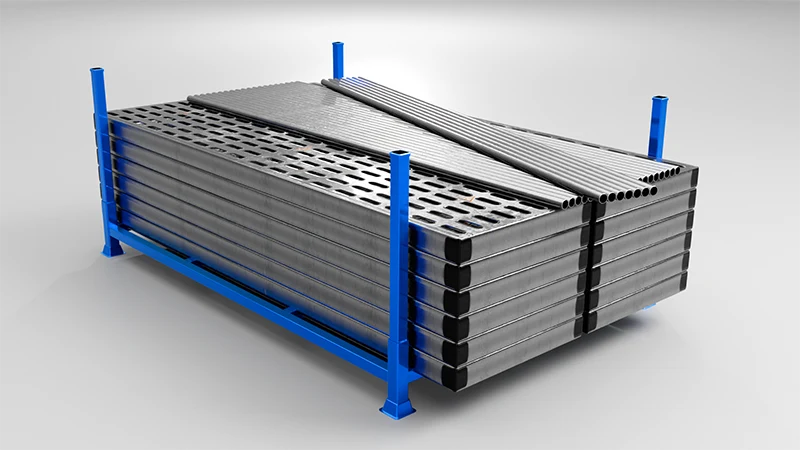

The cost of shipping products to your customers is a clear, calculated expense. But what about the cost of bringing the packaging back? Empty return trips are a silent drain on profitability, often turning sustainable, returnable packaging programs into logistical nightmares. The challenge isn’t the weight; it’s the volume. Shipping empty air in the form of assembled racks or bulky bins erodes margins with every mile. It’s time to address the true culprit of high reverse logistics costs: inefficiency in return transport.
The Hidden Drain: Why Empty Return Trips Inflate Your Logistics Budget
In any closed-loop supply chain, the goal is to reuse assets like pallets and racks to reduce waste and long-term costs. However, the economics often collapse during the return journey. A truck or container that delivered fully loaded racks returns with the same number of empty, space-consuming racks. This inefficiency has direct financial consequences:
- Maximized Transportation Costs: You are paying for a full truckload to transport what is essentially air. The cost per unit to return an empty, non-collapsible rack can sometimes exceed the savings gained from reusing it.
- Wasted Fuel and Labor: More return trips mean more fuel consumed, more driver hours paid, and more labor spent loading and unloading bulky, empty frames.
- Operational Bottlenecks: Storing these empty racks while waiting for a full return load consumes valuable warehouse or yard space that could be used for revenue-generating activities.
This problem forces many companies into a costly cycle of using disposable, one-way packaging, which creates environmental waste and offers no long-term asset value. The solution lies not in abandoning reusable packaging, but in fundamentally changing its design.
The Nesting Revolution: How Demountable Racks Change the Equation
The core innovation of portable stacking pallet racks, also known as post pallets, is their demountable design. The vertical posts can be quickly removed from the base without tools. This simple feature transforms the entire reverse logistics model.
From “Shipping Air” to “Shipping Density”
Once the posts are removed, the steel bases are engineered to nest securely into one another. A stack of 4 to 6 nested bases and their posts occupies the same footprint and a fraction of the vertical space as a single assembled rack. This immediately converts wasted volume into transportable density.

Instead of a truck returning with 30-40 assembled empty racks, the same truck can now carry 150-200+ nested units. This isn’t a marginal improvement; it’s a fundamental shift in efficiency.
The Math of Efficiency: A Quantifiable Impact
The value proposition is clear and measurable. By reducing the required return shipping volume by as much as 80%, you achieve direct, tangible savings. Consider a typical 40-foot shipping container: it can be filled with hundreds of nested post pallet bases. This dramatic increase in return density directly leads to:
- Slashed Freight Costs: You are consolidating what would have been 4-5 separate return shipments into a single trip. This is the single most significant way these racks lower reverse logistics costs.
- Lower Carbon Footprint: Fewer trucks on the road means a direct reduction in fuel consumption and CO2 emissions, bolstering corporate sustainability initiatives.
- Optimized Labor: Handling and loading consolidated stacks of nested bases is far quicker and more efficient for forklift operators than managing individual bulky racks.
Beyond Cost Savings: Ripple Effects on Your Operations
The benefits of a nestable, returnable rack system extend beyond the transportation budget. They create a more streamlined and efficient operation from end to end.
Simplified Handling for Everyone
At the destination, your customers or partners are not burdened with storing awkward, empty racks. The disassembly process is intuitive and fast. They can easily stack the nested bases in a small corner, freeing up their valuable floor space and improving your business relationship by making the return process painless.
Reduced Storage Footprint for Empties
Back at your own facility, you no longer need a vast “graveyard” of empty racks. Nested units can be stored compactly, liberating precious square footage for inventory, production, or cross-docking operations. This flexibility allows your warehouse layout to adapt to seasonal demand rather than being constrained by empty packaging.
Enhanced Asset Durability
Built from industrial-grade steel, these portable stack racks are a long-term asset. Unlike wooden pallets that splinter or plastic bins that crack, a steel rack withstands the rigors of repeated transport cycles. This high durability means a lower total cost of ownership and a reliable, consistent packaging solution that won’t fail mid-shipment.
Is a Nestable Rack System Right for Your Reverse Logistics?
If your business operates a closed-loop supply chain, manages inter-facility transfers, or ships high volumes of product to dedicated partners, the answer is likely yes. Industries such as automotive manufacturing, tire distribution, textiles, and bulk bag handling see immediate and substantial returns on investment. By tackling the inefficiency of empty return volume head-on, portable stacking pallet racks don’t just save money—they make your entire supply chain more resilient, efficient, and sustainable.
Frequently Asked Questions
1. How much space do nested racks actually save compared to assembled ones?
Typically, 4 to 6 nested rack bases occupy the same vertical space as one fully assembled rack. This translates to a volume reduction of 75-80%, which directly cuts down on return freight costs.
2. Are the removable posts difficult to manage or easy to lose?
No, the system is designed for efficiency. The posts are lightweight enough for a single person to handle, and they are typically bundled and stored securely on the top of the nested stack of bases for return shipment, minimizing the risk of loss.
3. What’s the main difference between a portable stack rack and a regular pallet?
A pallet is simply a base for goods. A portable stack rack is a self-contained structural unit. Its posts bear the load, protecting the products within from being crushed. This allows for safe stacking of crushable or irregularly shaped items. Most importantly for reverse logistics, its demountable and nestable design is specifically engineered to save return freight costs, a feature standard pallets lack.
4. Can these racks be stored outdoors while awaiting return?
Absolutely. Models with a hot-dip galvanized finish are fully protected against rust and corrosion, making them ideal for outdoor storage in any weather condition. This frees up indoor warehouse space.
5. How does this impact the loading and unloading time for return trips?
It drastically reduces handling time. A forklift operator can move a consolidated stack of 20 nested bases in a single lift, whereas they would have to handle 20 individual, bulky racks separately. This significantly speeds up the truck turnaround time for return shipments.
Need a Custom Storage Solution?
Speak directly with our technical engineers. We offer free structural designs, heavy-duty catalog evaluations, and quick B2B price quotations.
Request a Quote Now →