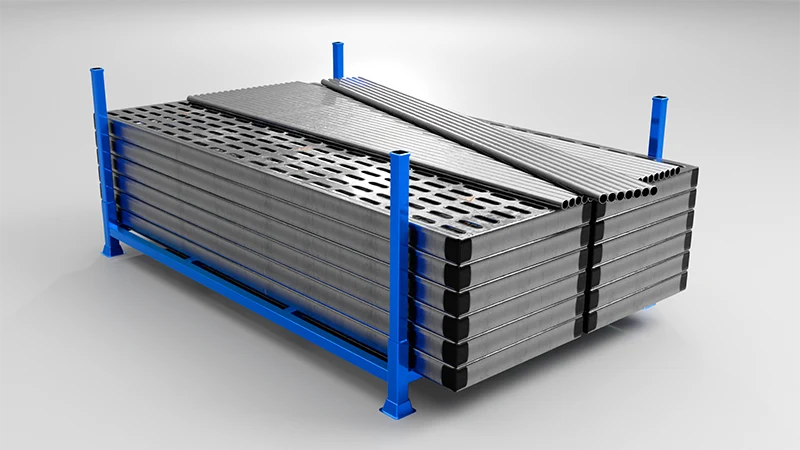

Storing textile rolls and delicate fabrics presents a unique challenge that standard pallets or shelving often fails to address. The risk of crushing, creasing, and material damage from improper storage can lead to significant financial loss through yield reduction. Traditional storage methods force a compromise between space utilization and product integrity. We provide engineered solutions that eliminate this compromise entirely.
The Hidden Costs in Every Crushed Fabric Roll
In the textile industry, the way you store your inventory directly impacts your bottom line. Standard floor stacking, often in a pyramid formation, seems like a simple solution but introduces severe, often unseen, costs. This method places the entire weight of the upper rolls onto the bottom layer. The result is “ovalization”—the crushing of cardboard cores and the distortion of the roll’s shape. This leads to permanent creasing and tension inconsistencies in the fabric, rendering the first several meters of each crushed roll unusable. This direct material loss, known as yield loss, eats away at profitability. Furthermore, rolls stacked on the floor are vulnerable to moisture from the concrete, dirt, and damage from pests, leading to spoilage and waste.
From Load-Bearing Fabric to Load-Bearing Steel
The fundamental solution is to shift the load-bearing responsibility from the product to the storage structure itself. A portable stack rack is essentially an industrial-grade steel skeleton for your inventory. When a fabric roll is placed within a rack, its weight is supported by the steel base. When another rack is stacked on top, the weight is transferred through the corner posts down to the floor. The fabric rolls, even those on the bottom layer, bear zero weight from the inventory above them. This simple change in physics completely eliminates the problem of crushing and ovalization, ensuring every inch of your fabric remains in perfect condition from the moment it’s stored to the moment it’s used.

The Power of Customization: Engineered for Textiles
While the concept of a stack rack is powerful, its true value for the textile industry is unlocked through customization. Fabric rolls are not uniform; they vary in length, diameter, and weight. A one-size-fits-all approach is inefficient. Customization allows the rack to be perfectly adapted to your specific inventory, maximizing both protection and density.
U-Shaped Cradles for Ultimate Protection
For high-value or delicate fabrics, customized stack racks can be fitted with U-shaped or V-shaped cradles. These cradles are welded onto the rack’s base, creating a series of channels that suspend each roll individually. This design prevents the rolls from touching each other, eliminating any risk of surface abrasion or pressure points. It also stops any potential for rolling or shifting during transport within the warehouse, providing the highest level of stability and protection for your most sensitive materials.
Side Frames for Bulk Roll Security
For operations handling large quantities of uniform rolls, racks can be designed with specialized side frames or containment bars. These additions act as a secure enclosure, preventing rolls from shifting or falling, especially when the racks are being moved by forklift. This feature is crucial for maintaining both product safety and workplace safety. By engineering the rack’s internal dimensions and support structures to match your roll diameters, you can achieve maximum storage density without sacrificing security.

A Side-by-Side Comparison: Traditional vs. Customized Racks
The transformation in your workflow and efficiency becomes clear when you compare the old method with a purpose-built system. The gains are not incremental; they represent a fundamental improvement in how you manage your inventory.
| Metric | Traditional Pyramid Stacking | Customized Portable Stack Rack System |
|---|---|---|
| Product Damage | High risk of crushing, ovalization, and creasing, leading to 5-10% yield loss on bottom-layer rolls. | Near-zero risk of compression damage. Each roll is independently supported by steel. |
| Space Utilization | Limited to 2-3 layers high due to product fragility. Wastes vertical warehouse space. | Stacks 4-5 layers high safely, increasing storage capacity by up to 400% on the same footprint. |
| Inventory Access | Last-In, First-Out (LIFO). Accessing a specific roll at the bottom requires de-stacking the entire pile. | 100% selectivity. Forklifts can access any rack at any level at any time. |
| Handling Efficiency | Labor-intensive manual handling of individual rolls, increasing risk of drops and contamination. | Unitized handling. A forklift moves an entire rack (multiple rolls) in a single, safe operation. |
| Warehouse Flexibility | Storage piles create fixed, inflexible layouts. | Racks can be easily moved to reconfigure warehouse layouts for seasonal inventory or workflow changes. |
Conclusion: An Investment in Material Integrity
Yes, portable stack racks can and should be customized for textile rolls and fabrics. This is not merely a storage upgrade; it is a strategic decision to eliminate waste, maximize space, and improve operational efficiency. By investing in a textile roll storage rack system that is engineered to protect your product, you are directly investing in the quality and profitability of your business. The cost of crushed and damaged fabric far outweighs the investment in a proper storage solution that protects your assets from the ground up.
Frequently Asked Questions
1. Can these racks be designed for fabric rolls of varying lengths?
Absolutely. The length of the rack base is one of the primary points of customization. We can design racks specifically for your standard 60-inch rolls, longer carpet rolls, or any other specific length to ensure the roll is fully supported from end to end without overhang.
2. What is the weight capacity of a customized textile rack?
Weight capacity is a key design parameter. Each rack is engineered based on the maximum weight of the rolls it will hold and the number of units it will store. Capacities typically range from 1,000 kg to 2,000 kg (2,200 to 4,400 lbs) per rack, and this can be increased for exceptionally heavy materials like industrial textiles or carpet.
3. How does customization affect the cost?
While custom designs may have a different initial cost than off-the-shelf products, they provide a much higher return on investment. By perfectly matching the rack to your product, you maximize storage density and eliminate waste from damaged goods, leading to significant long-term savings.
4. Are the racks difficult to assemble and move?
No, they are designed for flexibility. The corner posts are typically removable, allowing the empty bases to be nested or stacked compactly. A single worker can usually assemble or disassemble a rack in minutes without special tools. Their design includes forklift pockets for easy and safe relocation by standard warehouse equipment.
5. What surface finishes are available to protect delicate fabrics?
The standard finish is a durable powder coating, which provides a smooth, snag-free surface. For environments with high humidity or specific cleanliness requirements, hot-dip galvanized finishes are also available. We can also explore adding protective liners to cradle surfaces for ultra-sensitive materials.
Need a Custom Storage Solution?
Speak directly with our technical engineers. We offer free structural designs, heavy-duty catalog evaluations, and quick B2B price quotations.
Request a Quote Now →