
For operations handling heavy loads, standard 2 tier trolleys create significant challenges. The lower deck becomes a zone of inefficiency and physical strain, forcing operators to bend and reach deep into a confined space. This not only slows down picking and placing tasks but also increases the risk of product damage and musculoskeletal injuries. The optimal solution is a trolley engineered to eliminate this fundamental design flaw, transforming the lower deck into a fully accessible, ergonomic workspace. It must combine a high load capacity with a design that brings the work to the operator, not the other way around.
Why Standard 2-Tier Trolleys Fail with Heavy Loads
In any industrial workshop or distribution center, the standard 2 tier utility carts present a paradox of design. The top shelf operates within the ergonomic “golden zone,” allowing for easy access to goods. However, the lower shelf creates a significant operational bottleneck, especially when dealing with heavy or bulky items like automotive parts, industrial hardware, or bulk electronic components. This isn’t just an inconvenience; it’s a systemic flaw that impacts efficiency, safety, and product integrity.
The core issue lies in the biomechanics of access. To place a 25kg box of fasteners or a heavy brake disc onto the lower shelf, an operator must perform a strenuous “trunk flexion” movement—bending at the waist while extending their arms deep under the top shelf. This action creates a powerful lever effect on the lower back, dramatically increasing compressive forces on the lumbar spine. In a high-frequency order picking process, repeating this motion hundreds of time per shift leads directly to operator fatigue, reduced productivity, and a higher risk of musculoskeletal disorders. Furthermore, this “blind placement” often results in products being dropped or colliding with the trolley’s frame, causing costly damage.
Redefining Lower-Shelf Access: The Pull-Out Layer System
The most effective solution to this problem is not an incremental improvement but a fundamental redesign of how the lower space is used. The best heavy-duty trolleys replace the fixed bottom shelf with a fully extendable, load-bearing pull-out layer. This innovation fundamentally changes the nature of the task from a horizontal “reach and guess” into a direct, vertical “place and secure.” By sliding the entire lower deck out from the main frame, operators gain unobstructed, top-down access to the entire surface, effectively creating a second “golden zone” at a lower elevation.
The Engineering Behind Load-Bearing Stability
A common concern with any drawer system is its ability to handle heavy industrial loads without tipping or failing. A truly robust system achieves stability through a purpose-built, independent track system rather than conventional drawer slides.
- V-Wheel and Angle Rail Guidance: The pull-out layer glides on a V-wheel and angle steel rail combination. This industrial-grade design is self-centering, ensuring a smooth, non-binding motion even under an uneven load. Unlike enclosed ball-bearing slides, this open system is highly resistant to jamming caused by dust, debris, or metal shavings found in workshop environments.
- Auxiliary Front Casters: The most critical innovation is the addition of auxiliary casters at the front of the pull-out layer. When the deck is extended, these casters engage with the floor, creating a stable six-point footprint. This mechanically decouples the load of the lower deck from the main frame’s center of gravity, completely preventing the risk of the entire trolley tipping forward.
- Secure Locking Mechanisms: For safety during transit, the system incorporates an inner-lined latch pin. This design locks the pull-out layer securely within the frame, preventing accidental extension during movement, while its recessed profile avoids snagging on personnel or racking. Removable limit blocks are also in place to prevent the layer from being pulled completely off its tracks.

Beyond Ergonomics: Built for Industrial Realities
While ergonomic access is paramount, a trolley’s value in a heavy-load environment is ultimately defined by its structural integrity and durability. The best-in-class models are engineered to withstand the rigors of daily industrial use, starting from the material foundation up to the final finish.
Material Science and Manufacturing Process
The ability to consistently handle a safe working load of 600 kg is not accidental. It is the result of deliberate engineering choices:
- Q235 Structural Steel: The frame is constructed from high-quality Q235 carbon structural steel, typically using 30x30mm rectangular tubing. This material offers an excellent balance of strength and ductility, meaning it can absorb impacts from collisions without catastrophic brittle failure. Finite Element Analysis (ANSYS) testing confirms that under a distributed 600 kg load, the maximum stress on the frame remains well below the material’s yield strength.
- MIG/MAG Welding: The frame is joined using CO2 gas shielded welding (MIG/MAG). This high-production process creates deep, consistent welds with a heat-affected zone that is small, minimizing material distortion and ensuring the welded joints are as strong, or stronger, than the parent metal.
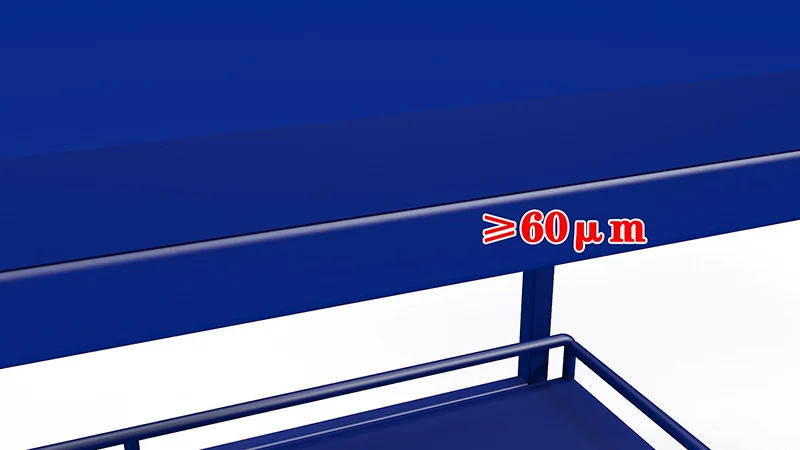
- Industrial Powder Coating: Durability extends to the surface. Before painting, the steel undergoes a crucial pre-treatment process of acid pickling and phosphating. This removes all rust and oil while creating a micro-crystalline surface that dramatically enhances paint adhesion. An electrostatic powder coat is then applied to a thickness of at least 60μm, providing a hard, resilient finish that resists chipping, scratching, and corrosion from industrial chemicals and fluids.

Choosing the Right Tool: A Comparative Analysis
To make an informed decision, it’s essential to compare the advanced pull-out trolley against other common options in the market. The ideal choice depends entirely on the specific demands of the application, particularly regarding load weight, access frequency, and the value of the goods being handled.
| Evaluation Dimension | Standard Metal Trolley | Plastic Utility Cart | Pull-Out 2 Tier Trolley |
|---|---|---|---|
| Lower-Shelf Accessibility | Poor (Deep bend and reach required) | Poor (Deep bend and reach required) | Excellent (Full pull-out, vertical access) |
| Ergonomics | High risk for back strain | High risk for back strain | Very Low Risk (Upright posture maintained) |
| Max Load Capacity (SWL) | ~300 – 500 kg | ~150 – 200 kg | 600 kg |
| Durability & Impact Resistance | Good (Welded steel) | Poor (Prone to cracking under impact) | Excellent (Q235 steel, reinforced design) |
| Best Application | General, light-to-medium transport | Light-duty, clean environments | High-frequency picking of heavy/bulky items |
Frequently Asked Questions
1. What is the actual Safe Working Load (SWL) of the pull-out trolley?
The entire trolley system, including the frame, welds, and pull-out mechanism, is engineered and tested for a Safe Working Load of 600 kg. This assumes a distributed load, with approximately 300 kg on the top shelf and 300 kg on the lower pull-out shelf. This is the certified system capacity for safe, everyday industrial use.
2. How does the pull-out mechanism perform in dusty or dirty environments?
The system is specifically designed for such conditions. The V-wheel and angle steel rail design is an open system, which is far less susceptible to jamming from dust, dirt, or small debris compared to enclosed ball-bearing slides. This ensures reliable, smooth operation with minimal maintenance in real-world workshop or warehouse settings.
3. Is this trolley suitable for environments with sensitive electronics (ESD)?
The all-metal (Q235 steel) construction of the trolley makes it an excellent candidate for ESD (Electrostatic Discharge) sensitive areas. Unlike plastic carts which can build up a static charge, the metal frame is naturally conductive. To make it fully ESD-safe, it can be easily fitted with conductive casters or a grounding drag chain to ensure any static buildup is safely dissipated to an ESD-safe floor.
4. What makes it significantly better than a standard trolley for heavy items?
There are two key advantages. First, ergonomics: it eliminates the need to bend and reach, drastically reducing physical strain and the risk of injury. Second, safety and control: with the shelf pulled out, you have full visibility and can place heavy items precisely using proper lifting techniques or even overhead assistance, preventing damage to the item, the trolley, or other goods already on the shelf.
5. What kind of maintenance does the trolley require?
The trolley is designed for minimal maintenance. The robust welded steel frame and powder-coated finish require only occasional cleaning. The high-quality polyurethane casters are durable and sealed. The primary maintenance check would be a periodic inspection of the latch pin and fasteners to ensure they remain secure, a simple task that ensures long-term safety and reliability.
Need a Custom Storage Solution?
Speak directly with our technical engineers. We offer free structural designs, heavy-duty catalog evaluations, and quick B2B price quotations.
Request a Quote Now →