
A utility trolley’s true value isn’t just in the weight it can hold, but in how it allows your team to access that weight safely and efficiently. Discover how engineered design transforms a simple load capacity number into a measurable improvement in workflow, safety, and durability for high-SKU environments like automotive parts distribution, electronics assembly, and industrial hardware warehousing.
Deconstructing Load Capacity: More Than Just a Number
When asking about the weight capacity of a 2 tier utility trolley, the straightforward answer is often a single number. For an industrially designed cart, this figure is typically the Safe Working Load (SWL), which for our Dptrolley model is 600 kg (approximately 1,322 lbs). However, this number represents the conclusion of a detailed engineering story. It signifies a capacity that can be safely and repeatedly handled day-in and day-out in demanding operational environments without material fatigue or structural failure.
This 600 kg SWL is engineered for balanced distribution, with each of the two tiers designed to support a 300 kg uniformly distributed load. This isn’t a theoretical maximum but a validated performance metric, confirmed through Finite Element Analysis (FEA) using software like ANSYS. In these simulations, a full 600 kg load is applied, and the resulting stress on the frame and components is analyzed to ensure it remains well below the material’s permissible limits.
The Material Science Behind a 600 kg Rating
The foundation of this impressive load capacity lies in the deliberate selection of materials. The main frame is constructed from Q235 carbon structural steel, a material chosen for its optimal blend of strength, weldability, and ductility. In an industrial setting where accidental bumps from forklifts or heavy equipment can occur, Q235 steel tends to bend or deform upon severe impact rather than cracking or shattering, providing a crucial safety margin. The frame is built using 30×30×1.5 mm rectangular tubing, providing excellent rigidity against torsional forces.
Manufacturing Processes That Guarantee Strength
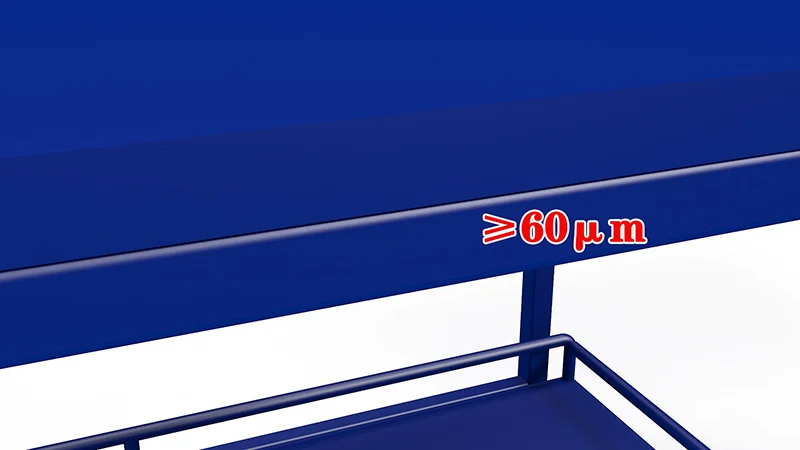
High-quality materials require corresponding manufacturing excellence. The trolley’s frame is joined using CO2 gas shielded welding (MIG/MAG), a process renowned for creating deep, clean, and robust welds that are often stronger than the base metal itself. This method minimizes heat-induced distortion, ensuring the final structure is true and dimensionally accurate. Following assembly, the trolley undergoes a multi-stage surface treatment process, including acid pickling and phosphating, before receiving an electrostatic powder coating with a thickness of at least 60μm. This creates a durable, corrosion-resistant finish that withstands the oils, chemicals, and abrasion common in workshops and warehouses.

Engineered for Access: How Weight Capacity Becomes Usable
A trolley’s most significant limitation is often not its vertical load capacity but the user’s ability to access the lower tier. Standard two-level carts create a “geometric blind spot” on the bottom shelf, forcing operators into awkward, inefficient, and ergonomically hazardous postures to load or retrieve heavy items. This is where intelligent design transforms static strength into dynamic utility.
The Pull-Out System: Eliminating the Dead Zone
The core innovation of this 2 tier tool cart is its pull-out lower deck. This mechanism fundamentally changes the interaction, converting a difficult horizontal “reach-and-shove” motion into a simple, vertical “place-and-retrieve” action. This eliminates the need for deep bending and twisting, drastically reducing physical strain and the risk of musculoskeletal disorders for your team.
This functionality is made possible by a robust independent track system. Instead of conventional sliders that can jam with debris, it utilizes a combination of V-groove wheels running on an angle steel rail. This design is self-centering, ensuring a smooth, non-binding motion, and is highly resistant to the dust and grime of an industrial floor. Critically, the front of the pull-out layer is equipped with two auxiliary casters. When the drawer is extended, these casters contact the floor, creating a stable six-point support base. This intelligent design transfers the lower deck’s 300 kg load capacity directly to the ground, preventing any risk of the entire trolley tipping forward, even when fully loaded and extended.

Load Capacity in Real-World Industrial Scenarios
The 600 kg capacity is not an abstract figure; it directly translates to enhanced productivity and safety across various high-SKU industries. The combination of raw strength and intelligent access solves specific, costly problems.
| Industry Application | Common Loads & Challenges | How the Trolley’s Design Adds Value |
|---|---|---|
| Automotive Aftermarket | Heavy and dense items like brake discs, alternators, batteries, and starters mixed with fragile parts like sensors and gaskets. High risk of damage from “blind tossing” onto a lower shelf. | The 600 kg capacity easily handles the weight. The pull-out tray provides full visibility, allowing operators to place heavy components carefully next to fragile ones, eliminating costly damage. |
| Electronics & Precision Manufacturing | Trays of sensitive PCB boards, reels of SMD components, and valuable power modules. Vibration and impact must be minimized. Static electricity is a concern. | High-strength Polyurethane (PU) casters absorb floor vibrations. The smooth V-wheel track prevents jarring motions. The all-steel frame can be easily grounded for ESD-safe applications. |
| Industrial Hardware & Fasteners | Small, extremely dense boxes of bolts, nuts, and fasteners. Picking errors are common due to poor visibility of labels on lower shelves. | The steel deck withstands high point loads without deforming. When pulled out, the lower tray is fully illuminated by overhead lights, making labels easy to read and drastically improving picking accuracy. |
Ultimately, a trolley’s weight capacity is only as good as its design. A 600 kg rating supported by Q235 steel, precision welding, and an innovative ergonomic access system delivers more than just strength—it provides a safer, more efficient, and more reliable tool for your material handling operations.
Frequently Asked Questions
What is the official Safe Working Load (SWL) of this 2 tier utility trolley?
The trolley is rated for a Safe Working Load of 600 kg (1,322 lbs), with each of the two tiers designed to handle a 300 kg distributed load during normal industrial use.
Can the lower pull-out tray support weight when fully extended?
Absolutely. The pull-out tray is engineered with its own set of auxiliary casters at the front. When extended, these casters engage with the floor, creating an independent support system that safely holds the full 300 kg capacity without putting tipping stress on the main frame.
What materials are used to achieve this high load capacity?
The high capacity is achieved through a combination of a robust frame made from Q235 carbon structural steel rectangular tubing, 1.2mm thick steel plate for the decks, and four high-strength Polyurethane (PU) industrial casters.
Is the trolley stable when the heavy lower drawer is pulled out?
Yes, stability is a key design feature. The front auxiliary casters on the pull-out drawer create a wide and stable six-point base when extended, effectively preventing any forward tipping and ensuring operator safety even with a heavy load.
How is the load capacity of the trolley verified?
The load capacity is verified through rigorous computer-aided engineering, specifically Finite Element Analysis (FEA). This simulation applies virtual loads to the 3D model to identify and reinforce high-stress points, ensuring the final design comfortably exceeds its rated SWL.
Need a Custom Storage Solution?
Speak directly with our technical engineers. We offer free structural designs, heavy-duty catalog evaluations, and quick B2B price quotations.
Request a Quote Now →