
Understanding the precise load capacity of industrial equipment isn’t just about compliance; it’s about operational safety, efficiency, and protecting your assets. This 2-tier trolley is engineered for high-demand environments where moving heavy, valuable components is a daily reality. Its design directly addresses the challenges of weight distribution and accessibility in industrial and warehouse settings.
Understanding the Total Load Capacity: Beyond the Numbers
The total certified load capacity for this 2 Tier Order Picking Trolley is 600 kg (approximately 1320 lbs). This figure represents the Safe Working Load (SWL), a crucial industry standard that defines the maximum weight the equipment can safely handle under normal operating conditions. It’s an engineered rating that considers the entire system—frame, welds, fasteners, and casters—not just the theoretical strength of individual components.
This 600 kg capacity is designed to meet the rigorous demands of industrial workshops, automotive parts distribution centers, and high-SKU warehouses. It ensures the trolley can securely transport dense materials like metal components, boxes of fasteners, or electronic sub-assemblies without structural fatigue or risk of failure.

Is the Weight Limit the Same for Each Shelf?
Yes, the weight limit is designed to be the same for each shelf. The system is engineered and validated for a symmetrical load distribution of 300 kg on the top shelf and 300 kg on the bottom shelf. This balanced design is not an accident; it is the result of a robust structural framework and an innovative pull-out mechanism for the lower level.
How Structural Integrity Supports Symmetrical Loading
The trolley’s ability to handle an equal, heavy load on both levels is based on two key design principles:
- The Main Frame: The top shelf is directly supported by the main frame, which is constructed from 30×30×1.5 mm rectangular Q235 carbon steel tubing. This frame is welded using CO2 gas shielded welding (MIG/MAG), creating joints that are often stronger than the parent material, providing a rigid and stable platform for the upper 300 kg load.
- The Independent Pull-Out Shelf: The lower shelf’s capacity is its most critical engineering feature. Unlike standard carts where the bottom shelf is a simple fixed base, this trolley features a pull-out layer that functions as an independent, load-bearing platform. When extended, its weight is supported by a dedicated V-wheel and angle steel rail system at the rear and two auxiliary front casters that engage with the floor. This design effectively transfers the 300 kg load directly to the ground, preventing any cantilever stress on the main frame and eliminating the risk of tipping.
This structural design was validated using ANSYS Finite Element Analysis (FEA), simulating a 300 kg uniformly distributed load on each shelf. The results confirmed that the maximum stress points remained well below the material’s permissible stress limits, ensuring long-term durability under maximum load conditions.

The Engineering Behind the 600 kg Capacity
The confidence in this 600 kg rating is rooted in deliberate material science and manufacturing process choices. Each element is selected to contribute to the overall system’s strength and longevity, particularly in demanding industrial environments.
Material Selection: Q235 Carbon Steel
The primary material, Q235 carbon steel, is chosen for its optimal balance of strength, plasticity, and weldability. In an industrial setting, equipment is subject to accidental impacts. Q235 steel tends to deform plastically upon impact rather than fracturing, which makes it a safer and more resilient choice than more brittle materials. The 1.2mm thick steel plate used for the shelf bases provides a solid foundation for heavy, concentrated loads without buckling.
Surface Treatment for Durability
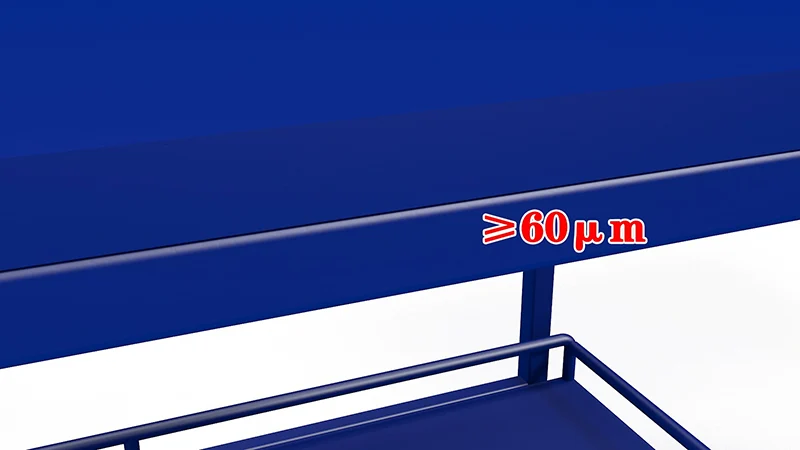
To protect the steel structure from corrosion and wear, the trolley undergoes a multi-stage surface treatment process. Before painting, all components are subjected to acid pickling and phosphating. This pre-treatment removes any surface impurities and creates a micro-crystalline phosphate layer that dramatically improves paint adhesion. The final electrostatic powder coating is applied to a thickness of ≥ 60μm, creating a hard, chip-resistant finish that withstands oil, grease, and common industrial chemicals.
The Critical Role of High-Strength Casters
A trolley is only as reliable as its casters. This unit is equipped with high-strength Polyurethane (PU) casters. PU is superior to rubber or nylon in this application because it offers high load-bearing capacity combined with non-marking properties, protecting warehouse floors. Importantly, while each caster may have a very high individual load rating (e.g., 200-350 kg), the system’s 600 kg SWL is the certified rating for the entire integrated assembly, providing a crucial margin of safety.
Load Capacity Specifications Overview
The following table summarizes the key specifications that contribute to the trolley’s performance and load-bearing capabilities.
| Specification | Value |
| Total Load Capacity (SWL) | 600 kg |
| Load Capacity Per Shelf | 300 kg (Symmetrical Loading) |
| Dimensions (L×W×H) | 1275 × 720 × 1050 mm |
| Material | Q235 Carbon Steel |
| Frame Construction | 30×30×1.5 mm Rectangular Tube |
| Surface Treatment | Electrostatic Spraying (Coating Thickness ≥ 60μm) |
| Caster System | High-Strength Polyurethane (PU) Casters |
Frequently Asked Questions
1. What is the official total load capacity of the 2-tier trolley?
The official Safe Working Load (SWL) for the entire trolley is 600 kg (approximately 1320 lbs). This is the maximum weight the trolley is certified to handle safely during operation.
2. Can I put 400 kg on the bottom shelf and 200 kg on the top?
The trolley is engineered and tested for a symmetrical load of 300 kg per shelf. While the structure is robust, deviating significantly from this balanced distribution is not recommended as it can alter the trolley’s center of gravity and handling characteristics. For optimal safety and performance, loads should be distributed as evenly as possible.
3. What happens if I accidentally overload the trolley?
The 600 kg capacity is the Safe Working Load, which includes a safety factor. Exceeding this limit will put undue stress on the frame welds, casters, and pull-out mechanism. Chronic overloading can lead to premature material fatigue, potential deformation of the shelves, and an increased risk of structural failure or accidents.
4. Does the pull-out shelf maintain its 300 kg capacity when fully extended?
Yes. The pull-out shelf is specifically designed to support its full 300 kg load when fully extended. This is achieved through a combination of the V-wheel rail system and front auxiliary casters that directly support the load on the floor, ensuring the trolley remains stable and balanced.
5. Why is the trolley made from steel if its capacity is 600 kg? Couldn’t a heavy-duty plastic trolley work?
While some plastic carts have high load ratings, Q235 steel is used for its superior rigidity, impact resistance, and durability in harsh industrial environments. Steel frames resist flexing and buckling under heavy, concentrated loads (like a motor block or box of bolts) far better than plastic. The welded steel construction ensures a long service life when exposed to the rigors of a workshop or warehouse floor.
Need a Custom Storage Solution?
Speak directly with our technical engineers. We offer free structural designs, heavy-duty catalog evaluations, and quick B2B price quotations.
Request a Quote Now →