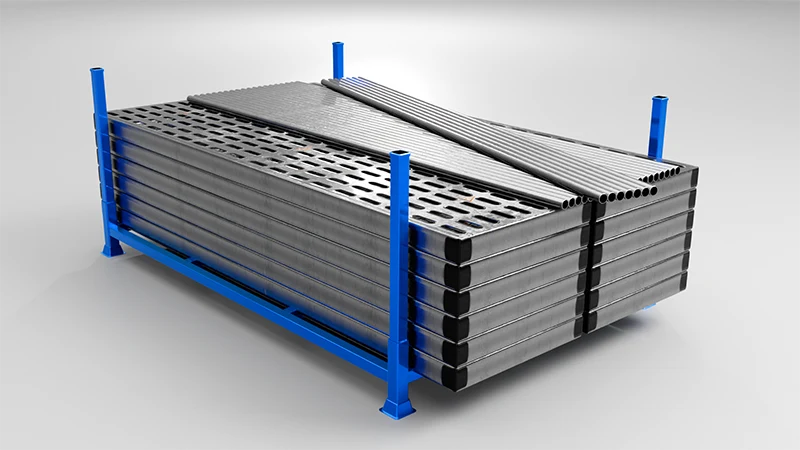

Tire warehouses often face a costly paradox: to save space, tires are compressed into dense, interlaced stacks, which inevitably damages the product. This outdated method leads to deformed beads, wasted space, and hazardous working conditions. It’s a system where efficiency comes at the direct expense of your inventory’s value. It’s time to break this cycle.
Tire storage presents a unique set of challenges that traditional racking or floor stacking simply cannot solve effectively. The common practice of “lacing” or barrel-stacking tires creates immense pressure on the bottom layers, leading to irreversible damage that compromises safety and performance. For businesses in the tire manufacturing, distribution, and retail sectors, this product degradation translates directly into lost revenue. Portable stack racks, also known as post pallets or tire pallets, offer a specialized solution that fundamentally changes the dynamics of tire warehousing. They are not just storage equipment; they are a strategic tool for preserving product value, maximizing space, and streamlining operations.
Eliminate Product Damage and Preserve Tire Integrity
From Compression to Suspension: The Core Principle
The most significant benefit of using a dedicated tire storage rack is the shift from “product-supported” to “structure-supported” storage. In a traditional floor stack, the bottom tires bear the crushing weight of everything above them. A portable stack rack system changes this entirely. Each rack is a self-contained, load-bearing steel frame. Tires are placed within this frame, and when another rack is stacked on top, its weight is transferred through the steel corner posts directly to the floor. The tires inside, whether they are on the bottom layer or the fourth layer, bear zero weight from the units above, effectively suspending them in a protective cradle.
Preventing Bead Deformation and Flat-Spotting
The constant, uneven pressure from lacing tires causes two critical types of damage: bead deformation and flat-spotting. A deformed bead can prevent the tire from sealing properly to the wheel rim, rendering it unsafe and unsellable. Flat-spotting creates balance issues that result in vibrations during driving. By storing tires correctly within a stack rack—either standing on their treads or interlaced on their sidewalls without compression—their structural integrity is perfectly maintained from the moment they enter the warehouse until they are shipped to the customer. This eliminates damage-related write-offs and protects your brand’s reputation for quality.

Maximize Warehouse Density and Space Utilization
Transforming Floor Space into Vertical Cube Space
Warehouse space is a finite and expensive asset. Floor-stacking tires is notoriously inefficient, often limited to heights that a person can safely manage. Portable stack racks immediately unlock your warehouse’s vertical potential. These engineered steel structures are designed to be safely stacked up to 4 or 5 levels high, converting unused overhead air into valuable storage space. By building upwards, facilities can increase their tire storage capacity by over 60% within the same footprint, delaying or eliminating the need for costly expansions or off-site storage.
Engineered for Tires: The Diameter-Based Design
Unlike generic racking, specialized tire pallet stillages are designed with tire geometry in mind. An intelligent design approach classifies racks based on the tires they will hold, such as Passenger Car Radials (PCR, typically 800mm diameter). The rack’s dimensions are optimized to hold a specific number of tires with minimal wasted space. This precision engineering ensures that you aren’t paying to store “air,” maximizing the number of tires per square foot and making every inch of your facility productive.
Streamline Operations and Boost Inventory Accuracy
Unitized Handling for Unprecedented Efficiency
Manually moving tires one by one is slow, labor-intensive, and a leading cause of workplace injuries. Portable stack racks transform tire logistics into a unitized handling process. A forklift can move an entire rack—containing dozens of tires—in a single trip. This dramatically reduces the time required for loading, unloading, and internal warehouse movements. What previously took hours of manual labor can now be accomplished by a single operator in minutes, freeing up staff for more value-added tasks and significantly improving overall throughput.
From Guesswork to 99.9% Accuracy
Conducting a physical inventory count in a warehouse with laced tire stacks is a logistical nightmare, often resulting in inaccuracies of 15% or more. Locating a specific SKU can involve dismantling an entire stack. With a standardized rack system, inventory management becomes simple and precise. Each rack holds a fixed quantity of a specific SKU. To count inventory, staff simply count the racks and multiply. This method increases inventory accuracy from around 85% to over 99.9%, providing clear visibility and enabling better forecasting and order fulfillment.
Unlock True Warehouse Flexibility
The Mobile Warehouse: Adapt to Seasonal Demands
The tire industry is subject to seasonal demand fluctuations. Fixed pallet racking locks your warehouse layout in place, creating inefficiencies during off-peak seasons. Demountable post pallets offer unparalleled flexibility. They require no bolts and no installation. You can reconfigure your entire storage area in a matter of hours to adapt to changing inventory levels. During slow periods, the racks can be dismantled, with the posts removed and the bases nested together, freeing up vast amounts of floor space for other operations like cross-docking or temporary project staging.
Frequently Asked Questions
| 1. What makes portable stack racks different from standard pallet racking for tire storage? |
| The key difference is flexibility and product protection. Standard racking is fixed and requires aisles, while portable stack racks create their own racking structure anywhere you need it. They can be moved and reconfigured easily. Most importantly, they are specifically designed to cradle tires, preventing the compression damage common when tires are stored on flat pallet rack beams. |
| 2. Can these racks accommodate different sizes of tires, from small car tires to large truck tires? |
| Absolutely. Portable stack racks are not a one-size-fits-all product. They are engineered and manufactured to specific dimensions based on the type of tire being stored. Whether you handle small PCR tires or large TBR and agricultural tires, a rack can be designed to maximize load density and ensure a secure fit. |
| 3. How do portable stack racks improve warehouse safety? |
| They improve safety in two main ways. First, by creating stable, interlocking stacks, they eliminate the risk of precarious, manually-built tire piles collapsing. Second, they drastically reduce manual handling. Instead of individuals lifting and carrying tires, forklifts do the heavy work, which significantly lowers the risk of back injuries and other strains. |
| 4. Are these racks suitable for outdoor storage environments? |
| Yes, many portable stack racks are available with a hot-dip galvanized finish. This process provides a thick, durable zinc coating that protects the steel from rust and corrosion, making them ideal for long-term use in outdoor yards or in humid climates where painted racks would quickly degrade. |
| 5. How do the racks save money on return shipping (reverse logistics)? |
| This is a major financial benefit. When empty, the corner posts can be removed. The empty bases are then designed to nest or stack together compactly. This “nesting” ability can reduce the storage and shipping volume of empty racks by up to 80%, drastically cutting costs when returning them to a distribution center or supplier. |
Need a Custom Storage Solution?
Speak directly with our technical engineers. We offer free structural designs, heavy-duty catalog evaluations, and quick B2B price quotations.
Request a Quote Now →