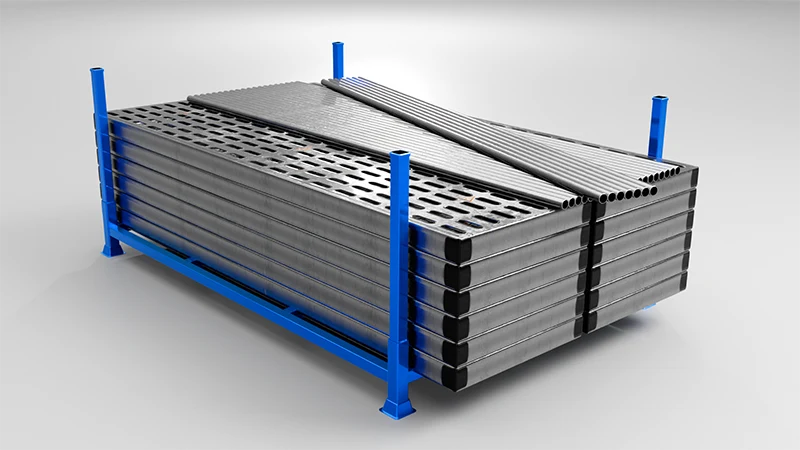

Maximizing warehouse height is a universal goal, but stacking products high comes with inherent risks of damage, instability, and inefficient access. This is especially true for non-rigid items like bagged goods or boxed products. The solution lies not in stacking harder, but in stacking smarter with a system designed for vertical load-bearing and operational flexibility.
The Crushing Problem of Traditional High-Level Stacking
For industries dealing with products like bagged animal feeds, flour, or cased goods, floor stacking (also known as block stacking) is a common practice. While it appears to eliminate the cost of racking infrastructure, it introduces significant hidden costs and operational bottlenecks. The fundamental flaw is that the products themselves are forced to bear the weight of everything stacked above them. This leads to a cascade of predictable problems.
Product Compression and Damage
The bottom layers of a block stack endure immense pressure. For bagged goods, this results in compaction, burst seams, and product loss. For boxed items, it leads to crushed corners and compromised packaging, often rendering the product unsellable. This direct financial loss, or yield loss, is a direct consequence of using the product as part of the storage structure.
Inventory Inaccessibility (The LIFO Trap)
Block stacking enforces a strict Last-In, First-Out (LIFO) inventory system. Accessing a specific batch or SKU at the bottom or middle of a stack requires de-stacking and re-stacking entire columns of product. This process is incredibly labor-intensive, time-consuming, and increases the risk of handling damage and workplace injuries. For businesses with multiple SKUs and varied expiration dates, this lack of selectivity is a major impediment to efficient inventory management.

A Structural Solution: From Product-Bearing to Rack-Bearing Loads
The most effective way to achieve safe high-level stacking is to remove the product from the load-bearing equation entirely. This is the core principle behind demountable post pallets, also known as stack racks or pallet stillages. These systems introduce a steel “skeleton” around your palletized goods.
How It Works: The Physics of Safety
A post pallet system consists of a sturdy steel base and four removable corner posts. The weight of each subsequent level is transferred through the steel posts directly to the posts of the unit below it, and ultimately to the warehouse floor. The products inside simply rest on their pallet, bearing zero weight from the levels above. This architectural shift immediately eliminates compression damage and allows you to safely stack goods 4 to 5 levels high, transforming unused vertical air space into valuable storage capacity.
Gaining Absolute Selectivity and Flexibility
Because each portable stack rack is a self-contained, movable unit, your warehouse is no longer constrained by fixed aisles or LIFO principles. A forklift can safely access and move any specific pallet unit from any location, at any height. This creates a dynamic storage environment where layouts can be reconfigured in hours to accommodate seasonal inventory peaks. During slower periods, empty racks can have their posts removed and their bases nested together, freeing up vast amounts of floor space for other operations like cross-docking or order fulfillment.
The Tangible Impact on Warehouse Operations
Adopting a system of heavy duty stack racks is not just an equipment upgrade; it is a fundamental workflow transformation. The improvements are direct, measurable, and impact the entire logistics cycle from receiving to shipping.
| Metric | Before: Traditional Floor Stacking | After: Post Pallet System |
| Storage Capacity | Limited by product’s crush strength (typically 1-2 levels). Vertical space is wasted. | Utilizes full warehouse height (4-5 levels). Increases storage density by up to 400%. |
| Product Damage Rate | High due to compression, instability, and excessive re-handling. | Near-zero. Product is protected within a steel frame, eliminating load-bearing stress. |
| Labor Efficiency | Low. Significant time spent on de-stacking and re-stacking to access specific inventory. | High. Forklifts have direct access to any pallet, reducing handling time by 20-30%. |
| Warehouse Flexibility | Static. Layout is fixed by the current product arrangement. | Dynamic. Racks can be moved and reconfigured daily. Empty racks nest to save space. |

Furthermore, these pallet stillages steel units function as returnable transport packaging (RTP). Goods can be shipped to a customer in the rack, providing protection during transit. For return logistics, the demountable posts allow the empty bases to be nested, drastically reducing the space needed on return trucks and lowering reverse logistics costs by up to 80%.
Frequently Asked Questions
1. What exactly is a post pallet or stack rack?
It is a modular, portable racking system composed of a base and removable posts. It’s designed to hold a single pallet of goods and can be stacked on top of other identical units. The key function is that the posts, not the product, bear the vertical load, enabling safe multi-level stacking of goods that couldn’t otherwise be stacked.
2. How high can you safely stack these racks?
The safe stacking height depends on the rack’s engineering, the load capacity, the weight of the goods, and the condition of the warehouse floor. However, a common and safe operational height for most industrial applications is four to five units high, reaching heights of 6-8 meters.
3. Are post pallets better than fixed racking for seasonal inventory?
Yes, for seasonal inventory, they offer superior flexibility. During peak season, you can use them to maximize your entire warehouse space. During the off-season, you can dismantle and nest the empty racks in a small corner, freeing up the majority of your floor space for other activities, something impossible with fixed, bolted-down racking systems.
4. How do these racks protect fragile or non-rigid goods?
They create a protective steel cage around the goods. This structure shields the product from compression from above, impacts from the sides during handling, and instability during transport. The weight of upper tiers is completely bypassed around the product, resting solely on the steel frame.
5. How do stack racks save money on return shipping?
The posts are removable. Once removed, the empty bases can be “nested” or stacked compactly together. Typically, 4 to 6 empty, nested bases fit into the same space as one fully assembled rack. This dramatically increases the number of empty units that can fit on a return truck, cutting reverse logistics costs significantly and making a reusable packaging loop economically viable.
Need a Custom Storage Solution?
Speak directly with our technical engineers. We offer free structural designs, heavy-duty catalog evaluations, and quick B2B price quotations.
Request a Quote Now →