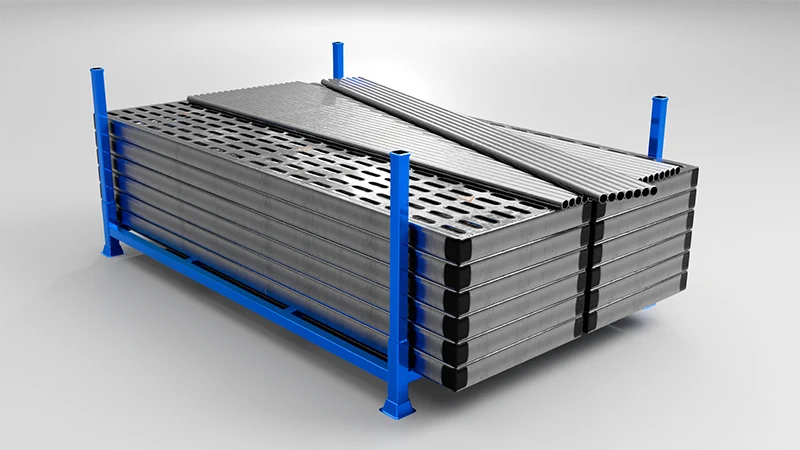

Your warehouse faces a constant battle between storage density and operational flexibility. Traditional fixed racking offers easy access but sacrifices vast amounts of floor space to permanent aisles. Floor stacking maximizes density but crushes products and creates an operational nightmare. What if you could eliminate this trade-off entirely?
The Core Difference: A Shift from Static Structures to Dynamic Assets
The primary distinction between a post pallet system and traditional fixed racking lies in their fundamental philosophy of space. Traditional racking treats a warehouse as a permanent library with fixed shelves and aisles bolted to the floor. It creates a rigid, unchanging infrastructure that dictates workflow.
In contrast, a post pallet system, also known as a stack rack or pallet stillage, treats warehouse space as a modular, fluid grid. Each unit is an independent, movable rack. This transforms your storage from a static liability into a dynamic asset that can be reconfigured in hours to meet fluctuating inventory demands, seasonal peaks, or changes in production lines. It’s not just a place to store goods; it’s an active component of your entire logistics workflow.

A Head-to-Head Comparison: Post Pallets vs. Fixed Racking
To understand the practical implications, let’s break down the key operational differences in a direct comparison.
| Feature | Traditional Fixed Racking | Post Pallet System (Stack Racks) |
|---|---|---|
| Space Utilization | Requires permanent, wide aisles for forklift access, resulting in only 30-40% of the warehouse floor being used for actual storage. | Enables high-density block stacking, eliminating the need for permanent aisles. This can increase storage capacity on the same footprint by up to 60%. |
| Flexibility & Layout | Bolted to the floor, requiring significant downtime, labor, and engineering to reconfigure. Layout changes are rare and costly. | Completely portable. Layouts can be changed on-demand with a forklift to adapt to seasonal inventory, creating temporary picking zones or bulk storage areas. |
| Product Protection | Protects goods from being crushed by stacking. However, it offers no inherent protection during transit. | The steel frame carries 100% of the load. This is critical for crushable items like bagged goods or delicate products. The frame also protects goods during transport. |
| Installation & Scalability | Requires professional installation, floor anchoring, permits, and significant lead time. A major capital project. | No installation required. Racks arrive ready to use. Scale your storage capacity up or down simply by adding or removing units. |
| Logistics Integration | Serves a single purpose: static storage. Goods must be de-palletized or re-palletized for shipping. | Functions as both a storage rack and a returnable shipping container (RTP). Goods can go from production to storage to transport to the end-user in the same rack, eliminating multiple handling steps. |
| Reverse Logistics | Not applicable. It remains in the warehouse. | Demountable posts allow empty racks to be nested, reducing return shipping volume by 75-80%. This makes a closed-loop supply chain economically viable. |
When Does a Post Pallet System Deliver Maximum Value?
While fixed racking has its place, a portable stack rack system excels in specific, high-impact scenarios that cripple traditional storage methods.
For Unstackable and Irregularly Shaped Goods
Consider products like tires, fabric rolls, pipes, or bulk bags of animal feed. Floor stacking is impossible or leads to severe product damage. Fixed racking might hold a standard pallet, but it doesn’t contain the goods themselves. Post pallets create a protective steel cage around the product. The posts prevent tires from deforming, textile rolls from developing flat spots, and long pipes from bending under their own weight. The load is transferred through the steel structure, ensuring the product at the bottom of a 4-high stack is under zero pressure.

For Operations with Seasonal Inventory Swings
Businesses in agriculture, retail, or food production face massive inventory fluctuations. During the off-season, fixed racking becomes a “ghost town” of empty shelves and aisles, consuming valuable space that could be used for other activities. With a post pallet system, empty racks are simply dismantled and nested in a small corner of the warehouse. This frees up hundreds or thousands of square feet of floor space for temporary production, cross-docking, or maintenance, transforming dead space into a productive asset.
For Integrating Storage with Transportation
The most profound advantage is the system’s role as a Returnable Transport Packaging (RTP) solution. Imagine a workflow where goods are loaded into a metal post pallet at the end of the production line. A forklift then moves this unit into a bulk storage area, stacking it 4-high. When an order comes in, the same forklift picks the entire unit and loads it directly onto a truck. The customer receives the goods, unloads them, and nests the empty rack for cost-effective return. This process eliminates multiple manual handling steps, drastically reduces labor costs, and brings product damage rates to near zero.
The Verdict: A Transformation in Workflow, Not Just a Change in Hardware
Choosing between a post pallet system and fixed racking is not merely a decision about storage equipment. It’s a strategic choice about your operational philosophy. Fixed racking locks you into a predefined, rigid workflow. A post pallet system empowers you with the flexibility to create a lean, agile, and resilient logistics process. It breaks down the walls between storage, handling, and transportation, merging them into a single, efficient flow that maximizes space, protects products, and dramatically reduces operational waste.
Frequently Asked Questions
1. What is the typical load capacity of a post pallet?
Standard heavy duty stack racks are typically designed to hold between 1000 kg (2,200 lbs) and 2000 kg (4,400 lbs) per unit. They can be safely stacked 4 to 5 units high when fully loaded, with the total weight being supported by the base unit’s posts. Custom designs can accommodate even heavier loads for specialized applications.
2. Can these stack racks be used outdoors?
Yes. While standard powder-coated finishes are suitable for indoor use, post pallets intended for outdoor or cold storage environments are often hot-dip galvanized. This process provides a thick, durable zinc coating that offers superior protection against rust and corrosion for 20 years or more, making them ideal for all-weather applications.
3. How do post pallets improve warehouse safety?
They improve safety in several ways. First, they create stable, engineered stacks, preventing the dangerous instability of manually stacked goods. Second, features like cone-shaped “cup feet” on the posts guide the units into place, reducing the risk of misalignment and tipping during stacking. Finally, by unitizing loads, they minimize manual handling, a leading cause of workplace injuries.
4. Are portable stacking racks compatible with a Warehouse Management System (WMS)?
Absolutely. In fact, they simplify inventory management. Each rack represents a standardized unit of inventory (e.g., “1 rack = 48 bags of flour”). This makes cycle counting as simple as counting racks rather than individual items. Barcode or RFID tags can be easily attached to each rack for seamless integration with any modern WMS.
5. What is the primary cost difference compared to selective pallet racking?
The initial investment (CAPEX) per pallet position can be higher for post pallets than for the most basic selective racking. However, the Total Cost of Ownership (TCO) is often significantly lower. Post pallets eliminate installation costs, provide greater storage density (reducing the need for expensive warehouse expansion), lower product damage costs, and reduce labor through improved handling efficiency. Their long lifespan and high residual value as steel also make them a better long-term asset.
Need a Custom Storage Solution?
Speak directly with our technical engineers. We offer free structural designs, heavy-duty catalog evaluations, and quick B2B price quotations.
Request a Quote Now →