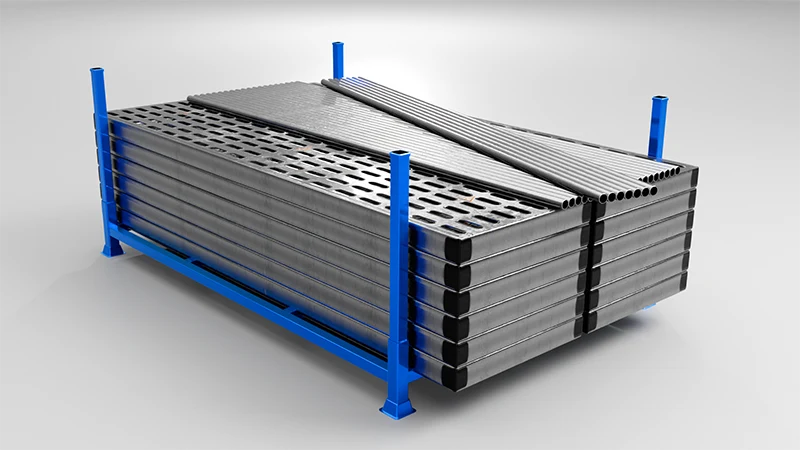

Your warehouse floor is finite, but your vertical space is untapped potential. Traditional floor stacking crushes your bottom-line products, while fixed racking locks you into an inefficient layout. Discover how a flexible, modular racking system can immediately increase your storage capacity by over 400% without a single construction permit.
The Physics of Smarter Stacking: Shifting from Product Load to Structural Load
The fundamental problem with stacking bagged goods like flour, animal feed, or industrial powders is physics. In a traditional floor stack (block stacking), the bottom layer bears the entire weight of the column above it. This leads to product compression, bag breakage, and significant financial loss. You are essentially forced to treat the bottom pallets as a “sacrificial” foundation. Warehouse Stacking Racks, also known as post pallets or pallet stillages, fundamentally change this equation. By introducing a rigid steel frame with four corner posts, the system creates an independent load-bearing structure. The weight of each subsequent level is transferred directly through the steel posts to the floor, completely bypassing the products stored below. Your goods, whether delicate food ingredients or heavy industrial components, bear zero weight. This single principle unlocks the ability to safely stack 4 or 5 levels high, effectively transforming your warehouse’s flat square footage into usable cubic volume.
Beyond Stacking: Achieving True Warehouse Agility
Unlike conventional pallet racking that is bolted to the floor, portable stack racks offer unparalleled flexibility. They function as modular building blocks for your inventory. Your warehouse layout is no longer a permanent fixture. During peak seasons, you can create dense storage blocks to accommodate incoming inventory. In slower periods, the racks can be disassembled—the posts removed and the bases nested together—to free up valuable floor space for other operations like cross-docking, order fulfillment, or equipment maintenance. This ability to dynamically adapt your storage footprint to match inventory velocity means you are always using your space at maximum efficiency. It’s the difference between a static warehouse and a fluid, responsive logistics hub.

Eliminating Product Damage: The End of Compromise
For any business handling goods with limited compressibility, the cost of product damage is a constant drain on profitability. The transition to a stacking rack system directly impacts your bottom line by preserving the integrity of every single unit. Consider the direct operational changes:
| Scenario | Before: Floor Stacking | After: Using Heavy Duty Stack Racks |
| Load Bearing | The bottom layer of bagged products is crushed under the weight of the stack. | Steel posts bear 100% of the load. Products bear zero weight, regardless of stack height. |
| Stack Height | Limited to 1-2 pallets high, determined by product fragility. | Safely stack 4-5 pallets high, limited only by ceiling height and forklift reach. |
| Inventory Access | Strictly Last-In, First-Out (LIFO). Accessing bottom pallets requires de-stacking the entire column. | Full selectivity. Forklifts can access any pallet in any rack without disturbing others. |
| Product Damage | High rates of compression damage, contamination from floor contact, and tears from manual handling. | Damage rates approach zero. Goods are protected within a steel “exoskeleton” from forklift impacts and compression. |
Maximizing Cube Utilization, Not Just Square Footage
The most immediate and quantifiable benefit of implementing a portable stacking pallet rack system is the dramatic increase in storage density. A typical warehouse with a 6-meter clear height using floor stacking might only utilize the bottom 1.5 meters of vertical space. That’s 75% of your available volume wasted. By stacking four units high, you can instantly reclaim that vertical space, increasing your storage capacity by up to 400% on the same floor footprint. This allows you to store more inventory, delay or cancel expensive warehouse expansion projects, and ultimately lower your cost-per-pallet-position stored.

The Hidden ROI: Optimizing Your Reverse Logistics
For businesses operating a closed-loop supply chain or managing returnable transport packaging (RTP), the cost of shipping “air” is a major expense. Returning empty wooden or plastic pallets is inefficient. The demountable design of metal post pallets provides a powerful solution. When empty, the posts can be quickly removed and stored on the base. The bases are then designed to nest or stack tightly together. This simple feature means that the space required for one fully assembled rack can hold 4 to 6 empty, nested units. This reduces return shipping volumes and costs by up to 80%, making your reusable packaging program economically viable and environmentally sustainable.
Frequently Asked Questions
1. Can these racks handle the heavy, dense weight of a full pallet of flour or animal feed?
Absolutely. These are heavy-duty industrial stacking racks constructed from high-grade structural steel (like Q235). They are engineered with typical load capacities ranging from 1,000 kg to 2,000 kg (2,200 to 4,400 lbs) per rack. When stacked four high, the total load on the ground unit is fully supported by its own structure, ensuring stability and safety.
2. We operate in a food-grade environment. Are these racks easy to clean and resistant to rust?
Yes. While standard powder coating is available, for food production or cold storage environments, a hot-dip galvanized finish is the ideal solution. This process creates a thick, durable zinc-alloy coating that provides decades of rust protection, even in damp conditions. The open-frame design allows for easy cleaning with high-pressure water or steam, preventing pest harborage and meeting stringent hygiene standards.
3. How do stacking racks affect our inventory management and stock rotation (FIFO)?
They significantly improve it over block stacking. Because each rack is a discrete, movable unit, you gain 100% selectivity. Your forklift operator can pick any specific rack (and the pallet within it) from a row without needing to move the ones on top of it or next to it. This makes implementing a First-In, First-Out (FIFO) system far more practical than with floor stacking.
4. Are they difficult or dangerous for forklift operators to stack?
They are designed for safe and efficient handling. Most models feature “cup feet” or conical locating caps on top of the posts. These act as guides, helping the feet of the upper rack to self-align with the posts of the lower one. This makes stacking faster and significantly reduces the risk of misalignment or tipping during placement.
5. What do we do with the racks during our off-season when inventory is low?
This is where their flexibility shines. Simply have your team remove the posts from the bases. The posts can be bundled, and the bases can be nested into a highly compact stack. A stack of 15-20 nested bases takes up roughly the same footprint as two fully assembled racks. This allows you to reclaim vast areas of your warehouse floor for other activities until the next peak season arrives.
Need a Custom Storage Solution?
Speak directly with our technical engineers. We offer free structural designs, heavy-duty catalog evaluations, and quick B2B price quotations.
Request a Quote Now →