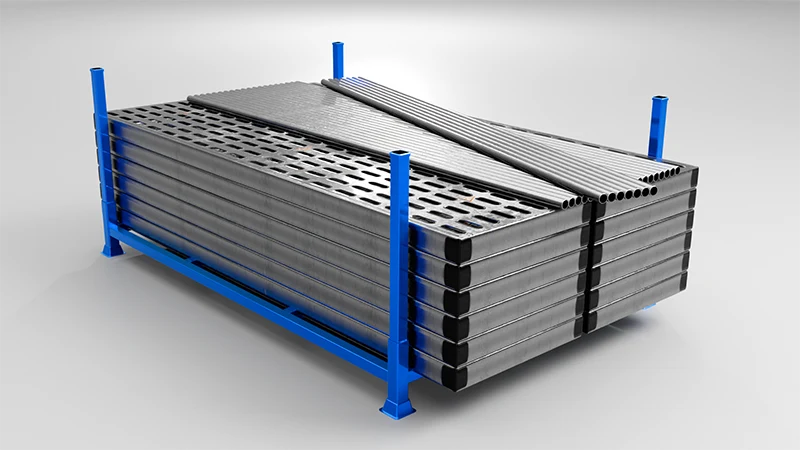

In modern warehousing, your most valuable asset isn’t just your floor space; it’s the entire cubic volume of your building. For businesses handling goods like bagged flour, animal feeds, or textiles, traditional storage methods often hit a wall, forcing a compromise between space efficiency and product integrity. Stacking Racks, also known as post pallets or pallet stillages, offer a fundamental shift in logic: they transform your warehouse from a flat plane into a high-density, vertical storage cube.
The Physics of Smart Stacking: Beyond the Limits of Bagged Goods
The core challenge with storing bagged goods—such as flour, animal feed, or cement—is that the product itself becomes the support structure. When bags are stacked directly on top of each other (floor stacking), the bottom layer bears the entire weight. This leads to inevitable product compression, damage, and potential loss. The height of your stack is limited not by your ceiling height, but by the compressive strength of your own product. This is a critical inefficiency that directly impacts your bottom line.
From Product-Supported to Structure-Supported Stacking
Warehouse stacking racks introduce a simple but revolutionary principle: they create an independent, load-bearing steel skeleton around your palletized goods. The weight of the upper levels is transferred through the rack’s vertical steel posts directly to the floor, completely bypassing the product stored below. Your goods are simply contained within a protective frame, bearing no weight other than their own.
How a Post Pallet System Works
A post pallet or stillage consists of a robust steel base and four removable posts. A full pallet of goods is placed on the base. When another rack is stacked on top, its legs rest securely in the “cup feet” or sockets of the posts below. This allows for safe, stable vertical stacking up to 4 or 5 levels high. The result is a dramatic multiplication of your storage capacity on the same footprint, with zero risk of crushing the goods at the bottom.

Unlocking True Warehouse Flexibility: Your Storage on Demand
Unlike fixed pallet racking, which locks your warehouse layout with permanent aisles, portable stack racks create a dynamic storage environment. Because they are not bolted to the floor, your storage areas can expand, contract, or relocate based on daily or seasonal needs. An open area used for staging inbound shipments in the morning can become a high-density storage zone by the afternoon.
The Power of Nesting in Reverse Logistics
A crucial feature of demountable post pallets is their ability to “nest” when empty. The posts can be removed and stored on the base, allowing multiple empty bases to be stacked or nested together. This reduces their return shipping volume by up to 75-80%. For any business operating a closed-loop supply chain, this feature drastically cuts reverse logistics costs and makes a returnable packaging system economically viable compared to disposable one-way packaging.
Stacking Racks vs. Traditional Methods: A Head-to-Head Comparison
| Feature | Floor Stacking (Bag-on-Bag) | Fixed Pallet Racking | Pallet Stillages (Stack Racks) |
|---|---|---|---|
| Vertical Space Use | Very Low (Limited by product strength) | High | Very High (Up to 5 levels) |
| Product Damage Risk | High (Crushing, compression) | Low | Near-Zero (Weight is on the structure) |
| Layout Flexibility | Moderate | None (Bolted to the floor) | Total (Can be moved at any time) |
| Selectivity & Accessibility | Very Poor (LIFO – Last-In, First-Out) | Excellent (100% selectivity) | Excellent (Any rack is accessible) |
| Upfront Setup | None | High (Installation, permits, floor bolts) | None (Ready to use on arrival) |
Transforming Your Workflow: More Than Just Storage
Adopting portable stack racks is not just an equipment upgrade; it’s a process re-engineering tool that impacts your entire material handling workflow.
Faster Inbound and Outbound
The system promotes unitization. Instead of handling 50 individual bags, a forklift operator handles one rack containing 50 bags. This single action can move 1-2 tons of product safely and efficiently. Unloading a container of pre-racked goods can be reduced from hours of manual labor to under 30 minutes of forklift work.
Simplified Inventory Management
When each rack holds a standardized quantity (e.g., 40 bags of layer mash feed per rack), inventory counting becomes a matter of counting racks, not individual items. This drastically improves inventory accuracy, from typical floor-stacking rates of 85% to over 99%, while significantly reducing the labor required for cycle counts.

Conclusion: Reclaiming Your Volume
The transition to a warehouse stacking rack system is a strategic decision to stop thinking in square feet and start capitalizing on cubic feet. By separating the storage structure from the product itself, you eliminate crush damage, unlock the full vertical height of your facility, and introduce a level of operational flexibility that fixed systems cannot match. It is the definitive way to convert your overhead air space from a liability into a high-density, productive asset.
Frequently Asked Questions
1. What is the typical stacking height for these racks?
Most industrial stacking racks are engineered to be safely stacked 4 to 5 layers high, which often corresponds to a total height of 6 to 8 meters (20 to 26 feet), depending on the rack dimensions and weight capacity.
2. Are stacking racks difficult for forklift drivers to use?
No, they are designed for efficiency. Many feature “cup feet” or conical locating caps on top of the posts, which create a self-aligning mechanism. This guides the legs of the rack above into the correct position, making stacking faster and safer for forklift operators.
3. Can these racks be used for outdoor storage?
Absolutely. For outdoor or high-moisture environments like cold storage, racks with a hot-dip galvanized finish are recommended. This process provides a thick, durable zinc coating that offers decades of protection against rust and corrosion.
4. What happens to the racks when they are not in use?
This is a key advantage. The vertical posts are typically removable. Once removed, the empty bases can be nested or stacked compactly, occupying a fraction of their assembled footprint. This frees up valuable floor space during off-peak seasons.
5. Can the racks be customized for specific products?
Yes. The base dimensions, post height, and load capacity of stacking racks can be fully customized to suit specific products, whether you are storing tires, fabric rolls, long pipes, or standard palletized goods. Custom inserts and decking options are also available.
Need a Custom Storage Solution?
Speak directly with our technical engineers. We offer free structural designs, heavy-duty catalog evaluations, and quick B2B price quotations.
Request a Quote Now →