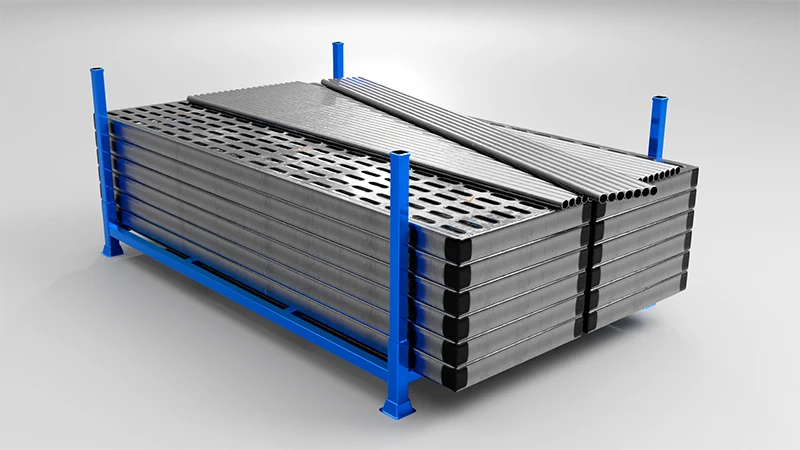

Your warehouse is stuck. Fixed racking creates permanent, space-wasting aisles, while floor stacking crushes your valuable inventory. There is a third way—a dynamic system that adapts to your needs, maximizes every cubic foot, and protects your products. It’s time to build a truly flexible warehouse.
The Static Warehouse Trap: Why Traditional Racking Fails Growing Businesses
Every warehouse manager faces a fundamental conflict: the battle between storage density and product accessibility. Traditional solutions force you to choose one at the expense of the other, creating operational bottlenecks and hidden costs.
The Emptiness of Fixed Aisles
Selective pallet racking offers 100% accessibility to every pallet, which is its primary advantage. However, this comes at a steep price. To achieve this access, you must dedicate up to 60% of your total floor space to permanent, unchanging forklift aisles. This space is a fixed cost that generates zero revenue. For businesses with seasonal inventory peaks or changing product lines, these static layouts become a cage, preventing efficient adaptation and wasting valuable real estate.
The Crushing Weight of Floor Stacking
The alternative, block stacking (or floor stacking), eliminates aisles to maximize density. But this approach is only viable for goods that are rigid and self-supporting. For products like tires, textiles, or bagged goods, this method is destructive. In the tire industry, for instance, the common practice of “lacing” or “barrel stacking” causes immense pressure on the bottom layers. This results in irreversible bead deformation and flat-spotting, rendering tires unsafe and unsellable. Furthermore, accessing a specific SKU at the bottom of a stack requires costly, labor-intensive de-stacking and re-stacking, introducing high risks of product damage and worker injury.
Unlocking True Flexibility: The Power of a “Rack and Stack” Philosophy
A flexible warehouse system is built on a simple yet revolutionary concept: what if your pallets had their own skeleton? This is the core principle behind portable stack racks, also known as post pallets or pallet stillages. By integrating removable steel posts onto a heavy-duty base, the load of upper levels is transferred directly to the ground through the rack’s structure, not through the products themselves. This single change fundamentally rewrites the rules of warehouse storage.

From Dead Aisles to Dynamic Zones
Because these heavy duty stack racks are not bolted to the floor, your warehouse layout is no longer set in stone. You can create high-density storage blocks during your peak season and then, during slower periods, nest the empty racks to open up massive floor space for staging, cross-docking, or value-added services. Your warehouse becomes a modular, adaptable environment that serves your business needs in real-time, not one that dictates them.
Vertical Growth: Multiplying Your Storage Capacity
The structural integrity of metal post pallets allows you to safely stack products 4 or 5 units high, reaching the full vertical clear height of your facility. This immediately transforms your storage calculation from square footage to cubic volume. For a warehouse with a 6-meter ceiling, this can increase effective storage capacity by 400-500% compared to a single layer on the floor, without the massive footprint of fixed racking aisles.
Protecting Your Assets, One Rack at a Time
The steel frame completely shields your goods from compression damage. Tires stored in a tire storage rack experience zero weight from the units above them, eliminating bead deformation. Fabric rolls are kept off the damp floor and prevented from developing permanent creases. Bagged goods are not crushed. This translates directly to a lower damage rate, fewer customer returns, and higher profitability.
A Practical Comparison: Fixed Racking vs. Portable Stack Racks
To understand the operational shift, consider this direct comparison:
| Feature | Fixed Selective Racking | Portable Stack Racks (Post Pallet System) |
| Space Utilization | Low (30-40% due to fixed aisles) | High (Up to 90% in block configuration) |
| Layout Flexibility | None. Layout is permanent. | 100% Flexible. Layout can be reconfigured daily. |
| Installation | Requires professional installation, floor anchoring, and permits. | None required. Ready to use upon delivery. |
| Product Accessibility | High (100% selectivity) | Moderate (LIFO within a stack, but each stack is movable) |
| Asset Protection | Protects from crushing, but vulnerable to forklift impact. | Excellent. Protects from compression and provides a protective cage. |
| Scalability | Difficult and costly to expand or relocate. | Effortless. Add more racks as needed; easily move to new facilities. |
The Hidden Economic Advantage: Optimizing Your Entire Logistics Chain
The benefits of a rack-and-stack system extend far beyond the warehouse walls. These units are not just storage equipment; they are also returnable transport packaging (RTP), creating efficiencies across your entire supply chain.
Slashing Reverse Logistics Costs with Nesting
A major barrier to using returnable packaging is the high cost of shipping empty containers back. Demountable post pallets solve this. By removing the posts, the bases can be nested together, with 4-6 empty units occupying the same footprint as one fully assembled unit. This simple design feature can reduce return shipping volume and costs by as much as 75-80%, making a closed-loop supply chain economically viable.

One Unit, End-to-End: Eliminating Re-Palletizing
Imagine your products are loaded into a stack rack at the end of the production line. A forklift then moves that entire rack into a shipping container. At the distribution center, it’s unloaded and stacked directly in the storage area. When an order is picked, the entire rack is moved onto a truck for delivery. The product is handled only once. This unitized flow eliminates multiple, non-value-added steps of loading, unloading, and re-palletizing, which dramatically reduces labor time and the risk of handling-related damage.
Building Your Flexible Warehouse: A Final Checklist
Transitioning to a flexible rack-and-stack system is a strategic move towards a more resilient and efficient operation. Before you begin, consider these key points:
- Assess Product Integrity: Analyze which of your products suffer from compression damage or are difficult to stack. These are your primary candidates for a portable rack system.
- Measure Vertical Space: Know your warehouse’s clear stacking height. This will determine how many units you can safely stack and calculate your potential capacity increase.
- Evaluate Seasonality: If your inventory levels fluctuate significantly, a flexible system that allows you to reclaim floor space during off-seasons offers a massive advantage.
- Map Your Logistics Loop: Consider the entire journey of your product. A system that doubles as transport packaging can unlock cost savings far beyond your warehouse doors.
Building a flexible warehouse isn’t about buying a specific product; it’s about adopting a new philosophy—one where your storage infrastructure adapts to your business, not the other way around.
Frequently Asked Questions
1. What is the difference between a post pallet, a stack rack, and a stillage?
These terms are often used interchangeably in different regions. “Post Pallet” and “Stack Rack” (common in North America) specifically refer to a base with removable posts for stacking. “Stillage” (common in the UK/Australia) is a broader term that can include post pallets as well as fixed metal cages or bins.
2. How high can I safely stack these racks?
This depends on the rack’s load capacity rating, the stability of the floor, and the weight of the product. Most industrial stack racks are designed to be safely stacked 4 to 5 levels high. Always consult the manufacturer’s specifications for your specific model.
3. Are portable stack racks suitable for outdoor or cold storage use?
Yes, but the surface finish is critical. For outdoor or cold, high-humidity environments, a hot-dip galvanized finish is essential. It provides superior, long-lasting protection against rust and corrosion compared to standard paint or powder coating.
4. Do I need special forklifts to handle these racks?
No. Standard forklifts are perfectly capable of handling portable stack racks. They are designed with forklift guides or pockets for safe and efficient lifting from all four sides, integrating seamlessly into existing material handling operations.
5. How does this system impact my Warehouse Management System (WMS)?
A portable rack system enhances WMS effectiveness. Since each rack can be treated as a movable, license-plated storage unit (e.g., “RACK-001”), it allows for dynamic slotting and provides better inventory tracking and visibility compared to untraceable floor stacks. This leads to higher inventory accuracy and faster picking times.
Need a Custom Storage Solution?
Speak directly with our technical engineers. We offer free structural designs, heavy-duty catalog evaluations, and quick B2B price quotations.
Request a Quote Now →