
Are you losing valuable inventory to bead deformation from improper stacking? This common practice silently destroys the integrity of your tires, leading to scrap, customer complaints, and lost revenue. It’s time to replace outdated methods with a system designed for preservation and efficiency.
The Hidden Cost of “Free” Floor Space: Understanding Bead Deformation
In the tire industry, the most common storage method is often the most destructive: lacing, also known as barrel stacking. This technique, where tires are interlaced to create dense, woven piles, seems like a smart way to maximize floor space. However, it exerts immense and uneven pressure on the tires at the bottom of the stack. This multi-directional force leads to irreversible damage that directly impacts your bottom line.
The Physics of Failure: How Lacing Stacks Damage Tires
A tire’s bead is the critical edge that seals it to the wheel rim. It is engineered to withstand high internal pressure but not the crushing, twisting force of a multi-ton stack. When tires are laced, the bottom layers are subjected to constant, uneven compression. This causes two primary forms of damage:
- Bead Deformation: The bead wire and surrounding rubber are bent, warped, or distorted. A deformed bead cannot create an airtight seal, making the tire unusable and unsafe. This damage is permanent.
- Flat-Spotting: The prolonged pressure flattens sections of the tire’s tread and sidewall. While temporary flat-spotting can sometimes be corrected, severe cases caused by heavy stacking become permanent, leading to vibration and poor vehicle handling.
This damage isn’t just a cosmetic issue; it’s a direct financial loss. Every deformed tire is a scrapped asset, eroding profit margins and creating costly disposal challenges.
Beyond Damage: The Operational Inefficiency of Tire Piles
The problems with floor stacking extend beyond physical damage. Retrieving a specific SKU from the bottom of a pile is a logistical nightmare. It requires significant manual labor to de-stack and re-stack hundreds of tires, dramatically slowing down order fulfillment and increasing the risk of workplace injuries, particularly back strain. This inefficient process translates directly to higher labor costs and reduced operational throughput.

The Structural Shift: From Product-Bearing to Rack-Bearing Storage
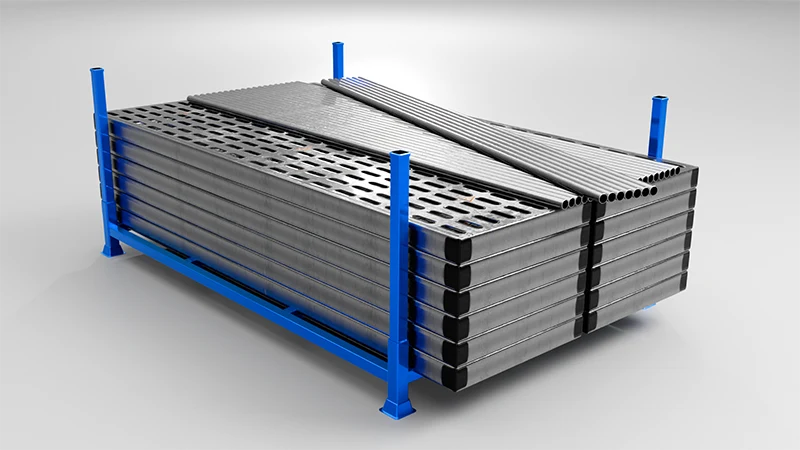
The solution is to fundamentally change how weight is managed in your warehouse. A tire storage rack, also known as a post pallet or portable stack rack, introduces a steel skeleton that completely isolates tires from damaging compressive forces. This system redefines the principles of tire storage.
Zero Compression, Zero Deformation
With a heavy duty stack rack, tires are placed within a rigid steel frame. When another rack is stacked on top, its weight is transferred through the four steel corner posts directly to the rack below and ultimately to the floor. The tires inside the lower unit bear no load other than their own weight. This complete removal of external pressure makes bead deformation and flat-spotting physically impossible, protecting 100% of your inventory.
Transforming Warehouse Airspace into Profitable Storage
By eliminating the height limitations imposed by the tires themselves, you can now safely stack units 4, 5, or even 6 levels high. This strategy converts unused vertical airspace into valuable, revenue-generating storage locations. Warehouses can see a storage density increase of 60% or more compared to floor stacking, all without the risk of product damage. The result is a dramatic increase in storage capacity within your existing footprint, delaying or eliminating the need for costly facility expansion.
Streamlining Operations from Warehouse to Retailer
Adopting a unitized storage system like demountable post pallets delivers efficiency gains that ripple through your entire supply chain.
Radically Faster Handling and Inventory Counts
Instead of handling individual tires, forklifts can move an entire rack—containing 16 to 20 tires, for example—in a single operation. This unitized approach slashes loading and unloading times by up to 80%. Furthermore, inventory management becomes incredibly simple and accurate. Instead of a painstaking manual count of thousands of individual tires, a task with an accuracy rate often as low as 85%, you simply count the racks. This method boosts inventory accuracy to over 99.9%, providing reliable data for your WMS and financial planning.
Data-Driven Design: Not All Tire Racks Are Created Equal
An effective storage solution is not one-size-fits-all. Professional tire storage systems are engineered based on tire geometry. The industry standard often uses a diameter-based classification to optimize rack design and maximize storage density:
- Passenger & Light Truck Tires (PCR – Diameter < 800mm): Racks are designed with a specific width and depth to hold a set number of tires (e.g., 4 across) securely, preventing rolling and maximizing space.
- Truck & Bus Tires (TBR – Diameter > 800mm): These require a larger base, stronger construction, and reinforced posts to handle the significantly increased weight and size, ensuring absolute safety under heavy loads.
This tailored approach ensures that every square foot of your warehouse is used to its full potential.
| Feature | Traditional Floor Stacking (Lacing) | Tire Stack Rack System |
| Product Damage Risk | High (Bead Deformation, Flat-Spotting) | Zero (Load supported by steel structure) |
| Storage Density | Low (Limited by tire strength) | High (Utilizes full vertical warehouse height) |
| Handling Efficiency | Very Low (Manual, one tire at a time) | Very High (Forklift moves entire unit) |
| SKU Accessibility | Poor (LIFO – Last-In, First-Out) | Excellent (100% selectivity, any rack is accessible) |
| Inventory Accuracy | Low (~85%) | Excellent (>99.9%) |
Frequently Asked Questions
1. What exactly is tire bead deformation?
Bead deformation is irreversible damage to the inner circle of a tire that seals it to the wheel rim. It is most commonly caused by the immense and uneven pressure from improper stacking methods like lacing, rendering the tire unsafe and unusable.
2. How do stack racks completely prevent this type of damage?
Stack racks feature strong vertical posts that bear the full weight of any racks stacked above them. This means the load is transferred through the steel frame to the floor, not through the tires. The tires inside only support their own weight, eliminating external compressive forces and making deformation impossible.
3. Can these racks accommodate different types and sizes of tires?
Yes. Tire pallets are typically designed with specific tire classes in mind, such as passenger car tires (PCR) or larger truck/bus tires (TBR). This ensures a perfect fit, maximizing both storage density and safety for different product lines.
4. Besides preventing damage, what is the biggest operational benefit?
The single biggest benefit is the shift to unitized handling. Instead of moving one tire at a time manually, a forklift can move an entire rack of 16 or more tires at once. This dramatically increases the speed of loading, unloading, and warehouse organization, leading to significant labor cost savings.
5. Are these racks a permanent installation in the warehouse?
No, they are highly flexible. These are portable stack racks that are not bolted to the floor. This allows you to reconfigure your warehouse layout in response to seasonal inventory changes or shifting business needs. When not in use, the posts can be removed and the bases nested to save space.
Need a Custom Storage Solution?
Speak directly with our technical engineers. We offer free structural designs, heavy-duty catalog evaluations, and quick B2B price quotations.
Request a Quote Now →