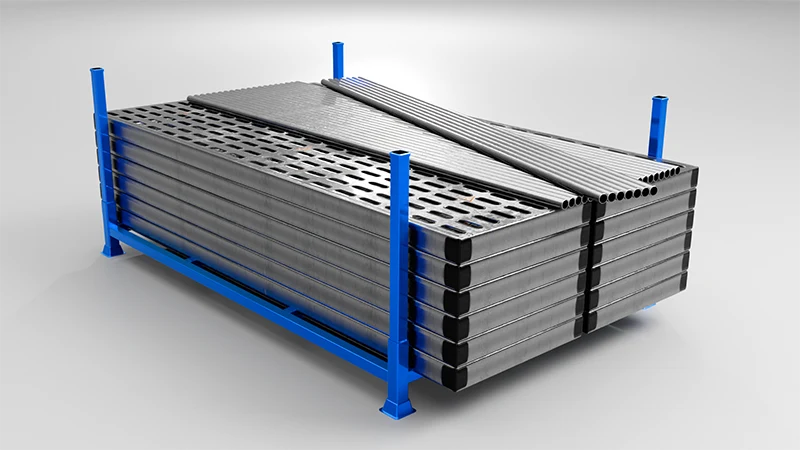

Floor stacking seems free, but the cost of crushed products, lost space, and inefficient handling quickly adds up. Discover a structural solution that protects your inventory and unlocks your warehouse’s true vertical potential. Stop stacking products; start stacking smart.
The Hidden Cost of “Free” Space: Why Floor Stacking Crushes Profits
For operations handling bagged goods, textiles, or any product with limited compressive strength, block stacking on the warehouse floor appears to be the most straightforward storage method. It requires no initial investment in infrastructure. However, this perceived “free” space comes at a significant, often hidden, cost: product crushing. When goods like bags of flour, animal feed, or rolls of fabric are stacked directly on top of one another, the bottom layer bears the entire weight. This leads to compression damage, irreversible deformation, and ultimately, unsellable inventory and direct financial loss.
Shifting the Burden: The Physics of Damage-Free Stacking
The fundamental flaw in floor stacking is that the product itself is the support structure. A modern approach completely decouples the product from this weight-bearing role. This is achieved through a structural frame, often known as an industrial stacking rack or a post pallet.
From Product-Supported to Structure-Supported Stacking
The core principle is simple yet transformative. By placing products inside a robust steel frame with vertical posts, the load from any subsequent layers is transferred directly through these steel posts to the floor. The goods on the bottom layer support only their own weight; they experience zero pressure from the tons of inventory stacked above them. This “structural skeleton” completely isolates products from compressive forces, effectively eliminating crushing damage regardless of stack height.
Unlocking Vertical Cube Space Safely
Once the product’s own strength is no longer the limiting factor, the full vertical height of a warehouse becomes usable. A typical floor stack might be limited to two or three layers before the risk of damage becomes unacceptable. With a structure-supported system, stacking four, five, or even six units high becomes standard, safe practice. This immediately transforms wasted overhead air into valuable storage capacity, increasing warehouse density by as much as 400% without expanding the building’s footprint.

Beyond Preventing Crushing: Gaining Operational Agility
While eliminating product damage is the primary advantage, adopting a modular, stackable shelving system introduces significant operational efficiencies that floor stacking cannot offer.
Eliminating the “Re-Stacking” Tax
Block stacking creates a rigid Last-In, First-Out (LIFO) inventory system. Accessing a specific pallet or product at the bottom or middle of a stack requires manually moving every single unit on top of it. This process, often called “honeycombing” or “re-stacking,” consumes immense amounts of labor and time, and each move introduces a new risk of handling damage. With portable stack racks, each unit is a discrete, accessible location. A forklift can retrieve any rack from an aisle-facing position without disturbing the units above or below it, enabling true selective access.
Creating a Dynamic Warehouse Layout
Unlike fixed pallet racking that is bolted to the floor, portable stacking systems offer unparalleled flexibility. Warehouse layouts can be reconfigured in hours, not weeks, to accommodate seasonal inventory peaks, create temporary work cells, or clear large areas for cross-docking operations. When not in use, the posts can be removed and the bases nested together, reducing their storage footprint by up to 80%. This allows a facility to adapt its storage infrastructure to meet the dynamic demands of the business, rather than forcing the business to conform to a static storage layout.

A Quick Comparison: Block Stacking vs. Portable Stack Racks
| Feature | Block Stacking (Floor Stacks) | Stackable Industrial Shelving (Post Pallets) |
|---|---|---|
| Weight Bearing Mechanism | Product itself bears the weight of the stack. | Steel posts bear the weight, protecting the product. |
| Vertical Height Limit | Limited by product’s crush strength (typically 2-3 layers). | Limited by rack’s engineering and ceiling height (4-6+ layers). |
| Product Accessibility | LIFO (Last-In, First-Out). Must unstack to access bottom layers. | Selective access to any unit facing an aisle. |
| Product Damage Risk | High risk of crushing, compression, and deformation. | Virtually zero risk of crushing damage. |
| Layout Flexibility | Static. Moving a stack is a major manual effort. | Highly flexible. Can be moved and reconfigured with a forklift. |
Frequently Asked Questions
1. What exactly is a stackable industrial shelving system?
It’s a modular storage unit, also known as a stack rack, post pallet, or pallet stillage. It consists of a steel base and removable corner posts. These units are designed to hold products and be stacked on top of one another, with the posts transferring all the weight to the floor, protecting the goods inside.
2. How high can we safely stack these racks?
This depends on the rack’s specific engineering, the load capacity, the weight of the items being stored, and the stability of the floor. However, it is common to safely stack these units 4 to 5 levels high, reaching heights of 6-8 meters (20-26 feet).
3. Are these systems suitable for industries with strict hygiene standards, like food and beverage?
Yes. Many stackable systems are available with a hot-dip galvanized finish. This coating provides superior rust and corrosion resistance, is easy to clean with high-pressure water, and does not harbor bacteria like wood pallets, making it ideal for food production, cold storage, and pharmaceutical environments.
4. Do we need special forklifts or equipment to handle them?
No. These racks are designed to be handled by standard forklifts. The bases typically feature four-way or two-way entry fork pockets, integrating seamlessly with existing material handling equipment.
5. What happens when we have a slow season and don’t need all the racks?
This is a key advantage. The posts can be easily removed, and the empty bases can be nested or stacked together. A stack of 5-6 nested empty bases takes up the same footprint as a single assembled rack, freeing up valuable floor space for other operations.
Need a Custom Storage Solution?
Speak directly with our technical engineers. We offer free structural designs, heavy-duty catalog evaluations, and quick B2B price quotations.
Request a Quote Now →