
Beyond Storage: Why Your Food Brand’s Reputation Rests on Steel, Not Wood
In the food supply chain, from flour mills to bakeries and livestock farms, the journey from production to end-user is fraught with risk. The primary challenge is maintaining product quality within the warehouse. Standard practices like using wooden pallets for bagged goods (flour, sugar, animal feed) create significant vulnerabilities. Wood absorbs moisture, harbors bacteria and pests, and can splinter, causing direct contamination. Floor stacking, while seemingly efficient, leads to immense pressure on bottom-layer bags, causing compaction, caking, and costly product damage. The solution lies in shifting the load-bearing responsibility from the product itself to a dedicated, hygienic structure: the metal stack rack.
The Hygiene Imperative: Galvanized Steel vs. The Hidden Dangers of Wood
Food safety is non-negotiable. Regulatory bodies and discerning customers demand strict adherence to standards like HACCP (Hazard Analysis and Critical Control Points) and GMP (Good Manufacturing Practices). This is where the choice of storage equipment becomes a critical control point itself.
The Unseen Threat of Wood Pallets
Wooden pallets are a primary source of contamination in food warehouses. Their porous nature makes them a breeding ground for mold and bacteria, especially in humid environments or facilities with temperature fluctuations. They are nearly impossible to sanitize effectively, and the risk of wood splinters or nails puncturing product packaging is constant. For any food production company, using wood pallets is a continuous operational risk that can lead to product recalls and severe brand damage.
The Hot-Dip Galvanized Solution
A hot-dip galvanized finish on steel pallet stillages provides the ultimate defense. This process involves submerging the entire steel rack in molten zinc, creating a metallurgical bond that forms a tough, corrosion-proof barrier. Unlike paint, which can chip and expose steel to rust, galvanization offers sacrificial protection. Even if the surface is scratched by a forklift, the surrounding zinc layer actively protects the exposed steel. This ensures a 20+ year lifespan without rust, even in cold storage or high-humidity environments. These racks can be easily cleaned and sanitized with high-pressure water, fully complying with food-grade hygiene standards.

Preserving Product Integrity: End Product Damage from Crushing
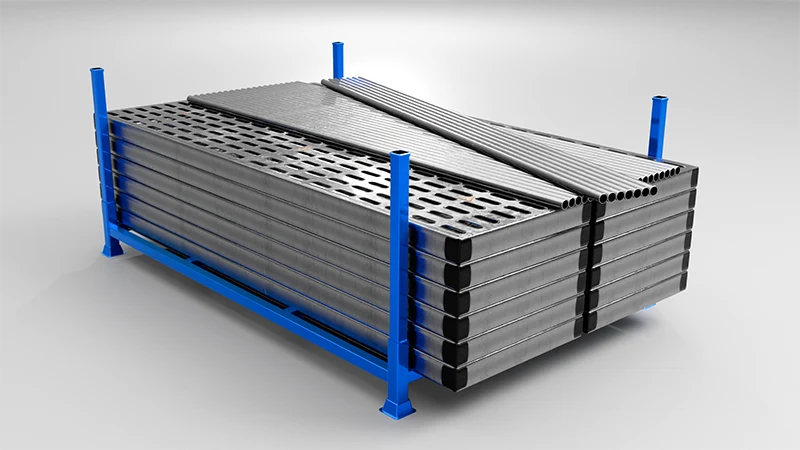
The core function of a post pallet is to create an independent, load-bearing “skeleton” around your goods. The weight of each subsequent layer is transferred through the vertical steel posts directly to the floor, not onto the products below. This simple mechanical principle fundamentally changes warehouse dynamics and eliminates a major source of financial loss.
| Feature | Traditional Floor Stacking | Metal Stack Rack System |
|---|---|---|
| Stacking Height | Limited to 1-2 layers by the product’s own compressive strength. | Utilizes full warehouse height, safely stacking 4-5 layers high. Storage density increases by up to 400%. |
| Product Safety | High risk of crushing, compaction, and caking for bottom-layer bags, leading to direct product loss. | Zero compression damage. The product carries no weight, preserving its form and quality from production to delivery. |
| Accessibility & Selectivity | Strictly Last-In, First-Out (LIFO). Accessing specific batches requires moving entire stacks, wasting time and labor. | 100% selectivity. Forklifts can access any pallet at any level, enabling efficient First-In, First-Out (FIFO) inventory management. |
Unlocking Operational Agility in Food Production
Beyond safety and protection, portable stack racks introduce a level of flexibility that fixed racking systems cannot match. This agility is crucial for businesses facing seasonal demand spikes, such as bakeries during holidays or feed mills during specific planting seasons.
The “Movable Warehouse” Concept
Because these racks are not bolted to the floor, your warehouse layout can be reconfigured in hours, not weeks. During peak seasons, you can create dense blocks of storage to maximize capacity. During slower periods, the racks can be demounted and nested together, freeing up valuable floor space for other operations like cross-docking or equipment maintenance. This transforms your warehouse from a static liability into a dynamic, adaptable asset.

Streamlined Unitized Logistics
The post pallet acts as both a storage unit and a returnable transport package (RTP). A full rack of bagged flour can be moved directly from the warehouse onto a truck and delivered to a large-scale bakery without ever touching or re-handling the individual bags. This unitized approach dramatically reduces labor costs, speeds up loading/unloading times, and minimizes the risk of handling damage during transit, ensuring the product arrives at your customer’s door in pristine condition.
A Strategic Asset for Your Brand’s Future
Investing in a metal stack rack system is more than a simple equipment upgrade; it is a strategic decision to protect your brand at its most vulnerable points. It directly addresses the core challenges of food safety, product integrity, and operational efficiency. By eliminating contamination risks from wood, preventing product loss from crushing, and creating a more agile and responsive warehouse, you are building a more resilient supply chain. This robust infrastructure is the foundation upon which a trusted food brand is built and maintained.
Frequently Asked Questions
1. Are these metal stack racks suitable for refrigerated or cold storage environments?
Absolutely. Racks with a hot-dip galvanized finish are specifically designed for such applications. The zinc coating provides superior protection against the moisture and condensation common in cold storage, preventing rust and ensuring a long, hygienic service life.
2. How do portable stack racks save more space than traditional fixed pallet racking?
While both use vertical space, portable racks eliminate the need for permanent, fixed aisles. This allows for high-density “block stacking” where racks are placed immediately next to each other, converting unused aisle space into valuable storage capacity. The layout can be changed at any time to suit inventory levels.
3. Can these racks handle heavy, dense products like 1-ton bulk bags of flour or grain?
Yes. These are industrial, heavy-duty racks constructed from high-strength Q235 steel. They are engineered to handle significant weight capacities, typically from 1,000 kg to 2,000 kg ($2,200 to $4,400 lbs) per rack, making them ideal for bulk bags and other heavy food products.
4. How are the racks cleaned to meet food safety standards?
The non-porous surface of galvanized steel and open design make them easy to clean. They can be washed with high-pressure water, steam-cleaned, or sanitized with industrial cleaning agents without risk of damage or absorption, unlike wood.
5. What happens to the racks when they are empty or need to be returned?
The four corner posts are fully demountable. The empty bases can then be nested or stacked together. This “nesting” capability reduces the space required for storing empty racks by up to 80% and significantly lowers freight costs for return logistics in a closed-loop system.
Need a Custom Storage Solution?
Speak directly with our technical engineers. We offer free structural designs, heavy-duty catalog evaluations, and quick B2B price quotations.
Request a Quote Now →