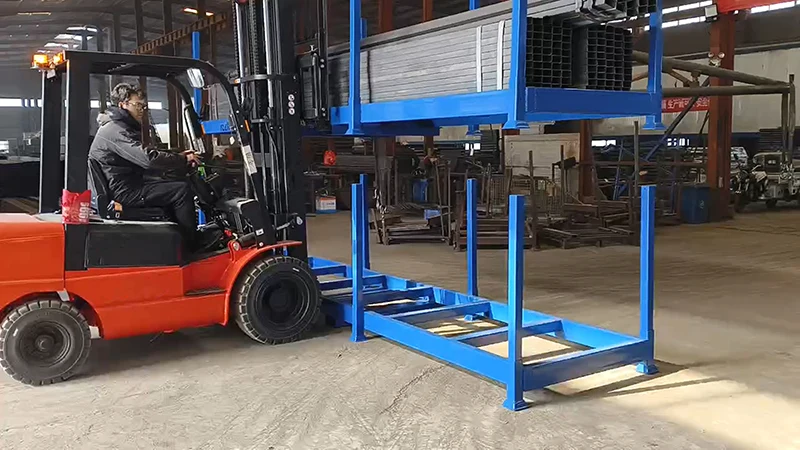

Is your warehouse floor a chaotic sea of laced and barrel-stacked tires? Are you losing valuable inventory to compression damage and wasting hours digging for specific SKUs? It’s time to reclaim your vertical space and protect your assets from the ground up.
The Real Cost of “Lacing”: Why Your Warehouse Layout Is Crushing Profits
For tire distributors, the default storage method is often floor stacking. Whether “laced” like a zipper or “barrel stacked” in tall columns, this approach seems efficient at first glance. However, it creates significant, often hidden, operational costs that directly impact your bottom line. The weight of an entire stack rests on the few tires at the bottom, leading to irreversible damage and operational chaos.
Bead Deformation and Flat-Spotting: The Silent Inventory Killer
The core problem with floor stacking is simple physics. The immense pressure exerted on the bottom layers of tires causes two critical types of damage:
- Bead Deformation: The constant, uneven pressure warps the tire bead, making it impossible to seat and seal on a rim properly. These tires are often returned by dealers or must be scrapped, resulting in a direct financial loss.
- Flat-Spotting: Prolonged compression can create permanent flat spots on the tread, compromising the tire’s dynamic balance and ride quality. This is especially true for performance and high-value tires.
Every tire lost to compression damage is a direct hit to your profitability, a loss that a proper warehouse layout can entirely prevent.

The Picking Nightmare and Inventory Blindness
When a customer needs a specific set of tires located at the bottom of a 10-foot-high stack, your warehouse operation grinds to a halt. Your team must manually unstack and restack hundreds of tires, a labor-intensive and high-risk process that kills efficiency. This “last-in, first-out” (LIFO) reality makes accessing specific SKUs a nightmare. Consequently, cycle counts become guesswork, leading to inventory inaccuracies in your WMS, lost sales, and frustrated customers.
A Strategic Shift: Building Up with a Modular Tire Rack System
The solution is to change the fundamental logic of your storage. Instead of letting tires bear the weight, you introduce a steel structure that does it for them. A modular tire storage rack system acts as a load-bearing exoskeleton for your inventory, allowing you to safely utilize your warehouse’s full vertical height.
Engineered for Every Tire: From PCR to Heavy-Duty TBR
A one-size-fits-all approach doesn’t work for tires. An effective racking solution is designed around the specific geometry of your products. The system is often classified by tire diameter:
- PCR & Light Truck (Under 800mm dia.): Racks are designed to hold tires upright or interlaced horizontally, with dimensions optimized to prevent rolling and maximize unit count.
- TBR / Commercial (Over 800mm dia.): These require a larger footprint and stronger construction. The heavy duty stack racks are engineered with reinforced bases and thicker steel posts to handle the extreme weight of truck and bus tires, stacking them safely without any load on the tires themselves.

Transforming Floor Area into Usable Cubic Volume
By transferring the load to the steel frame, you can now safely stack units 4, 5, or even 6 levels high. This instantly converts your warehouse from a measure of square feet to a measure of cubic feet. The result is a dramatic increase in storage capacity—often over 60% more tires in the same footprint. You’re not just storing tires; you’re creating a dense, organized, and fully accessible inventory wall.

The Payoff: Revolutionizing Your Daily Operations
Implementing a portable stack rack system does more than just save space. It transforms your entire workflow from receiving to shipping.
100% Accessibility & 99.9% Inventory Accuracy
Every rack is a discrete, movable unit. A forklift can access any rack at any level, at any time. This 100% selectivity eliminates the LIFO problem entirely. Furthermore, each tire pallet holds a standardized quantity of tires. To count inventory, you simply count the racks. This method boosts inventory accuracy to near-perfect levels, making your WMS data reliable and your operations predictable.
A Flexible Footprint for Seasonal Demand
Tire demand fluctuates. Unlike bolted-down racking, these portable units offer unmatched flexibility. During peak season, you can create dense storage blocks. In the off-season, the racks can be disassembled, and the bases nested together, clearing huge areas of floor space for other activities like cross-docking or vehicle staging. This “nesting” capability also dramatically reduces the cost of shipping empty racks back to a central depot.

Empty racks can be nested, reducing their storage footprint and return shipping costs by up to 80%.
Frequently Asked Questions
1. How do these racks accommodate the wide range of tire sizes my facility handles?
The systems are not one-size-fits-all. They are designed based on tire diameter ranges. We provide specific models optimized for passenger car tires (PCR) and separate, more robust models for heavy truck and bus tires (TBR). This ensures a perfect fit, maximizes storage density for each type, and guarantees structural integrity.
2. Is it really safe to stack tires 4 or 5 racks high?
Absolutely. The safety is engineered into the design. Each rack features “cup feet” or interlocking posts that create a secure, self-aligning connection between levels. The weight is transferred directly through the vertical steel posts to the ground, not through the tires. All racks have a clearly defined load capacity which is rigorously tested.
3. How does this system integrate with my existing Warehouse Management System (WMS)?
The system simplifies WMS integration. Each rack becomes a single, trackable unit holding a standard quantity of a specific SKU. By applying a barcode or RFID tag to the rack instead of each tire, you can manage inventory at the unit level. This makes receiving, put-away, picking, and cycle counting faster and far more accurate within your WMS.
4. What happens when the racks are empty? Don’t they take up a lot of space?
This is a key advantage. The vertical posts are removable. Once removed, the empty bases can be “nested” or stacked into each other. Typically, 4 to 6 empty, nested bases take up the same footprint as a single assembled rack, freeing up valuable floor space for other operations during slower periods.
5. What is the typical ROI for switching from floor stacking to a modular tire rack system?
The ROI is driven by several factors: 1) Increased storage capacity (often 60%+) in your existing footprint, delaying or eliminating the need for expensive warehouse expansion. 2) Elimination of product damage from compression, turning scrapped inventory into revenue. 3) Drastically improved labor efficiency in picking and put-away (up to 80% faster). Most distributors see a full return on their investment in 12-24 months.
Need a Custom Storage Solution?
Speak directly with our technical engineers. We offer free structural designs, heavy-duty catalog evaluations, and quick B2B price quotations.
Request a Quote Now →