
The winter tire rush is coming. Is your warehouse prepared for the seasonal surge, or are you facing another year of damaged beads, chaotic floor stacks, and inefficient handling? When your storage density directly impacts your profitability, relying on outdated methods is a liability you can’t afford.
The Hidden Costs of Traditional Tire Storage: Bead Deformation and Wasted Space
For tire distribution centers, “lacing” or “barrel stacking” tires on the floor seems like a space-saving solution. In reality, it’s a direct path to profit loss. This method exerts immense, uneven pressure on the sidewalls of the tires at the bottom of the pile. The result is irreversible bead deformation and flat-spotting, rendering valuable inventory unsellable and damaging your reputation with installers.
Furthermore, this approach creates an operational nightmare. Need a specific SKU from the bottom of a 10-foot stack? Your team must manually unstack and restack hundreds of tires, a process that is slow, labor-intensive, and carries a high risk of workplace injuries. This isn’t storage; it’s a blockade that cripples your picking efficiency, especially during peak season.

A Smarter Framework: Shifting Weight from Product to Structure
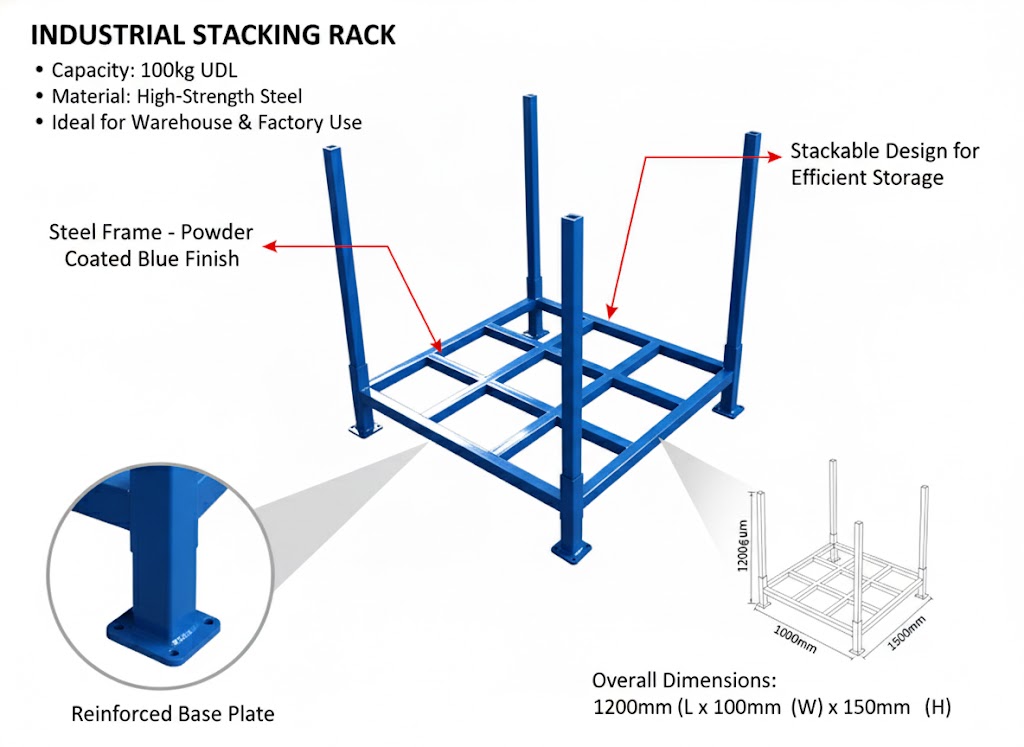
The core problem is that the tires themselves are forced to be the storage structure. Our portable tire storage racks introduce a fundamental change: they provide a robust steel skeleton to support the load. Each rack is essentially a modular, movable block of warehouse airspace.
How It Works:
- Structural Integrity: Four heavy-duty steel posts lock into a reinforced base, creating a rigid frame. When you stack another rack on top, its weight is transferred directly through these posts to the floor. The tires inside bear zero load, completely eliminating compression damage.
- Vertical Density: Free from the constraints of tire compressibility, you can safely stack these units 4 or 5 high, converting unused vertical airspace into profitable storage. This can increase your storage density by over 60% compared to floor stacking.
- Safe & Efficient Handling: Each rack becomes a standardized unit load. A single forklift operator can move dozens of tires at once, safely and quickly. The self-aligning “cup feet” design allows for fast and secure stacking, reducing handling time by up to 30%.

Engineered for Every Tire: From PCR to Heavy-Duty TBR
A one-size-fits-all approach doesn’t work for tires. Our solutions are engineered based on a proven diameter classification algorithm to maximize density and ensure safety.
- PCR & Light Truck (Diameter < 800mm): Racks are designed with optimal width and depth to hold a specific quantity of passenger tires (e.g., 16 tires) without wasted space, preventing them from shifting during transport.
- TBR & Commercial (Diameter > 800mm): For heavier truck and bus tires, our heavy duty stack racks feature larger footprints and reinforced posts to handle the extreme weight and dimensions with absolute stability.
This standardization revolutionizes inventory management. Instead of inaccurate manual counts, your WMS can track inventory by the rack. A quick scan or visual count of racks gives you a 99.9% accurate inventory picture in minutes.

Mastering the Seasonal Swing: Flexibility Fixed Racking Can’t Offer
Your inventory volume isn’t static, so why should your storage system be? Fixed pallet racking is a permanent fixture. During the off-season, it becomes a vast monument to wasted space, occupying valuable floor area that could be used for other operations.
This is where the “portable” in portable stack racks becomes a strategic advantage. When the seasonal rush ends and inventory levels drop, the posts can be easily removed from the bases. The empty bases then nest into each other, reducing their storage footprint by up to 80%. This “collapsibility” frees up your floor for cross-docking, order fulfillment, or other value-added services. It also dramatically lowers costs for reverse logistics, making a returnable packaging loop economically viable.

Frequently Asked Questions
| 1. How high can we safely stack these tire racks? |
| Typically, our tire racks are engineered to be stacked 4 to 5 units high, reaching heights of 20-26 feet (approx. 6-8 meters), depending on the specific tire weight, forklift capacity, and ceiling height. Each system is rated for a specific load capacity to ensure safety. |
| 2. Will the tires on the bottom rack get crushed? |
| Absolutely not. This is the key advantage of a metal post pallet system. The entire weight of the upper racks is transferred through the vertical steel posts directly to the floor. The tires inside are protected within the frame and bear no load. |
| 3. Can we use these racks for outdoor storage during peak season? |
| Yes. We recommend a hot-dip galvanized finish for any outdoor application. This process provides a thick, durable zinc coating that protects the steel from rust and corrosion for 20+ years, making the racks ideal for temporary or long-term outdoor storage. |
| 4. How many tires can a single rack hold? |
| Capacity is customized to your inventory. A standard PCR rack, for example, is often designed to hold 16 tires, arranged to maximize density within a truck trailer or shipping container. We design the rack around your tires to eliminate “shipping air.” |
| 5. What do we do with the racks in the off-season? Won’t they take up space? |
| The posts are fully demountable. During the off-season, you can remove the posts and nest the empty bases. A stack of 5-6 nested bases takes up the same footprint as a single assembled rack, freeing up over 80% of the floor space for other operations. |
Need a Custom Storage Solution?
Speak directly with our technical engineers. We offer free structural designs, heavy-duty catalog evaluations, and quick B2B price quotations.
Request a Quote Now →