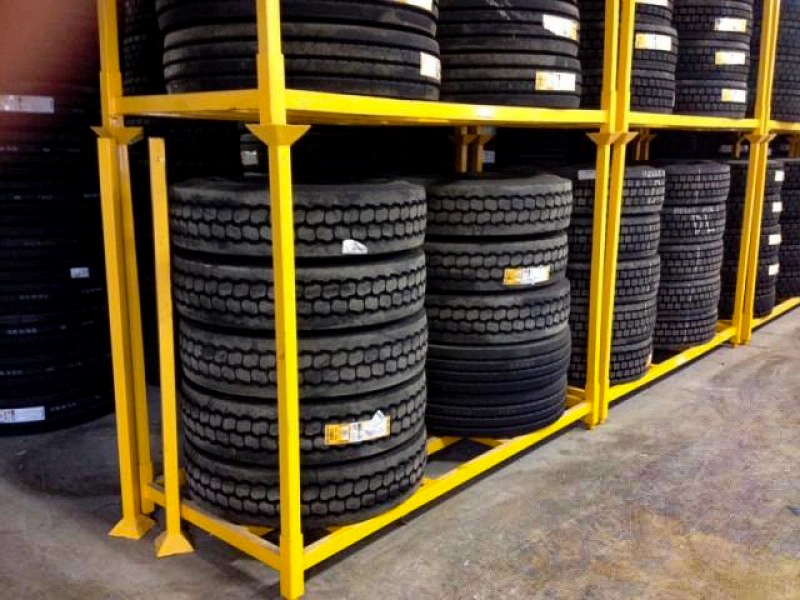

Are you losing valuable warehouse space to inefficient “laced” or “barrel stacked” tire pyramids? Is irreversible bead deformation and flat-spotting eating into your profits? It’s time to stop storing tires and start engineering your logistics flow. We transform warehouse floors from liability into a high-density, flexible asset.
The Tire Warehouse Dilemma: Why Floor Stacking Is Costing You More Than Just Space
In the tire distribution and manufacturing industry, space is profit. Yet, traditional storage methods actively work against it. The common practice of “lacing” or “barrel stacking” tires directly on the floor seems efficient at first glance, but it creates a cascade of hidden costs that impact your entire operation. This method forces a rigid, inefficient system where the product itself becomes the structure.
The Real Costs of Lacing and Pyramid Stacks
When tires are stacked in dense, interlaced pyramids, the bottom layers bear immense and uneven weight. This leads directly to:
- Irreversible Product Damage: The constant pressure causes bead deformation and flat-spotting. These are not just cosmetic flaws; they affect the tire’s balance and safety, leading to customer rejections, warranty claims, and costly write-offs.
- Picking Nightmares: Need a specific SKU from the bottom of the pile? Your team is forced into a labor-intensive, time-consuming process of manually unstacking and re-stacking hundreds of tires. This cripples picking efficiency and introduces significant risks of worker injury.
- Zero Inventory Selectivity: Floor stacking operates on a strict “Last-In, First-Out” (LIFO) basis. This is a critical problem when managing tire batches with different manufacturing dates, making a First-In, First-Out (FIFO) system impossible to implement.
- Wasted Vertical Space: Your warehouse rent is paid for cubic feet, not just square feet. Every foot of air above your tire pyramids is wasted potential, limiting your storage capacity and potentially forcing you into expensive off-site storage.

From Static Piles to a Dynamic Asset: The Power of Portable Stack Racks
The solution is to decouple the storage structure from the product. A portable stack rack is essentially a modular, structural steel skeleton for your inventory. It creates a self-contained unit of tires that can be safely stacked, stored, and transported without the product ever bearing a structural load. This simple change in logic transforms your entire warehousing philosophy.
Benefit 1: Multiply Your Storage Capacity by 400%
By transferring the load from the tires to the steel posts, our heavy duty stack racks allow you to safely go vertical, stacking 4 or 5 units high. You immediately convert unused airspace into valuable storage, increasing your warehouse density by up to 400% without leasing a single extra square foot. Your inventory is organized, visible, and accessible.

Benefit 2: Create a “Liquid” Warehouse That Adapts to Your Business
Unlike bolted-down, permanent racking systems that lock you into a fixed layout, portable stack racks offer unparalleled flexibility. During peak season, you can maximize density. During slower periods, the empty racks can be disassembled and nested in a corner, freeing up floor space for cross-docking, kitting, or other value-added services. Your warehouse layout becomes a fluid asset that changes with your inventory flow.

Benefit 3: Slash Return Logistics Costs by up to 80%
For any business involved in returnable transport packaging (RTP), the cost of shipping “air” in empty containers is a major expense. Our pallet stillages are designed with removable posts. The empty bases can be nested together, allowing 4 to 6 empty racks to fit into the same footprint as one fully assembled unit. This simple feature drastically reduces return freight costs, making a closed-loop supply chain economically viable.

Engineered for the Demands of Tire Logistics
Our systems are not one-size-fits-all. We understand the geometric differences between Passenger Car (PCR) and Truck & Bus (TBR) tires. Our solutions are engineered to your specific needs:
- Diameter-Based Design: We utilize an algorithm-based approach to design racks that maximize the number of tires per unit, whether it’s 4-wide for PCR tires or heavy-duty cradles for large-diameter TBR and OTR tires.
- Forklift-Friendly: With 4-way forklift access and self-aligning “cup feet” on the posts, our racks are designed for fast, safe, and efficient handling by your existing material handling equipment.
- Built to Last: Constructed from high-strength Q235 steel and available with a hot-dip galvanized finish for outdoor or harsh environments, these racks are an asset with a lifespan measured in decades, not years.
Stop letting outdated storage methods dictate your operational efficiency. It’s time to implement a system that protects your product, maximizes your space, and provides the flexibility to grow your business.
Frequently Asked Questions
| 1. How high can you safely stack these tire racks? |
| Typically, our stack racks are engineered to be stacked 4 to 5 levels high, depending on the weight of the tires and the specifics of the rack design. This allows you to utilize the full vertical height of your warehouse, often up to 6-8 meters (20-26 feet). |
| 2. Can these racks accommodate both smaller car tires (PCR) and large truck tires (TBR)? |
| Absolutely. We offer customized designs. For PCR tires, racks are often optimized to hold a set number of tires standing upright. For heavier and larger TBR or OTR tires, we design heavy-duty racks with increased load capacity and specific base dimensions to ensure stability and safety. |
| 3. What is the typical load capacity of a single rack? |
| Load capacity is tailored to the application but commonly ranges from 1,000 kg (2,200 lbs) to 2,000 kg (4,400 lbs) per rack. We conduct a thorough analysis of your tire types and handling requirements to specify a rack with the appropriate safety factor. |
| 4. Are the racks suitable for outdoor storage? |
| Yes. While our standard powder-coated finish is durable for indoor use, we highly recommend a hot-dip galvanized finish for any outdoor applications. This provides superior, long-lasting protection against rust and corrosion, ensuring a 20+ year asset life even in harsh weather. |
| 5. How does the “nesting” feature work for return transport? |
| The four corner posts are completely removable. Once removed, the empty rack bases are designed to interlock or “nest” into one another. This reduces their stacked height significantly, allowing you to fit 4 to 6 empty, disassembled units in the space that one assembled unit would occupy on a return truck. |
Need a Custom Storage Solution?
Speak directly with our technical engineers. We offer free structural designs, heavy-duty catalog evaluations, and quick B2B price quotations.
Request a Quote Now →