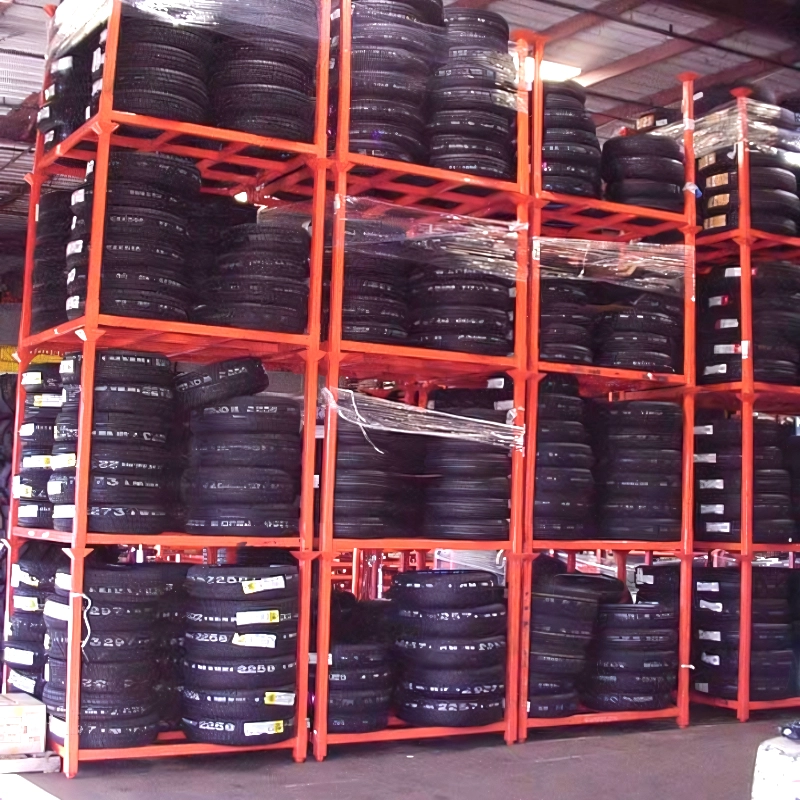

Your warehouse is overflowing with bagged goods—flour, animal feeds, bakery ingredients. Floor stacking creates unstable pyramids, crushes bottom-layer bags, and makes accessing specific batches a back-breaking task. You’re not just losing space; you’re losing product and efficiency with every crushed bag and wasted man-hour.
The Hidden Costs of Floor-Stacking Flour and Animal Feeds
In the food and feed production industry, from high-volume flour mills to specialized producers of layer mash for chickens, the warehouse floor is often the default storage solution. But this seemingly simple method introduces significant operational drains. Bagged products, whether it’s Swan flour or hog starter feeds, cannot bear substantial weight. Traditional pyramid or block stacking leads to a cascade of problems:
- Product Loss: Bags at the bottom of a stack are compressed, leading to “caking” in flour and potential degradation of nutrients in feed. This direct loss eats into your profit margins.
- Inventory Gridlock: Floor stacks create a rigid “Last-In, First-Out” (LIFO) system. Accessing an older batch requires manually unstacking hundreds of bags, a labor-intensive and time-consuming process that complicates proper stock rotation.
- Wasted Vertical Space: With a stacking height limited by the product’s own integrity, you are effectively paying for a warehouse but only using the floor. The valuable cubic space above your goods remains empty and unused.
- Contamination Risks: Goods stacked on wooden pallets are susceptible to splinter damage, while direct floor contact increases the risk of moisture absorption and pest issues, compromising product quality.
From Crushed Bags to Protected Units: The Portable Stack Rack Advantage
The fundamental flaw of floor stacking is that the product itself is forced to be the structure. A stack rack, also known as a metal post pallet, fundamentally changes this equation. It provides a robust, external steel exoskeleton for your palletized goods. The weight of upper levels is transferred through the solid steel posts directly to the floor, completely bypassing the product below.
Eliminate Product Compression and Damage
By placing your pallet of bagged goods inside a pallet stacking rack, you create a self-contained, protected unit. The bags are no longer a structural element. This means you can stack units 4 or 5 high with zero risk of crushing the products at the bottom. This ensures every bag, from the top of the warehouse to the floor, is in perfect, sellable condition.

Unlock Your Warehouse’s Full Vertical Potential
Imagine transforming your storage capacity without expanding your footprint. By stacking these units, you convert unused overhead air into valuable storage space. A warehouse with a 20-foot ceiling can go from a single layer of storage to four or five, instantly increasing storage density by up to 400%. This is crucial for handling seasonal inventory surges or expanding your product lines without leasing new facilities.
Achieve Operational Agility with a “Movable Warehouse”
Unlike fixed, bolted-down racking that locks your layout in place, portable stack racks offer unparalleled flexibility. Your warehouse storage layout can now adapt to your business needs in real-time.
- Dynamic Layouts: Clear a space for cross-docking in the morning and re-establish it as a bulk storage area in the afternoon. During slow seasons, the racks can be demounted and nested together, freeing up vast amounts of floor space.
- 100% Selectivity: Every single rack is a movable unit accessible by a forklift. You can retrieve any pallet, of any SKU, at any time, without moving other stock. This is a game-changer for effective inventory management and fulfilling orders quickly and accurately.
- Streamlined Operations: The entire workflow is simplified. A pallet of goods is loaded into a rack at the production line, moved into storage, and then directly loaded onto an outbound truck—all as one single, secure unit. This dramatically reduces handling time and the risk of damage.

Beyond Storage: Optimizing Total Cost of Ownership
The value of heavy duty stack racks extends beyond the four walls of your warehouse. Constructed from industrial-grade steel, these are long-term assets, not disposable packaging. Unlike wooden pallets that splinter, absorb moisture, and harbor pests, pallet stillages steel construction offers a hygienic and durable solution that can last for over a decade. When empty, the posts are removed and the bases nest together, slashing the cost of return shipping by up to 75% and making a returnable packaging loop economically viable.

Frequently Asked Questions
1. How do these custom stack racks handle the heavy, dense weight of bagged flour or feed?
Our racks are engineered from high-strength Q235 steel. The load capacity is determined by the design of the base and the thickness of the steel posts. We customize these specifications for your exact product weight, with standard models easily handling 2,000 to 4,000 lbs per rack, ensuring complete structural integrity even when stacked four or five units high.
2. Are these racks hygienic and suitable for a food-grade environment?
Absolutely. Steel is non-porous and does not harbor bacteria, mold, or pests like wood pallets do. We offer surface treatments like hot-dip galvanizing or powder coating, which create a smooth, easy-to-clean surface that resists rust and corrosion, helping you comply with food safety standards.
3. Can we use our existing forklifts and standard pallets with your system?
Yes. Our custom stack racks are designed to integrate seamlessly with standard material handling equipment. The base is built with four-way forklift entry pockets, and the internal dimensions are customized to fit your standard pallet sizes (e.g., 48″ x 40″) perfectly, ensuring a secure fit without any wasted space.
4. What is the key benefit of these portable racks over installing permanent pallet racking?
Flexibility. Permanent racking is a fixed installation that cannot be easily moved or reconfigured. Our portable racks require no installation and allow you to change your warehouse layout on-demand to adapt to seasonal inventory changes or evolving business needs. They are assets that move with your business, not a permanent part of the building.
5. How do these racks help us manage our many different SKUs, from chick booster to various types of siopao flour?
They are ideal for high-SKU environments. Each rack holds a specific pallet load of one SKU. Because every rack is individually accessible, your team can pick any specific batch they need without having to move other products. This drastically improves picking accuracy, speeds up order fulfillment, and makes cycle counting and inventory audits significantly easier and more accurate.
Need a Custom Storage Solution?
Speak directly with our technical engineers. We offer free structural designs, heavy-duty catalog evaluations, and quick B2B price quotations.
Request a Quote Now →