Your CNC saw and laser cutters are the heart of your operation. So why are they constantly idle, waiting for a forklift to dig out a specific bundle of bar stock? Stop burning profit on material handling bottlenecks. It’s time to reclaim lost production hours and up to 50% of your floor space.
The Hidden Costs Draining Your Steel Service Center’s Profitability
In any busy steel service center or metal fabrication shop, the daily grind looks familiar. A hot order comes in for a specific grade of 6-inch stainless steel tube. The problem? It’s buried under three bundles of carbon steel pipes at the bottom of a traditional cantilever rack or, worse, in a floor stack. The ensuing “material shuffle” begins. A forklift operator carefully navigates a congested aisle, lifts the top bundles, sets them aside, retrieves the target material, and then re-stacks the other bundles. This process, often called “secondary handling,” can take 15-25 minutes. During that time, your multi-million dollar cutting equipment sits waiting, and your production schedule slips.
This inefficiency is compounded by two other major issues:
- The Aisle Tax: Traditional fixed racks demand wide forklift aisles—often 10-13 feet—that consume a massive amount of your valuable floor space but add zero storage value. This “aisle tax” limits your ability to bring in new processing equipment or increase inventory without a costly facility expansion.
- Product Damage: Every time a forklift tine gets near a bundle, you risk costly dings, scratches, and dents. For high-value materials like architectural aluminum profiles or polished stainless steel, a single scratch can mean the entire piece is scrapped, directly impacting your bottom line.
From Aisle Congestion to Overhead Access: The Roll Out Cantilever Rack Revolution
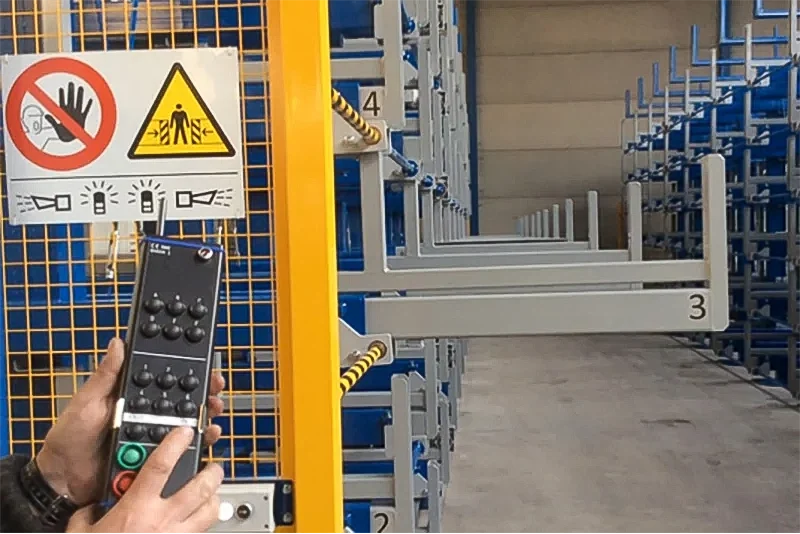
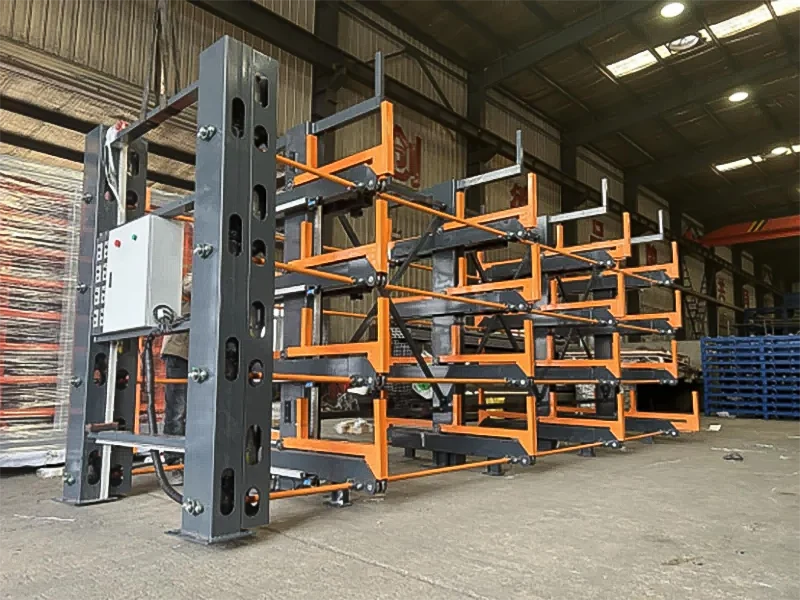
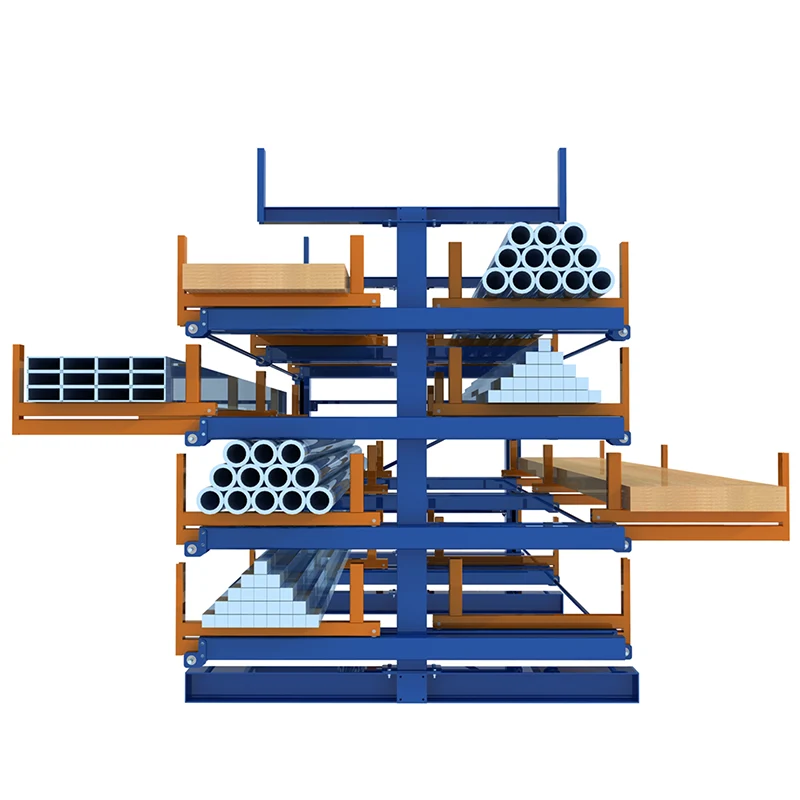
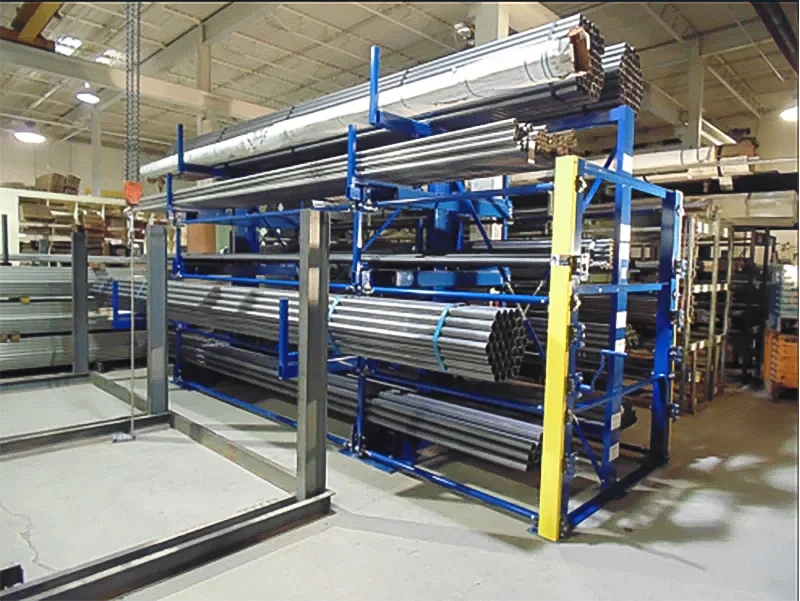
The fundamental flaw of traditional storage is its reliance on horizontal access by forklifts. The roll out cantilever rack fundamentally changes the game by introducing 100% vertical access. Each storage level is not a fixed arm but a fully extendable, heavy-duty drawer. With the turn of a crank or the push of a button, a single operator can roll out a specific level, completely exposing the stored material from above.
This simple-yet-powerful mechanic shifts the primary material handling tool from a ground-based forklift to your existing overhead crane. The crane can now access any bundle directly, vertically, and without obstruction. This single change creates a cascade of operational benefits that directly address the core challenges of steel service center storage.
Slash Material Retrieval Time from 20 Minutes to Just 3
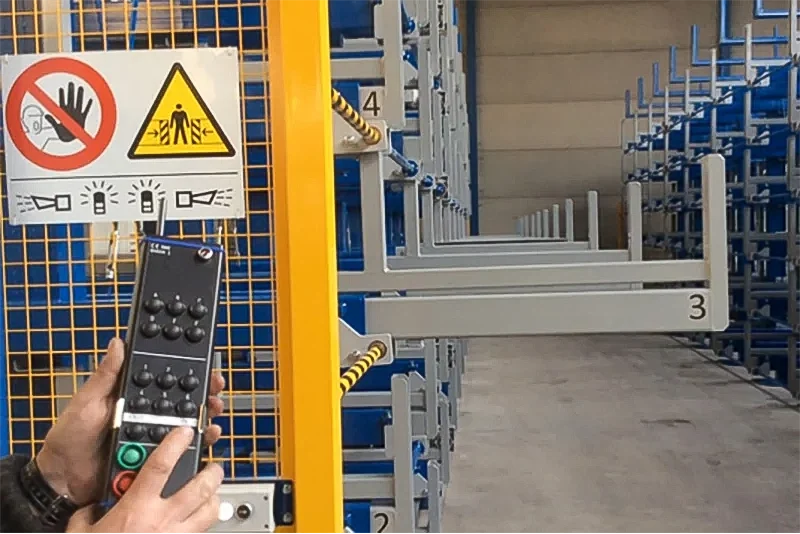
Imagine the same hot order scenario. Now, your operator walks to the rack, identifies the correct level, and uses a remote control to extend the drawer. The target bundle of stainless steel tube is presented in an open, accessible position. The overhead crane, equipped with nylon slings or a vacuum lifter, swoops in and lifts the material cleanly. The entire process takes 3-5 minutes. By eliminating secondary handling, you feed your saws, plasma tables, and laser cutters faster, dramatically increasing their uptime and overall plant throughput. This isn’t just a marginal improvement; it’s a transformation in your operational tempo.
Reclaim 50% of Your Floor Space Without Facility Expansion
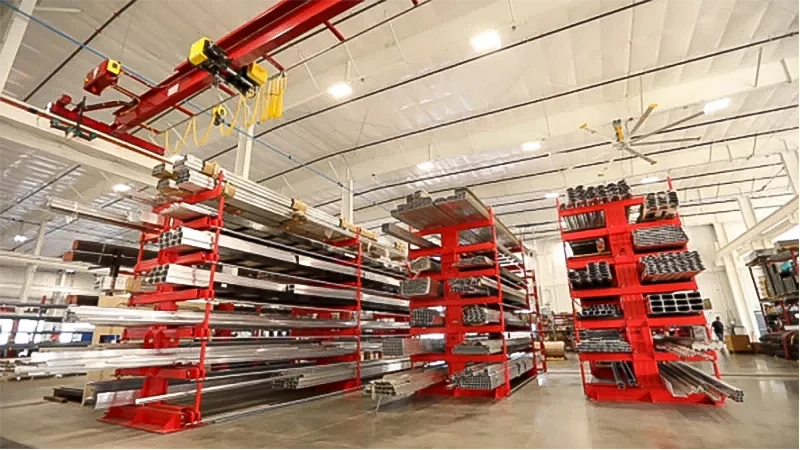
By making the forklift aisle obsolete for material picking, you can immediately and dramatically increase your storage density. A typical layout involves replacing two rows of conventional racks and their shared aisle with a single back-to-back roll out cantilever rack. This move alone can reduce the footprint required for the same amount of pipe and tube storage or bar stock storage by up to 50%. The reclaimed square footage is now available for revenue-generating activities—adding another cutting machine, expanding your welding department, or simply improving workflow with a larger staging area. You unlock new capacity within your existing walls.
Enhance Safety and Eliminate Product Damage
An overhead crane accessible racking system is an inherently safer system. By drastically reducing forklift traffic in storage areas, you minimize the risk of collisions with personnel or structures. Furthermore, vertical lifting with the proper rigging eliminates the dangerous instability of shuffling heavy, long bundles. For your product, this means an end to the damage that erodes your margins. The “no-touch” retrieval process protects delicate surface finishes on aluminum and stainless steel, ensuring the material that reaches your customer is in pristine condition.
Engineered for Your Specific Stock: Customization and Heavy-Duty Build
We understand that a steel service center handles a vast array of shapes and sizes. Our systems are not one-size-fits-all; they are engineered for your specific inventory. Built on a rock-solid foundation of H-beam steel and protected by a durable powder-coat finish, these racks are designed for the toughest industrial environments. We customize every aspect to match your needs:
- Load Capacity: From 1 to 5 tons (2,200 – 11,000 Lbs) per level.
- Configuration: Single or double-sided units to maximize your layout.
- Dimensions: Arm length, number of levels, and column spacing are all tailored to your material.
- Operation: Choose between a cost-effective manual hand-crank or a high-efficiency electric-powered system.
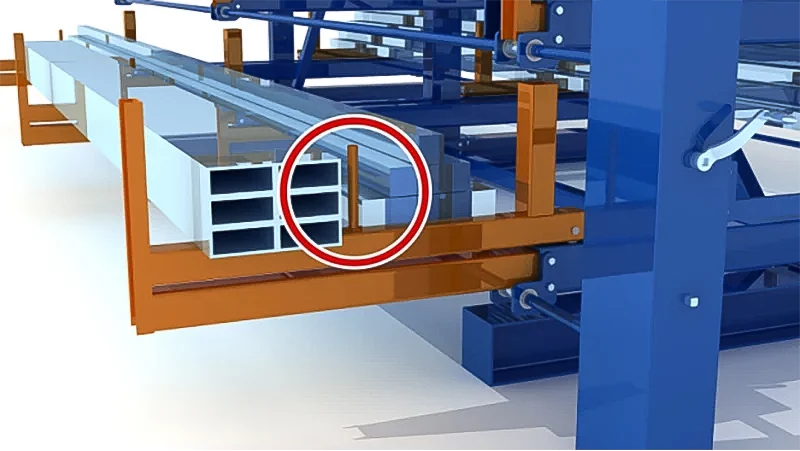
- Accessories: Add-on features like removable dividers allow for the organized storage of multiple smaller bundles or off-cuts on a single level.
Frequently Asked Questions for Steel Service Centers
1. How does this system handle different lengths of bar stock, like 20ft vs 40ft?
The system is modular. To support longer materials, we simply add more vertical columns at the appropriate intervals (e.g., every 8-10 feet) to ensure the material is fully supported and does not sag. The roll-out drawers are connected across all columns to move as a single unit.
2. What are the floor loading requirements for such a dense storage system?
Because these racks concentrate a significant amount of weight in a smaller footprint, a solid foundation is essential. We will provide detailed point-loading data based on your specific rack configuration and maximum load. A standard 6-inch reinforced concrete slab is typically sufficient, but we will work with your team to verify your floor’s capacity.
3. Can this rack system be integrated directly with our saw or laser cutting infeed?
Absolutely. This is the ideal application, often called “point-of-use” storage. Placing the rack directly beside your processing equipment creates the most efficient material flow, minimizing handling time and maximizing machine uptime. The overhead crane can lift material directly from the extended drawer onto the machine’s infeed table.
4. Manual crank or electric-powered—which is right for my operation?
The choice depends on retrieval frequency and load weight. For heavy loads (over 6,000 lbs) or high-frequency operations where every second counts, the electric-powered system with remote control is the superior choice. For less frequent access or budget-conscious applications, the manual crank system is incredibly efficient, using a gear reduction system that allows a single person to easily extend a fully loaded drawer.
5. How does the powder coating hold up in a typical metal fab shop environment with oils and coolants?
The powder coating finish is significantly more durable than conventional paint. It is electrostatically applied and then cured under heat, forming a hard, thick shell that is highly resistant to scratches, impacts, oils, coolants, and other common workshop chemicals. This ensures a long service life and a professional appearance for years to come.
Need a Custom Storage Solution?
Speak directly with our technical engineers. We offer free structural designs, heavy-duty catalog evaluations, and quick B2B price quotations.
Request a Quote Now →