
|
Stop Paying Freight to Ship “Air” Back to Your WarehouseFor glass wholesalers and fabricators, the most expensive part of the delivery cycle isn’t the outbound trip—it’s the return leg. Your drivers are hauling empty, bulky A-frames that eat up trailer space while carrying zero value. It’s time to switch to a system designed for High-Density Reverse Logistics. |
The Hidden Cost of Traditional A-Frames
If you are distributing Wholesale Tempered Glass or delivering IGUs to a commercial jobsite, you know the math. You send out a 53-foot trailer loaded with glass. Once the glazing contractor unloads the crates or racks, you are left with rigid, non-stackable A-frames.
The problem? You can only fit about 20 empty standard A-frames back on that truck. The rest are left stranded at the jobsite, risking theft or damage, or requiring a second truck run just to retrieve empty metal. This is the definition of inefficient reverse logistics.

High-density loading: The nesting capability transforms container and truck utilization.
The Geometry of Savings: L-Shape Nesting Technology
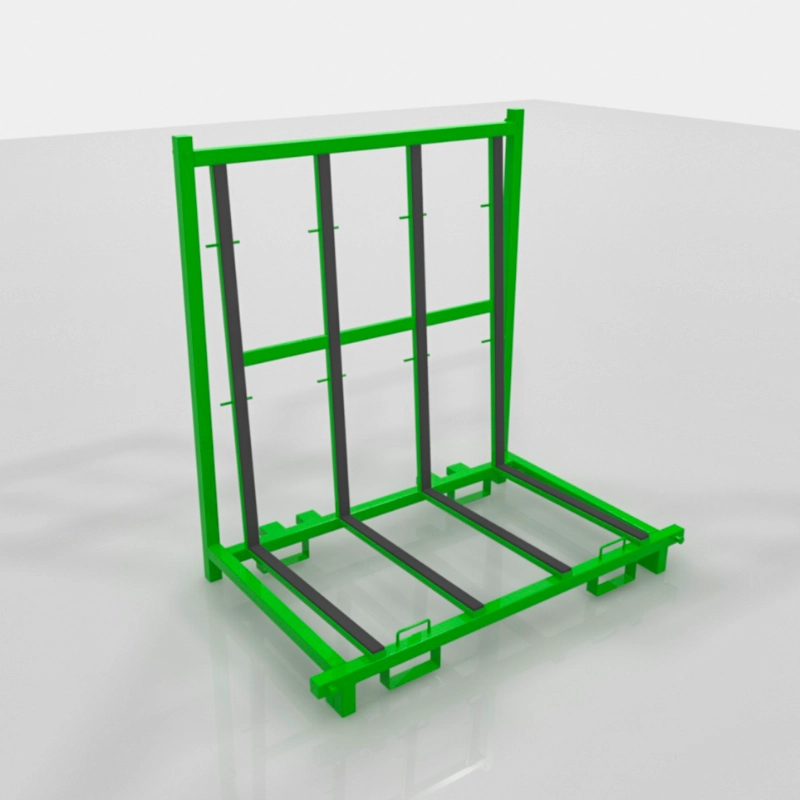
The solution lies in structural engineering. Unlike the triangular footprint of an A-frame, our glass transport rack utilizes an L-Shape design with a computed geometric base offset.
When empty, these racks don’t just sit next to each other; they slide into each other.
- Compression Ratio: You can stack 7 to 10 empty racks in the space of one fully assembled unit.
- Freight Logic: instead of fitting 20 empty racks on a return truck, you can fit over 100. This effectively reduces your return shipping cost per rack by up to 80%.
- Warehouse Space: In your facility, this frees up massive square footage for WIP storage or raw float glass inventory, rather than storing mountains of empty steel.

Top-down view showing the precise geometric nesting of the base structures.
Asset Protection: No More Metal-on-Glass Contact
Reducing shipping costs implies nothing if the rack destroys the product. In the glass industry, the enemy is “chipped edges” caused by worn-out dunnage.
Standard racks often use glued-on rubber strips. After a few months of sliding heavy Insulated Glass Units (IGU) or laminated sheets on and off, the glue fails. The rubber peels, exposing the bare steel. One heavy brake on the highway, and you have a truck full of cullet.
We engineered the Steel-Core Rubber Profile to solve this.

Steel-core rubber fastened with self-tapping screws ensures the protection never peels off.
Instead of adhesive, our rubber contains an internal steel plate and is mechanically fastened to the Q235 steel frame with self-tapping screws. The glass edge cuts against the rubber but is stopped by the inner steel core, preventing it from ever touching the frame. It stays in place, load after load.
Specs Comparison: L-Rack vs. Standard A-Frame
| Feature | Traditional A-Frame | Nestable L-Shape Rack |
|---|---|---|
| Return Logistics | 1:1 Ratio (Bulky) | 7:1 Ratio (Compact) |
| Floor Space Impact | Consumes aisle space | Clears 70% of storage area |
| Glass Angle | Typically 5-7° fixed | 90° Upright with 3-5° Lean |
| Protection | Glued Rubber (Prone to peeling) | Screw-Fixed Steel Core Rubber |

Recover valuable warehouse square footage by nesting empty racks when not in use.
Frequently Asked Questions
Absolutely. Constructed from Q235 structural steel with 2.5mm to 3.0mm wall thickness, these glass storage racks are rated for loads up to 4,400 lbs (2 tons) or more depending on the custom configuration, making them ideal for heavy tempered laminates.
No. The geometry is designed so that the steel frames nest without grinding against the primary surfaces. However, for outdoor storage in coastal areas (like California), we recommend Hot-Dip Galvanizing over powder coating for maximum rust resistance.
Yes. The base features reinforced forklift channels (typically 100x50mm rectangular tubing) designed for 4-way entry. This allows safe handling by standard warehouse forklifts or pallet jacks without damaging the rack structure.
While L-racks are great for large sheets, for smaller loose items, we provide ratchet strap anchor points on the frame. Additionally, we can install stop bars or retention poles to prevent smaller glass units from sliding sideways during transit.
Since we manufacture from the raw tube up, we can customize dimensions for Jumbo sheets (e.g., 130″ x 204″) easily. Typical production time is 15-20 days, plus shipping time to your facility.
Need a Custom Storage Solution?
Speak directly with our technical engineers. We offer free structural designs, heavy-duty catalog evaluations, and quick B2B price quotations.
Request a Quote Now →