
|
The sound of a remake is the most expensive noise in your plant. When a 1/2″ tempered lite explodes on a truck, it’s rarely because of the road bump. It’s because the cheap glue on your rack failed, the rubber pad slipped, and the glass edge kissed the steel upright. Stop relying on adhesive in a 110°F warehouse. Upgrade to mechanically fixed, steel-core protection. |
The Hidden Cost of “The Shell-Out”
In the glass fabrication industry, we talk about “clean edges” until we are blue in the face. You invest in high-end Italian edging machines and seaming tables to ensure the glass is stress-free before tempering. Yet, the moment that glass leaves the furnace and hits the glass transport rack, your logistics assets often betray your production quality.
The industry standard for decades has been gluing generic rubber strips onto steel hollow sections. It works—until it doesn’t. Summer heat in a delivery truck or UV exposure in an outdoor yard degrades the adhesive. The rubber peels back, often unnoticed. When you load a heavy IGU or a 10mm laminate sheet, the edge pressure cuts through the remaining weak rubber, making contact with the steel. This creates a “shell” or a microscopic chip. It might not break immediately, but once that glass experiences thermal stress or wind load on the jobsite, it fails.

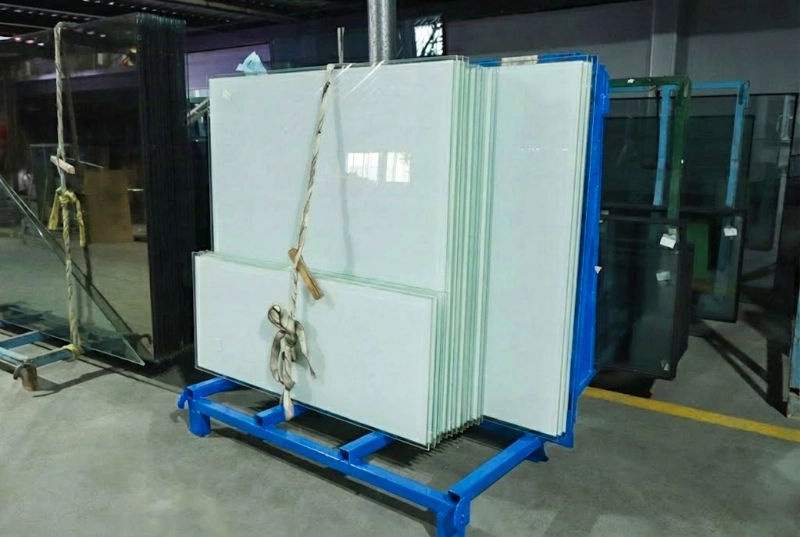
*The unforgiving weight of large IGUs requires protection that cannot shift or peel under pressure.*
Engineering the Solution: Steel-Core Rubber Technology
To guarantee Metal-on-glass contact prevention, we removed the variable of adhesive entirely from our L-Shape Glass Rack design. We utilize a proprietary Steel-Core Rubber Profile.
- Internal Anatomy: Inside the EPDM rubber extrusion, there is a vulcanized steel plate. This acts as a spine, preventing the sharp edge of a glass sheet from slicing through the rubber, even under dynamic loads of 4,000 lbs.
- Mechanical Fixation: We do not glue these strips. We use self-tapping screws driven directly through the steel core and into the Q235 steel uprights of the rack.
- Impact on Operations: You can drag a heavy stone slab or a jumbo glass sheet across the base without the rubber rolling over or tearing off.

*Close-up of the mechanical connection: Steel-core rubber screwed directly into the frame ensures zero metal-to-glass contact.*
Geometry Matters: The 3-5° Safe Tilt
Protection isn’t just about the rubber; it’s about physics. A purely vertical rack risks glass tipping forward during forklift braking. An overly angled rack puts excessive dead load on the back sheet, causing “blocking” or pressure cracks in center lites.
Our Grack units are engineered with a precise 3-5° tilt angle. This geometry, combined with the 90° relationship between the back and the base ledge, ensures that the glass pack sits neutrally. It eliminates the bending moment on the glass surface while keeping the center of gravity safely over the base during heavy duty glass rack transport.
Workflow Integration: From Seaming Line to Delivery Truck
In a high-volume fabrication plant, these racks serve dual purposes. They are robust enough for WIP (Work In Progress) storage at the end of the insulating line, and compact enough to load directly onto delivery trucks.
For glass wholesalers shipping to glaziers, the Nesting (stackable) capability is a game changer for reverse logistics. Once your driver delivers the glass, they can stack empty racks (L-into-L style), reducing the volume by 70%. This clears up deck space for backhauls or simply makes unloading at the depot faster.

*Nesting empty racks like shopping carts maximizes truck space on return trips.*
Switching to a glass storage rack that prioritizes edge protection is not an equipment cost; it’s an insurance policy against remakes. Every sheet that arrives intact is margin protected.
Frequently Asked Questions (FAQ)
Q1: Does the steel core in the rubber risk scratching the glass if the rubber wears down?
No. The steel insert is deeply vulcanized within the EPDM rubber. The rubber is designed with a specific Shore A hardness (70-80) to resist cutting. Furthermore, because it is screw-fixed, if a strip ever gets damaged by a forklift, you can unscrew and replace it in minutes, unlike glued rubber which requires scraping and solvent cleaning.
Q2: Can these L-racks handle the weight of 3/4″ (19mm) thick granite slabs?
Absolutely. While designed for glass, the Grack series is rated for loads up to 4,000 lbs (approx 1.8 metric tons). The Q235 steel structural tubing (50x50mm or 60x60mm posts) provides the rigidity needed for heavy stone slabs without flexing.
Q3: How do you prevent the racks from rusting in a wet processing environment?
For indoor fabrication plants, we use an industrial-grade Electrostatic Powder Coating (Standard RAL 5010 Blue) applied after acid washing and phosphating. For racks that will be stored outdoors or used in uncovered transport, we recommend our Hot-Dip Galvanized finish option, which offers 10+ years of corrosion resistance.
Q4: Will these racks fit into a standard shipping container if I order in bulk?
Yes, the dimensions are optimized for export. The standard 1600mm length allows us to load up to 98 units in a 40HQ container by utilizing the nesting capability and inverted stacking methods, significantly lowering your landed cost per unit.
Q5: Can I mix different glass sizes on one rack without them sliding?
Yes, provided you follow the “Bookending” principle (large sheets in back, small in front). We also provide integrated ratchet strap hooks and optional stopper bars (glass retention poles) to secure mixed loads during transit.
Need a Custom Storage Solution?
Speak directly with our technical engineers. We offer free structural designs, heavy-duty catalog evaluations, and quick B2B price quotations.
Request a Quote Now →