
Stop ‘shipping air’ and crushing profits. Your warehouse stores tires, but traditional floor stacking wastes over 60% of your cubic space and causes irreversible bead deformation on your bottom layer. There’s a calculated approach to reclaiming that space and protecting every single tire.
The Unspoken Cost of “Lacing”: Why Traditional Tire Stacking Fails
In the tire industry, floor stacking—often using methods like “lacing” or “barrel stacking”—seems like a space-efficient solution. In reality, it’s a hidden source of massive inefficiency and product loss. This method creates a dense, unstable mass where the tires at the bottom bear the weight of the entire stack. This leads to critical, non-recoverable damage.
- Bead Deformation: The immense pressure from multiple directions warps the tire bead, making it impossible to mount and seal on a rim properly. This tire is now scrap.
- Flat-Spotting & Carcass Damage: Prolonged compression creates permanent flat spots and can compromise the integrity of the internal structure, directly impacting vehicle safety and performance.
- Picking Inefficiency: Need a specific SKU from the bottom of a 10-foot pile? Your team has to manually de-stack and re-stack hundreds of tires, a time-consuming and high-risk task for worker back injuries.
- Wasted Vertical Space: You pay for your warehouse’s full cubic volume, but lacing limits you to the height a tire stack can safely support itself, leaving a vast, expensive void of air above.
The core problem is simple: the tires themselves are being used as the storage structure. This is a fundamental flaw in logistics design.

The Paradigm Shift: From “Cargo-Bearing” to “Structure-Bearing”
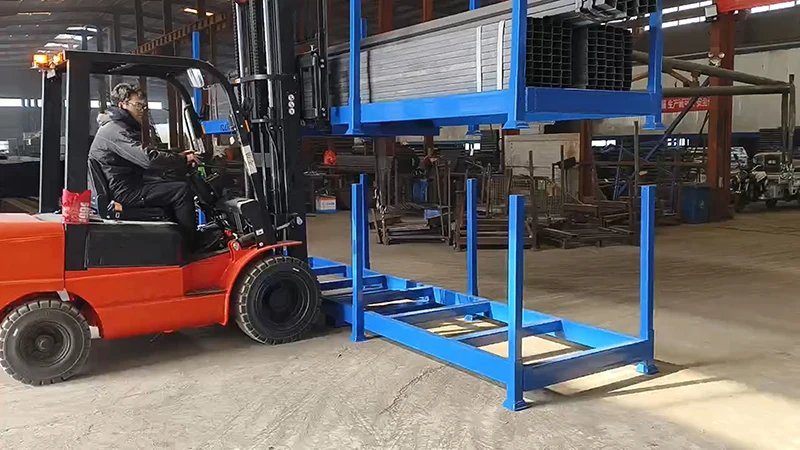
The solution is to introduce a modular, engineered skeleton that bears 100% of the load. Our portable stack racks act as individual storage cells. The weight of an upper rack is transferred through its steel posts directly to the frame of the rack below it, and ultimately to the floor. The tires inside, whether it’s one layer or twenty, experience zero compression. This single change eliminates product damage and unlocks your warehouse’s true vertical potential.
The Core Calculation: Designing Racks Around Tire Geometry
A “one-size-fits-all” approach to tire storage is a recipe for inefficiency. Effective high-density design isn’t about the rack itself; it’s about how the rack’s dimensions are calculated based on the specific geometry of the tires it will hold. This ensures maximum space utilization inside the rack and within the shipping container.
Step 1: The Diameter Divide (< 31.5 inches vs. > 31.5 inches)
The first and most critical calculation is based on tire diameter. This broadly separates passenger car tires from larger truck and commercial tires.
- Class A (PCR / Light Truck): Diameter < 800mm (~31.5 in). For these tires, the design logic prioritizes maximizing the count per rack. Racks are dimensioned to fit a specific number of tires (e.g., 4 or 5 wide) placed on their treads or interlaced horizontally. The goal is to fill the internal cube of the rack with minimal empty space.
- Class B (TBR / OTR): Diameter > 800mm (~31.5 in). For heavy-duty Truck and Bus Radial (TBR) or Off-the-Road (OTR) tires, the calculation shifts to load capacity. The base frame, post thickness, and welding specifications of the heavy duty stack racks are engineered to handle extreme point loads, often exceeding 2,500 Lbs per rack.

PCR tires optimized for density.

TBR tires engineered for extreme weight.
Step 2: Calculating Unit Load and Stacking Capacity
Once the tire class is determined, we calculate the unit load. For example, if a PCR rack is designed to hold 16 tires averaging 25 Lbs each, the total product weight is 400 Lbs. Adding the rack’s self-weight (e.g., 150 Lbs) gives us a total unit load of 550 Lbs. Our metal post pallet systems are typically rated for 2,200 Lbs capacity, allowing for safe stacking of 4 fully loaded units high (550 Lbs x 4 = 2,200 Lbs). This calculation gives you a predictable, safe, and dense storage model, transforming your floor space into a structured, high-rise storage system.
From Static Storage to Dynamic Logistics: The True Power of a Modular System
A high-density tire rack is more than just a storage device; it’s a reusable transport packaging (RTP) unit that streamlines your entire supply chain. Because the racks are not bolted to the floor, they create a “portable warehouse.”
- Inbound/Outbound Speed: Instead of manually handling individual tires, a forklift moves an entire unit of 16, 20, or more tires at once. This can reduce truck loading/unloading times by over 80%.
- Inventory Accuracy: Stop counting individual tires. Your WMS can now track inventory by the rack. If one rack holds 16 tires, counting 100 racks means you have 1,600 tires. Inventory accuracy jumps from 85% in floor stacks to over 99.9%.
- Flexible Layouts: During peak season, you can configure your warehouse for maximum density. In the off-season, you can nest the empty racks and free up the floor space for other operations like cross-docking or value-added services.
The Nesting Advantage: Slashing Reverse Logistics Costs by 80%
The biggest challenge for any reusable packaging system is the cost of returning empty units. Our pallet stillages are designed with removable posts. After unloading at the destination, the posts are removed and the bases are nested together. In the space that one fully assembled rack occupies, you can stack 4 to 6 nested bases. This simple design feature dramatically increases the density of return shipments, making a closed-loop, sustainable logistics model not just environmentally friendly, but economically superior to disposable one-way packaging.

Frequently Asked Questions
1. How many passenger car tires can a standard rack hold?
While custom sizes are our specialty, a typical design for PCR tires (up to 31″ diameter) can hold between 16 and 25 tires, depending on whether they are stored on their treads or interlaced horizontally. The final number is a result of a calculation to maximize density for your specific tire SKUs.
2. Are these racks strong enough for heavy Truck & Bus Radial (TBR) tires?
Absolutely. We design specific heavy duty stack racks for TBR and even larger OTR tires. These feature reinforced steel bases, thicker gauge posts, and certified welding to handle dynamic loads of 2,500 Lbs or more per rack, ensuring complete safety even when stacked multiple levels high.
3. How high can we safely stack these tire racks?
Most of our tire rack systems are engineered to be stacked 4 to 5 units high, depending on the unit load and the stability of the floor surface. This allows most warehouses to utilize their full vertical clear height, typically reaching 18 to 24 feet, increasing storage capacity by 400-500% compared to a single layer on the floor.
4. How do these open-frame racks improve fire safety?
Unlike dense, solid “laced” stacks which can block water penetration, the open-frame design of our industrial stacking racks allows overhead sprinkler systems to effectively reach all levels of storage. This is a critical factor for compliance with many local fire codes regarding tire storage.
5. What is the real ROI when considering the cost of these racks?
The return on investment comes from multiple areas: (1) Space Savings: Deferring or avoiding the cost of leasing a larger warehouse. (2) Product Savings: Eliminating scrap from compression damage. (3) Labor Savings: Drastically reduced manual handling time for loading, unloading, and picking. (4) Logistics Savings: Lowered return shipping costs due to the nesting feature. Most customers see a full ROI in 12-24 months.
Need a Custom Storage Solution?
Speak directly with our technical engineers. We offer free structural designs, heavy-duty catalog evaluations, and quick B2B price quotations.
Request a Quote Now →