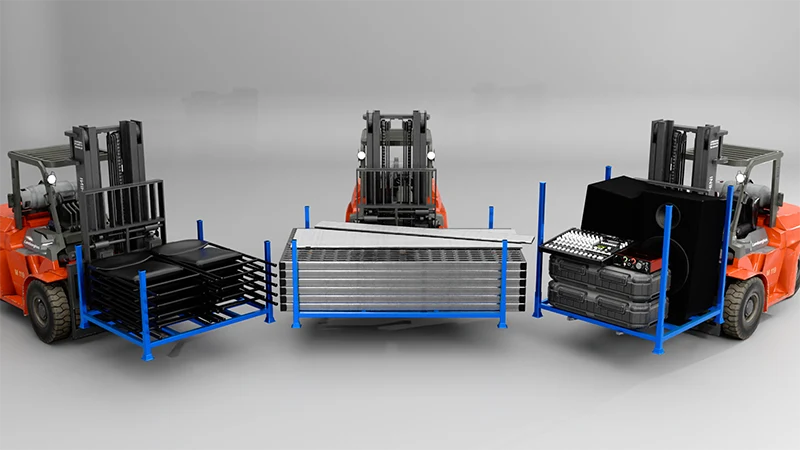

Every tire damaged by improper stacking is pure profit erased from your balance sheet. The pressure of “barrel stacking” causes irreversible bead deformation and flat-spotting, turning valuable inventory into costly scrap. It’s time to reclaim your warehouse space and protect your assets with a system designed for tires.
Galvanized vs Powder Coated Steel Stillages for Tires
For any tire warehouse manager, the challenge is constant: how to store a bulky, heavy, and compressible product without compromising its integrity. Traditional floor stacking, or “lacing,” is a recipe for disaster. While investing in pallet stillages is the clear solution to prevent product damage and maximize cubic space, a critical decision remains: which surface finish offers the best long-term value? The choice between a powder coated finish and a hot-dip galvanized one is not merely aesthetic; it’s a strategic decision that directly impacts your Total Cost of Ownership (TCO) and operational resilience.
The Root of the Problem: Why Laced Stacking Is Obsolete
In traditional tire warehousing, “lacing” or “barrel stacking” has been a common practice to save floor space. However, this method places the entire weight of the stack on the bottom layers of tires. The consequences are severe:
- Irreversible Bead Deformation: The immense pressure can permanently warp the tire bead, making it impossible to mount and seal on a rim. This is a primary cause for customer returns and warranty claims.
- Flat-Spotting: Tires left under load for extended periods can develop flat spots, leading to vibration and ride quality issues for the end-user.
- Operational Nightmare: Retrieving a specific SKU from the bottom of a 10-foot-high laced stack is a slow, labor-intensive, and dangerous process that kills productivity.
Steel tire pallets fundamentally solve this by creating an independent steel skeleton. The weight of each level is transferred through the vertical posts to the floor, not through the tires themselves. Your tires are simply stored, not crushed.

Choosing Your Armor: Powder Coat vs. Hot-Dip Galvanizing
Once you’ve decided on a steel rack system, the finish becomes the next crucial factor. This choice dictates the rack’s lifespan, durability, and suitability for your specific operational environment.
Powder Coated Steel Stillages: The Workhorse for Indoor Environments
Powder coating is an advanced painting process where a dry, free-flowing powder is applied electrostatically to the steel surface and then cured under heat to form a hard, durable “skin.”
- Pros: It offers a smooth, high-quality aesthetic finish and is available in various colors (like safety orange or your corporate branding). For strictly indoor, climate-controlled warehouses, it provides effective protection against minor scrapes and rust at a lower initial cost.
- Cons: The coating is a surface layer. A deep scratch or impact from a forklift tine can break this barrier, exposing the raw steel underneath. Once breached, moisture can creep under the coating, causing rust to spread unseen until the paint begins to flake and fail.
Hot-Dip Galvanized Stillages: The Ultimate Defense for All Conditions
Hot-dip galvanizing is an industrial process where the entire fabricated steel rack is submerged in a bath of molten zinc at approximately 840°F (450°C). This creates a metallurgical bond between the zinc and the steel.
- Pros: This is not just a coating; it’s a series of zinc-iron alloy layers that are harder than the base steel itself. It offers superior abrasion resistance. Crucially, it provides cathodic (sacrificial) protection. If the surface is deeply scratched, the surrounding zinc will corrode first, “healing” the wound and protecting the exposed steel. This makes galvanised stillages virtually rust-proof for decades, even in outdoor storage yards or damp, humid climates.
- Cons: The initial investment (CAPEX) is higher than for powder coating. The finish is a more industrial, matte gray appearance.
A Practical Decision Framework
Use this table to determine the best choice for your tire logistics operation:
| Decision Factor | Powder Coated | Hot-Dip Galvanized |
|---|---|---|
| Operational Environment | Best for clean, dry, indoor warehouses. Not recommended for outdoor or high-humidity areas. | Ideal for outdoor storage yards, damp climates, and any application demanding maximum longevity. |
| Durability & Abrasion Resistance | Good. Resists minor scuffs, but deep scratches from forklifts can compromise the coating and lead to rust. | Excellent. The alloy layers are harder than steel. Features “self-healing” properties to prevent rust at scratch points. |
| Upfront Cost (CAPEX) | Lower initial investment. | Higher initial investment. |
| Long-Term Cost (TCO) & Lifespan | Lower TCO in controlled environments. Lifespan of 5-10 years, depending on use and maintenance (touch-ups). | Significantly lower TCO over the asset’s life due to zero maintenance and a 20+ year lifespan. Higher resale value. |
Beyond the Finish: The Core Value of a Modern Tire Rack System
Regardless of your choice of finish, implementing a dedicated metal post pallet system delivers transformative benefits:
- Maximize Cube Utilization: Safely stack tires 4 or 5 levels high, effectively tripling or quadrupling your storage capacity within the same footprint.
- 100% SKU Selectivity: A forklift can directly access any rack at any time, slashing picking times and improving inventory accuracy.
- Flexibility Personified: These portable stacking pallet racks aren’t bolted to the floor. Reconfigure your warehouse layout in hours, not weeks, to adapt to seasonal inventory peaks.
- Drastically Reduced Damage: By eliminating load-bearing on the tires, you protect your inventory from the moment it arrives until it ships out, preserving its value and your reputation.

Ultimately, the decision between galvanized and powder coated steel stillages is a calculation of value versus cost. For a protected indoor setting, powder coating provides a cost-effective and reliable solution. For operations with outdoor storage, punishing environmental conditions, or a focus on maximum asset lifespan, hot-dip galvanizing is the undisputed champion, delivering peace of mind and superior long-term financial performance.
Frequently Asked Questions
1. Can these tire racks accommodate different sizes, like PCR and TBR tires?
Absolutely. Our heavy duty stack racks are engineered based on tire diameter and weight. We design specific models for smaller Passenger Car Radial (PCR) tires and more robust versions for heavy Truck and Bus Radial (TBR) tires to ensure a perfect, safe fit.
2. How much weight can a single tire stillage hold?
Standard capacity is typically between 2,000 to 4,000 lbs (approx. 900 to 1800 kg), but this is fully customizable. We design the base and post thickness based on your specific load requirements, especially for heavy commercial or OTR tires.
3. What do we do with the racks when they are empty?
Our racks are designed for efficient reverse logistics. The vertical posts are removable, allowing the empty bases to be nested or stacked compactly. This can reduce the storage space and return shipping cost of empty racks by up to 80%.
4. Is a hot-dip galvanized finish safe for long-term contact with rubber tires?
Yes. The zinc coating is inert and stable. It will not react with or degrade the rubber compound of the tires, ensuring they remain in pristine condition during storage.
5. How well does a powder coat finish stand up to daily forklift traffic?
High-quality powder coating is tough and designed for industrial use. It resists scuffs and minor impacts well. However, a direct, forceful impact from a forklift tine can chip it. While much more durable than simple spray paint, it does not have the “self-healing” properties of a galvanized finish when the steel is exposed.
Need a Custom Storage Solution?
Speak directly with our technical engineers. We offer free structural designs, heavy-duty catalog evaluations, and quick B2B price quotations.
Request a Quote Now →