Your saws and cutters are waiting. Your crew is wasting hours shuffling through tons of steel just to find the right bundle. There’s a safer, faster way to feed your operation and reclaim up to 50% of your floor space by eliminating the need for forklift aisles.
The High Cost of “Business as Usual” in a Steel Service Center
In the world of steel service centers and large-scale metal fabrication, speed and efficiency are everything. Yet, for many, the most significant bottleneck isn’t the cutting speed of their saws or plasma tables—it’s the chaotic and time-consuming process of getting the right material to them. Traditional storage methods, like floor stacking and standard fixed cantilever racks, create a “hidden factory” of waste that silently drains your profits.
Choked Workflow: The Vicious Cycle of Shuffling and Waiting
The scenario is all too familiar. A rush order comes in for a specific grade of 6-inch steel tubing. But the required bundle is buried under three others in a fixed rack. Your operator has to fire up the forklift or crane, carefully move tons of obstructive material out of the way (a process known as “secondary handling”), retrieve the target bundle, and then move everything back. This 20-minute search-and-shuffle operation precedes a 5-minute cutting job, leaving your multi-million dollar machinery—and your operator—idle and “starved” for material. This isn’t just inefficient; it’s a direct loss of production capacity.
The Forklift Bottleneck: A Constant Threat to Safety and Materials
Standard cantilever racks force a reliance on forklifts maneuvering in tight aisles. This “forklift-crane tango” is a major source of safety incidents and material damage. A moment’s inattention can lead to a collision, or worse, an injury. Furthermore, valuable stock like stainless steel bars or aluminum extrusions are easily scratched or dented by forks, potentially leading to costly rejections. The wide aisles required for forklifts—often 10-12 feet—are pure “dead space,” consuming valuable square footage that could be used for revenue-generating equipment.
A Fundamental Shift: From Static Storage to Dynamic Machine Feeding
A cantilever roll out racking system is engineered to solve these exact problems. It fundamentally redefines your storage area from a passive warehouse into an active, high-efficiency feeding station for your production line. The concept is simple but revolutionary: instead of taking a forklift to the material, the material is brought directly to your overhead crane.
100% Extension for Unobstructed Overhead Crane Access
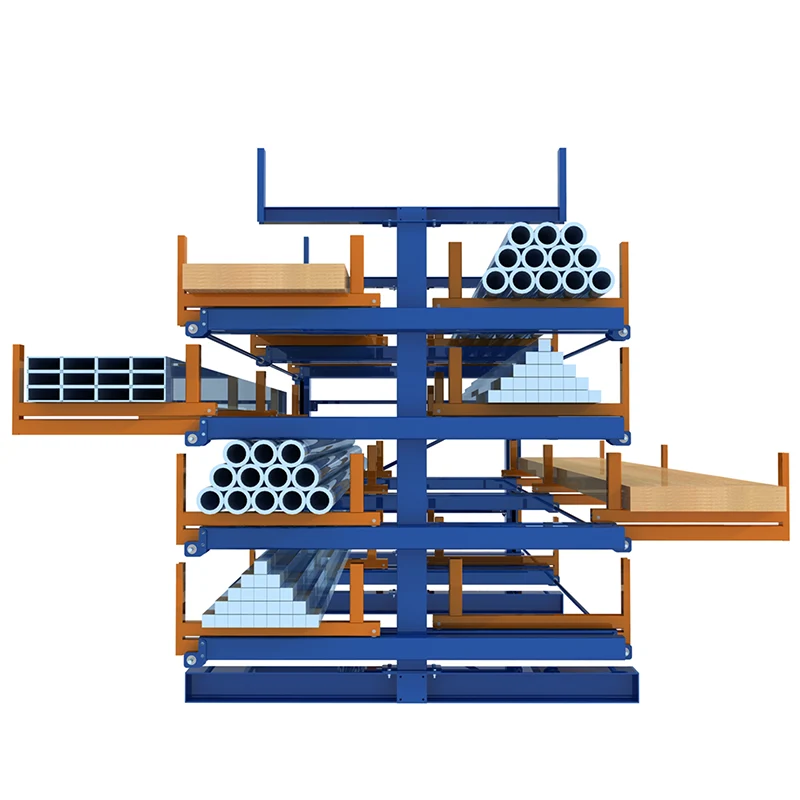
The core of the system is its ability for every single storage level to extend—or “roll out”—100% from the main structure, just like a heavy-duty drawer. This single feature is a game-changer. When a level is fully extended, the stored material (pipes, tubes, bar stock) is completely clear of the rack structure. Your overhead crane accessible racking allows you to perform a direct, vertical lift with slings or vacuum lifters. There are no obstructions, no visual blind spots, and no need to touch any other material. This eliminates secondary handling entirely.
Engineered for the Demands of a Steel Environment
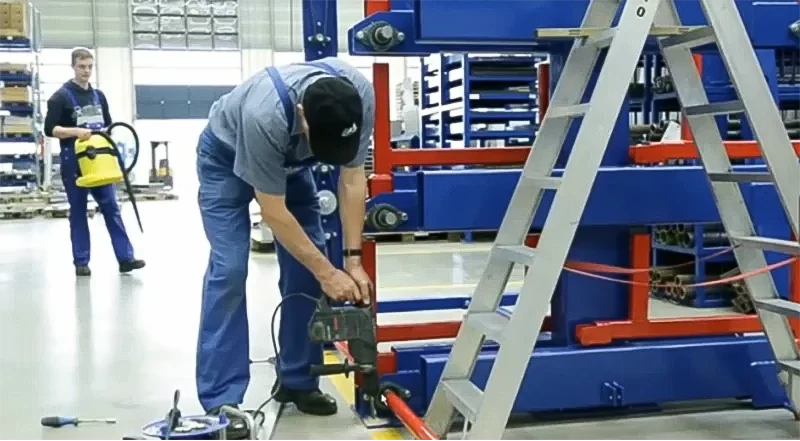
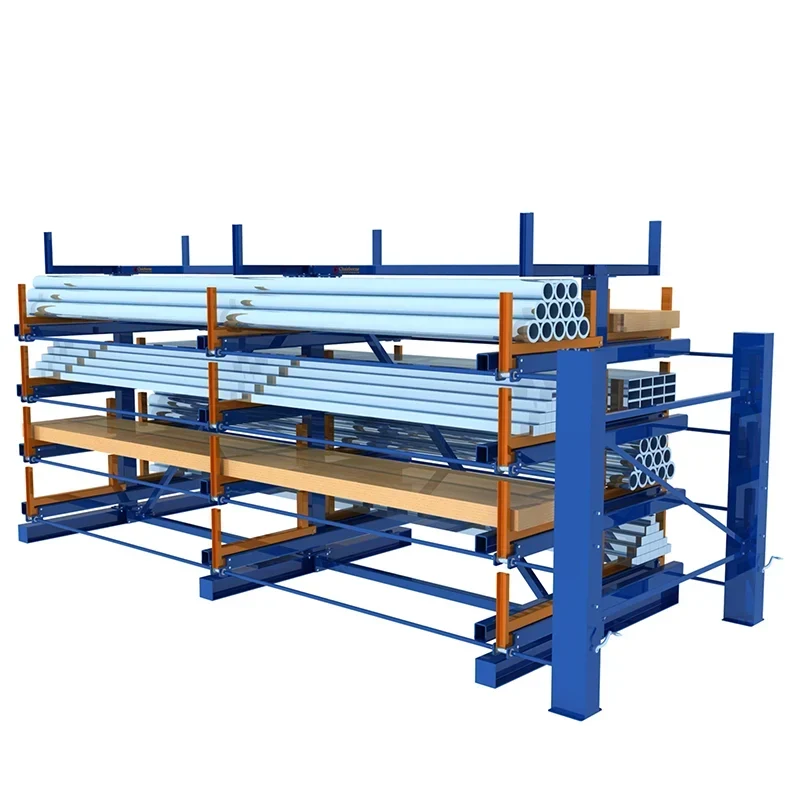
This isn’t light-duty shelving. The entire structure is built from heavy-duty steel. The foundation rests on massive H-beam steel profiles, providing a rock-solid base that prevents tipping even with multi-ton loads fully extended. All components are connected with high-strength bolts for structural integrity and are protected by a durable powder-coat finish. This surface treatment resists the rust, scrapes, and impacts common in any busy fabrication shop, ensuring a long service life with minimal maintenance.
The “After” Scenario: Measurable Gains in Productivity and Space
Implementing a roll-out racking system transforms your operations, delivering a clear and rapid return on investment through tangible improvements in efficiency, safety, and space utilization.
Slash Retrieval Times from 20 Minutes to 3
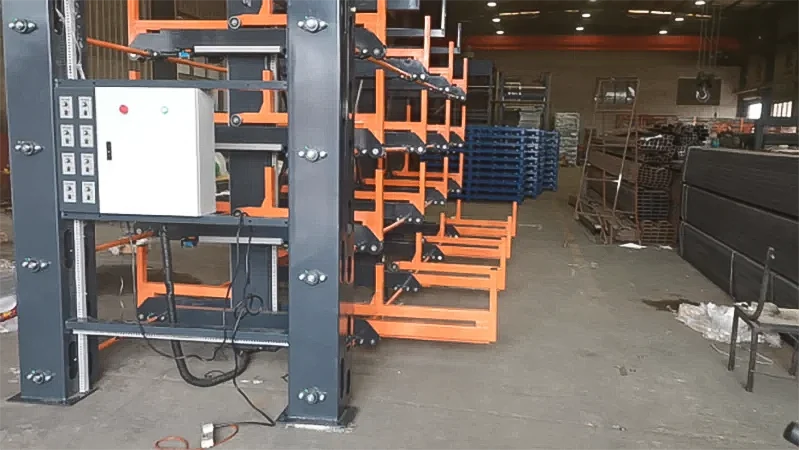
Imagine your operator receiving a work order. They walk to the control panel, press a button, and the correct level extends in seconds. Your overhead crane moves into position for a clean lift, and the material is at the saw in under 3 minutes. By slashing the average retrieval time from 20+ minutes down to just a few, you can recapture hundreds of hours of lost production time per year. This directly translates to increased machine uptime, higher throughput, and the ability to take on more jobs.
Reclaim Up to 50% of Your Floor Space
By eliminating the need for wide forklift aisles, you can achieve incredible storage density. A single back-to-back Extendable Cantilever Rack unit can replace two rows of traditional racks and the massive aisle between them. This frequently results in a 50% reduction in the footprint required for the same amount of pipe and tube storage. The 200 sq. ft. you just reclaimed can now house a new deburring station, a welding cell, or another value-adding machine—turning wasted space into a new revenue stream.
From Manual Strain to Remote-Controlled Safety
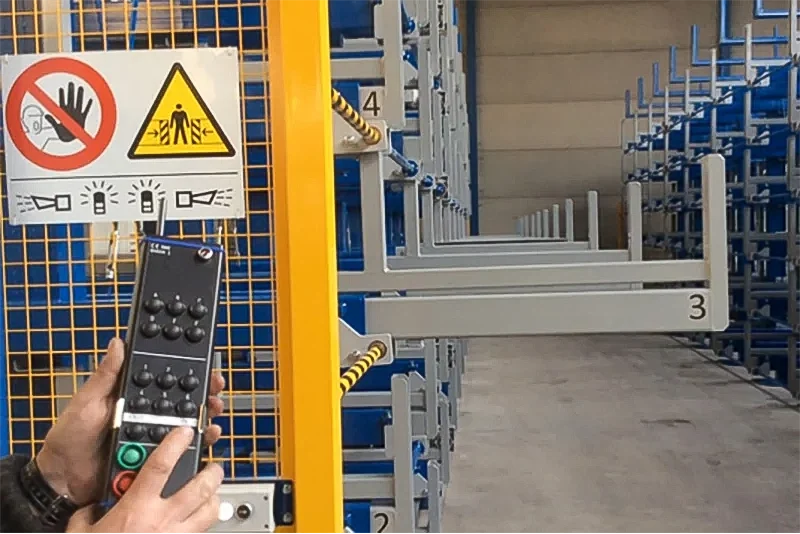
With an electric-powered system, a single operator can handle loads of up to 5 tons (11,000 lbs) with a simple handheld remote. This dramatically improves workplace ergonomics and safety. It provides for the safe storage of heavy pipes and tubes by removing the physical strain and risks associated with manual maneuvering or forklift operations in confined spaces. The operator has a clear line of sight, full control, and is kept out of harm’s way.
Tailored to Your Specific Stock and Workflow
No two steel service centers are identical. That’s why these systems are fully customizable to match your inventory and facility. Whether you need to handle 40-foot lengths of structural beams or small batches of specialty alloys, the solution can be tailored.
| Configuration | Single-sided for wall placement or double-sided for maximum density. |
| Drive System | Manual crank out cantilever rack for less frequent access or a fully motorized electric system for high-throughput operations. |
| Capacity | Load capacity per level is customizable from 1 to 5 tons (2,200 – 11,000 lbs). |
| Dimensions | Arm length, number of levels, and column spacing are all designed around your specific material sizes. |
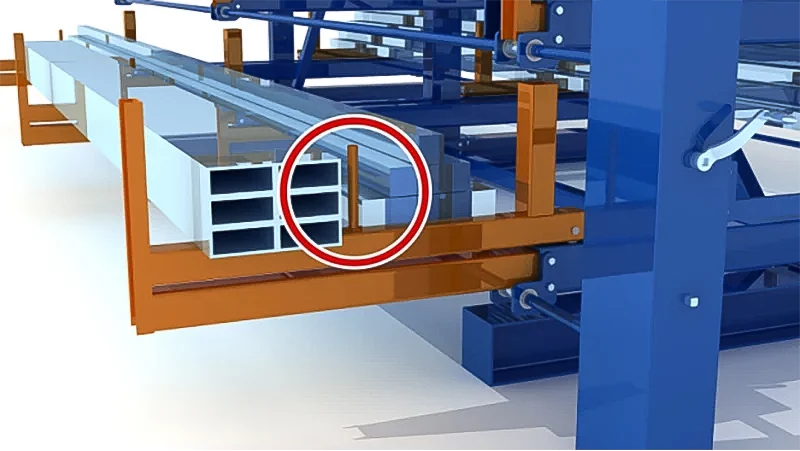
| Accessories | Optional dividers can be added to arms for organizing smaller batches or different SKUs on a single level, preventing material mixing. |
Frequently Asked Questions
1. How is this really different from the standard cantilever racks I already have?
The fundamental difference is the access method. Standard racks are static and require a forklift to maneuver within an aisle to access material. A roll-out rack is dynamic; it presents the material directly to your overhead crane in an open area. This eliminates the need for forklift aisles, stops the “secondary handling” of material, and is inherently safer.
2. My overhead crane is already busy. Won’t this system just add to its workload?
It actually makes your crane’s work far more efficient. Instead of the crane and a forklift operator spending 20 minutes shuffling material, the crane is now used for a single, precise 3-minute lift. It eliminates the most inefficient tasks, freeing up your crane and operator for value-added work like loading trucks or feeding machines.
3. What are the floor loading requirements? My concrete slab is old.
Due to the high storage density, floor loading is a critical consideration. As part of our consultation and design process, we provide detailed point-loading data based on your system’s final configuration and maximum capacity. We work with you to verify that your concrete slab meets these requirements to ensure safe, long-term operation.
4. We handle very long stock, like 40-foot bars. Can this system handle that?
Absolutely. The system is modular. For long materials, we simply design the rack with additional support columns spaced appropriately along its length. This ensures that long bars, pipes, or extrusions are fully supported without sagging or risk of damage, whether they are 20, 40, or 60 feet long.
5. How does the manual crank-out version perform with a heavy load, like 3 tons?
The manual systems are engineered with a high-efficiency gear and rack mechanism. This design provides significant mechanical advantage, allowing a single operator to smoothly and safely extend or retract a fully loaded, multi-ton level with minimal physical effort. It’s a highly effective and budget-friendly option for applications with lower access frequency.
Need a Custom Storage Solution?
Speak directly with our technical engineers. We offer free structural designs, heavy-duty catalog evaluations, and quick B2B price quotations.
Request a Quote Now →