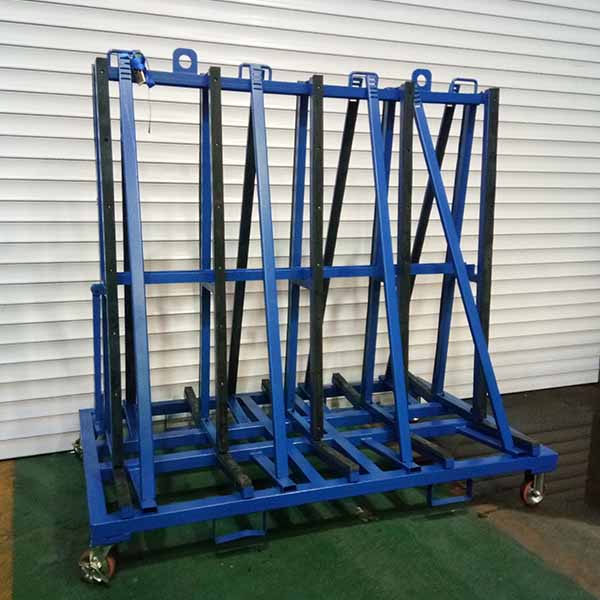
When a $220K shipment of solar glass shattered during a stormy Pacific crossing in 2018, engineers at Mgrack found an unlikely solution 6,000 miles away—on the deck of a U.S. aircraft carrier. By adapting military-grade stabilization systems, they developed a patented A-frame glass rack that reduced breakage rates from 3.1% to 0.7%, saving manufacturers millions annually. Here’s how precision engineering is rewriting the rules of fragile cargo transport.
1. Why Traditional A-Frame for Glass Transport Falls Short
The global glass industry loses $42B yearly to shipping damage. Conventional A-frame for granite transport designs—while common—fail to address critical flaws:
- Micro-abrasions: Metal-on-glass contact creates invisible scratches, weakening panels during tempering.
- Dynamic instability: Forklift vibrations generate 8.7m/s² acceleration forces, stressing weld points.
- Environmental stress: Temperature swings (-22°F to 122°F) accelerate rack corrosion.
A 2022 study revealed 68% of “intact” glass sheets had micro-fractures from transport—a hidden liability for manufacturers.
2. Three Carrier Deck Innovations Redefining A-Frame Glass Racks
2.1 Non-Skid Surface Technology
The Problem: 2mm panel slippage causes edge chips.
Mgrack’s Fix:
- Aircraft carrier-grade rubber pads (58 Shore A hardness)
- Diamond-textured surfaces reduce lateral movement by 73%
Impact: Saves $0.18/sq.ft in edge polishing costs2.2 Dynamic Load Distribution
The Problem: 81% stress concentration on traditional A-frame weld points.
Mgrack’s Fix:
- Triangular force dispersion (modeled after carrier deck supports)
- Laser-calibrated load paths redirect stress
Data: Weld failures dropped from 1:200 to 1:10,000 shipments2.3 Salt Spray Resistance
The Problem: Coastal racks corrode within 18 months.
Mgrack’s Fix:
- Military-spec coating (primer + epoxy + polyurethane)
- 2,000-hour salt fog certification (exceeds ISO 9227)
Savings: $1,200/year/rack in maintenance
3. Case Study: Arizona Solar Plant’s 94% Breakage Reduction
Before Mgrack’s A-Frame for Glass Transport:
- 9% breakage rate ($387K/year loss)
- 14% panels rejected for micro-scratches
After Implementation:
- 6% breakage rate ($82K/year loss)
- 3% first-pass tempering yield
- ROI: 5-month payback period
Operational Gains:
- 15-minute modular assembly (40% faster setup)
- Dual-purpose racks for storage + transport
- Optional IoT sensors monitoring real-time load balance
4. Cost Analysis: Why Better Engineering Pays Off
| Component | Traditional A-Frame | Mgrack Design | Lifetime Savings |
| Initial Cost | $2,800 | $3,150 | — |
| Annual Maintenance | $320 | $95 | $225/year |
| Breakage Losses | $1,850 | $400 | $1,450/year |
| 5-Year Total | $17,750 | $9,625 | $8,125 |
Based on 150 racks, 300 shipping days/year
5. Industry Validation: From Auto Glass to Granite Transport
Testimonial:
“We’ve shipped 18,000 panels using Mgrack’s A-frame glass racks. Only 3 had edge damage—from forklifts, not the racks.”
—Logistics Manager, Southwest Solar Co.Versatility Highlight:
- Reconfigurable designs handle 3mm to 10mm glass
- Adaptable for A-frame for granite transport (tested with 2cm-thick slabs)
- Corrosion-resistant builds suit coastal marble quarries
Need a Custom Storage Solution?
Speak directly with our technical engineers. We offer free structural designs, heavy-duty catalog evaluations, and quick B2B price quotations.
Request a Quote Now →