
When selecting industrial equipment, material choice is paramount. You might be looking at a robust trolley and wondering about its composition, specifically if it’s made from 201 or the more premium 304 stainless steel for corrosion resistance. However, the optimal material for a heavy-duty industrial environment is often determined by a balance of strength, durability, and specialized surface protection rather than the base metal alone. This article clarifies the material science behind our industrial trolley, revealing why a different, more strategic choice was made to maximize performance in warehouses and workshops.
The Critical Question: 201 vs. 304 Stainless Steel in Industrial Carts
In the world of metals, the distinction between 201 and 304 stainless steel is significant, especially concerning corrosion resistance and cost. Grade 304 stainless steel is the industry standard for food-grade applications, medical equipment, and environments with high exposure to moisture or chemicals due to its higher nickel and chromium content. Grade 201 is a lower-cost alternative with less nickel, making it strong but more susceptible to rust over time, particularly in harsh conditions. For buyers of industrial equipment, asking this question is a valid shortcut to assessing long-term durability.
The Definitive Answer: A Purpose-Built Solution with Q235 Carbon Steel
While the question about stainless steel is common, this specific 2 tier utility cart is not made from either 201 or 304 stainless steel. Instead, it is constructed from Q235 high-quality carbon structural steel. This is a deliberate engineering decision based on the primary demands of its intended applications: heavy-duty industrial workshops, automotive parts distribution, and high-frequency order-picking warehouses.
Engineered for Impact Resistance and Heavy Loads
The primary requirement in an industrial setting is not just resisting rust, but withstanding constant, heavy use. Q235 steel offers superior toughness and weldability. In environments where the trolley might be bumped by a pallet jack or loaded with heavy, sharp-edged metal components, Q235 provides excellent plastic deformation properties. It will dent or bend under extreme impact rather than crack or fracture like a more brittle material might. This structural integrity is essential to support its verified 600 kg load capacity. Finite element analysis (ANSYS testing) confirms that even under a full 600 kg load, the maximum stress on the frame (214 Mpa) remains well below the material’s yield strength, ensuring long-term structural reliability without fatigue.

The Advanced Shield: A Multi-Stage Surface Treatment
The main drawback of carbon steel—its susceptibility to rust—is comprehensively neutralized by a meticulous, multi-stage surface treatment process that goes far beyond a simple layer of paint. This process is what gives the trolley its robust defense against the rigors of the workshop floor.
- Acid Pickling & Phosphating: Before any coating is applied, the entire steel frame undergoes acid pickling to remove all mill scale and surface impurities. This is followed by phosphating, a chemical process that creates a micro-crystalline conversion layer on the steel’s surface. This phosphate layer dramatically increases surface area and chemical bonding, ensuring unparalleled adhesion for the final coating.
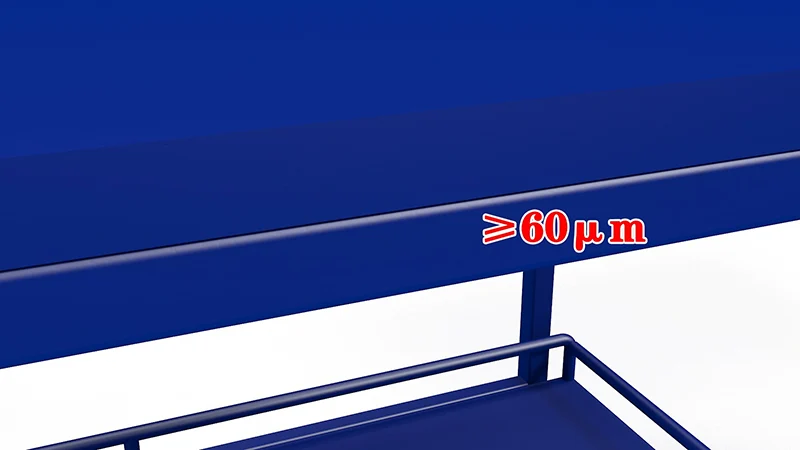
- Electrostatic Powder Coating: The trolley is then treated with an electrostatic spray, applying a dry powder that clings to the metal surface. When baked, this powder melts and fuses into a thick, uniform, and incredibly durable shell. This coating measures 60μm or more in thickness, creating a hard barrier that is highly resistant to scratches, chipping, chemicals, and corrosion.

Q235 Carbon Steel vs. Stainless Steel: A Practical Comparison
Choosing the right material involves trade-offs. For a 2 tier order picking trolley, the combination of Q235 steel and advanced powder coating provides the optimal blend of performance and value for its target environment.
| Attribute | Powder-Coated Q235 Carbon Steel | 304 Stainless Steel | 201 Stainless Steel |
|---|---|---|---|
| Impact Resistance | Excellent (High toughness, deforms before breaking) | Good | Good (More brittle than Q235) |
| Corrosion Resistance | Excellent (Relies on the integrity of the thick powder coating) | Excellent (Inherent property of the metal alloy) | Fair (Prone to pitting and crevice corrosion over time) |
| Cost-Effectiveness | Excellent (Provides premium performance at a lower material cost) | Low (Significantly more expensive) | Moderate |
| Ideal Application | Industrial workshops, warehouses, logistics, automotive parts centers | Food service, medical labs, cleanrooms, marine environments | Decorative applications, dry indoor environments |
When is Stainless Steel the Right Choice?
To be clear, stainless steel is an exceptional material, and it is the only correct choice for certain applications. In industries where sanitation is paramount—such as commercial kitchens, pharmaceutical manufacturing, or laboratories—the non-porous and inherently anti-corrosive surface of 304 stainless steel is non-negotiable. It can withstand harsh cleaning agents and high-temperature sterilization without degrading. For these use cases, the extra cost is justified by regulatory compliance and safety requirements.
Conclusion: The Right Material for the Demands of the Job
The industrial 2 tier platform trolley is a product of purpose-driven design. It is built with Q235 carbon steel not as a compromise, but as a strategic choice to deliver maximum mechanical strength and impact durability. This robust foundation is then protected by an advanced, multi-layer surface treatment that provides outstanding resistance to the wear and tear of an industrial environment. The result is a trolley that offers the resilience needed for heavy-duty work, ensuring a long service life and reliable performance where it matters most.
Frequently Asked Questions
1. What exactly is Q235 steel?
Q235 is a widely used carbon structural steel with a yield strength of 235 Mpa. It is known for its excellent balance of strength, toughness, and weldability, making it an ideal choice for manufacturing durable frames and structures like this heavy-duty trolley.
2. How does the powder coating protect the trolley from rust?
The electrostatic powder coating creates a thick, non-porous plastic barrier that completely seals the steel from oxygen and moisture, the two elements required for rust to form. The pre-treatment process of pickling and phosphating ensures this coating adheres so strongly that it resists chipping and scratching, maintaining the integrity of the protective seal even with rough handling.
3. Is this trolley suitable for outdoor use?
While the powder coating offers excellent weather resistance for temporary or occasional outdoor use, the trolley is primarily designed for indoor industrial environments. Continuous, long-term exposure to direct rain and sun may eventually degrade the coating. For permanently outdoor applications, a hot-dip galvanized or stainless steel product would be more suitable.
4. With a carbon steel frame, how can it achieve a 600 kg capacity?
The 600 kg capacity is a result of smart engineering design, not just material choice. It is achieved through the use of strong 30×30×1.5 mm rectangular tubing, professional-grade MIG/MAG welding that creates joints stronger than the base metal, and a structural design validated by computer stress analysis (ANSYS) to handle the specified load with a significant safety margin.
5. Why not use a cheaper paint instead of powder coating?
Traditional wet paint provides a much thinner, less durable layer of protection. It is prone to chipping, scratching, and peeling, which would expose the carbon steel underneath to corrosion. Powder coating is a superior industrial finish that is thermally bonded to the metal, making it far more resistant to impact, abrasion, and chemicals found in a workshop or warehouse.
Need a Custom Storage Solution?
Speak directly with our technical engineers. We offer free structural designs, heavy-duty catalog evaluations, and quick B2B price quotations.
Request a Quote Now →