
The question of whether trolleys can withstand outdoor elements goes beyond a simple material choice. It involves understanding the interplay between structural engineering, surface science, and the specific demands of your operational environment. While stainless steel is a common answer, a more robust and cost-effective solution often lies in advanced industrial coatings on high-tensile carbon steel, designed for durability against both weather and mechanical stress.
Understanding Outdoor Durability for Industrial Trolleys
The straightforward answer is yes, certain trolleys can be used outdoors. The primary candidate for this application is stainless steel, renowned for its inherent corrosion resistance. This property comes from the chromium content in the alloy, which forms a passive, self-healing layer of chromium oxide on the surface. This layer prevents oxygen and water from reaching the iron underneath, effectively stopping rust before it starts. For environments with saltwater exposure, such as coastal areas, a higher grade like 316 stainless steel is often necessary due to its enhanced resistance to chlorides.
However, relying solely on stainless steel overlooks a critical aspect of industrial use: mechanical resilience and cost-effectiveness. In many B2B environments like manufacturing plants, distribution yards, and automotive service centers, trolleys face not just rain, but also impacts, abrasion, and chemical spills. This is where the engineering of the entire system, particularly the surface treatment, becomes the deciding factor in a trolley’s lifespan and performance.
Beyond Material: The Critical Role of Industrial Surface Treatment
An alternative approach, offering exceptional durability for most outdoor and harsh industrial settings, is using a robust substrate like Q235 carbon structural steel and protecting it with a multi-stage, industrial-grade surface treatment. This method creates a trolley that is not only weather-resistant but also tougher and more resistant to the physical demands of daily work.
The Science of a Multi-Layer Defense
A high-performance finish isn’t just a layer of paint. It’s a systematic process designed to create a permanent bond between the steel and a protective barrier. This process involves several crucial steps:
- Preparation (Pickling & Phosphating): Before any coating is applied, the raw steel frame undergoes chemical treatments. Acid pickling removes any surface rust or mill scale. This is followed by phosphating, which microscopically etches the steel surface and deposits a layer of phosphate crystals. This conversion coating is vital as it provides a clean, stable foundation that dramatically increases the adhesion of the final topcoat.
- Application (Electrostatic Spraying): The trolley frame is then treated with an electrostatic spray, also known as powder coating. A dry powder polymer is given an electrostatic charge and sprayed onto the grounded steel part. This charge causes the powder to wrap around and adhere evenly to all surfaces, even complex shapes.
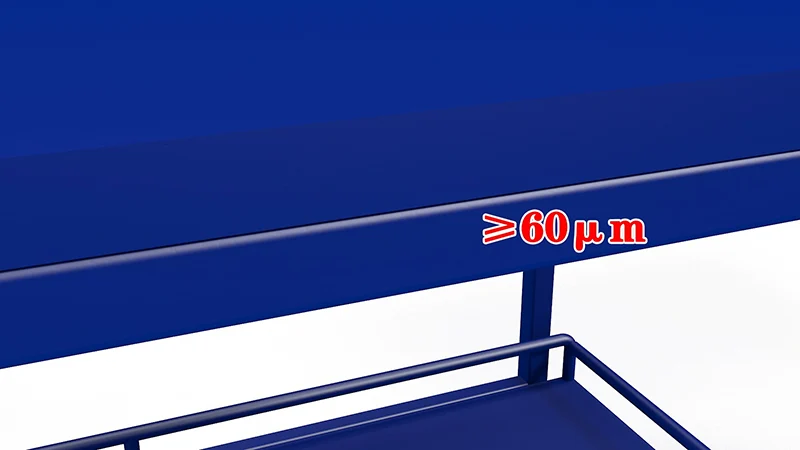
- Curing: The coated part is baked in an industrial oven. The heat melts the powder, causing it to flow into a smooth, continuous film that cures into a hard, durable finish. An industrial standard coating thickness of 60μm or more ensures a substantial barrier against the elements.

This cured powder coat is significantly tougher than conventional liquid paint. It provides superior resistance to chipping, scratching, fading, and chemical corrosion from oils or cleaning agents often found in industrial yards.
Engineered for Real-World Outdoor Challenges
A trolley’s ability to perform outdoors depends on more than just its rust resistance. The entire structure must be designed to handle the unpredictable nature of outdoor surfaces and workloads.
Structural Integrity Under Dynamic Loads
Outdoor surfaces are rarely perfectly smooth. Navigating over cracked pavement, expansion joints, or gravel puts immense stress on a trolley’s frame. A fully welded structure, often using CO2 gas shielded welding (MIG/MAG), offers far greater rigidity and durability than a bolted frame. This technique creates weld seams that are often stronger than the parent metal, ensuring the frame remains square and stable even when transporting heavy loads, like the 600 kg capacity of an industrial-grade trolley.
Mobility and Stability on Uneven Terrain
The choice of casters is paramount for outdoor use. High-strength polyurethane (PU) casters offer an ideal balance of properties:
- Shock Absorption: The inherent elasticity of PU material helps to dampen vibrations from rough surfaces, protecting both the trolley’s contents and its welded joints from fatigue over time.
- Durability: PU wheels are highly resistant to abrasion, tearing, and chemical degradation from contact with oils or solvents.
- Quiet Operation: Unlike hard nylon or steel wheels, PU casters run quietly, reducing noise pollution in the workplace.

Making the Right Choice: A Comparative View
To select the best trolley for your application, consider how different options stack up against key performance indicators for outdoor and industrial use.
| Evaluation Dimension | Standard Stainless Steel | Powder-Coated Q235 Steel | Standard Painted Steel | Plastic Utility Cart |
|---|---|---|---|---|
| Corrosion Resistance | Excellent (Inherent) | Very Good (Barrier) | Poor to Fair (Scratches easily) | Excellent (Cannot rust) |
| Impact & Abrasion Resistance | Good | Excellent | Poor | Fair (Can crack or shatter) |
| Load Capacity | High | Very High (e.g., 600 kg) | Medium to High | Low (e.g., 150 kg) |
| Cost-Effectiveness | Low | Very Good | Excellent (Initial Cost) | Good |
Conclusion: A Holistic Approach to Outdoor Equipment
While stainless steel trolleys are a viable option for outdoor use, they are not the only solution, nor always the best one. For demanding industrial applications, a systems-based approach is superior. An engineered trolley built from high-strength carbon steel, protected by a professionally applied powder coating, and equipped with durable PU casters offers a compelling combination of weather resistance, mechanical strength, and long-term value. This approach ensures your equipment is built not just to survive the outdoors, but to thrive in the dynamic, challenging environment of your daily operations.
Frequently Asked Questions
1. What is the main difference between 304 and 316 stainless steel for trolleys?
The primary difference is the addition of molybdenum in 316 stainless steel. This element significantly enhances its resistance to corrosion from chlorides, such as saltwater or de-icing salts. While 304 is suitable for general outdoor use, 316 is the preferred choice for marine, coastal, or chemical processing environments.
2. How does powder coating protect a steel trolley from rust?
Powder coating creates a durable, non-porous polymer barrier that completely seals the steel surface from oxygen and moisture, the two key elements required for rust (iron oxide) to form. The electrostatic application and thermal curing process create a much thicker and more resilient shield than traditional paint, which is more susceptible to scratching and chipping that expose the underlying metal.
3. Are PU (polyurethane) casters suitable for rough outdoor surfaces like asphalt?
Yes, PU casters are an excellent choice for surfaces like asphalt and concrete. Their slight elasticity allows them to absorb shocks and roll smoothly over minor imperfections and debris. They are also highly resistant to the type of abrasion and wear that rough surfaces can inflict, giving them a longer service life than softer rubber wheels in such conditions.
4. Can a powder-coated trolley be used in a coastal or salty environment?
While an industrial powder coat offers significant protection, a constant salt spray environment is one of the most corrosive conditions possible. For these specific applications, 316-grade stainless steel is generally the most reliable long-term solution. A powder-coated trolley could be used, but it would require regular freshwater rinsing and diligent inspection for any breaches in the coating to prevent underlying corrosion.
5. How does the load capacity of a carbon steel trolley compare to a stainless steel one?
Structurally, Q235 carbon steel and 304 stainless steel have similar tensile strengths. Therefore, if two trolleys are built to the same design specifications (tube thickness, weld quality, etc.), their load capacities will be nearly identical. The choice between them is typically based on corrosion resistance and cost, not on inherent strength for a given design.
Need a Custom Storage Solution?
Speak directly with our technical engineers. We offer free structural designs, heavy-duty catalog evaluations, and quick B2B price quotations.
Request a Quote Now →