
Your warehouse floor is maxed out, but your ceiling is empty. Traditional floor stacking is crushing your profits by damaging the very tires you sell. The endless cycle of manual restacking to find a specific SKU isn’t just slow—it’s a direct hit to your bottom line and a major safety hazard. There is a more profitable way to use your existing space.
The Hidden Costs of “Pyramid” and “Laced” Tire Stacking
In the tire industry, floor space is a constant battle. The default method—interlacing tires in a “barrel stack” or weaving them into a pyramid—seems like a space-saver at first glance. However, this approach silently drains your profitability. Tires are not designed to be load-bearing structures. When you stack them 10-15 feet high, the bottom layers bear immense weight from multiple angles, leading to two critical, irreversible types of damage:
- Bead Deformation: The immense pressure warps the tire bead, the critical edge that seals to the wheel rim. A deformed bead can lead to mounting difficulties and improper sealing, rendering a brand-new tire unsellable.
- Flat-Spotting: The weight causes the tire’s sidewall and tread to develop permanent flat spots. This directly impacts the tire’s dynamic balance, leading to vibrations and ride-quality complaints from customers.
Beyond direct product loss, this method creates operational chaos. Need to retrieve a specific set of winter tires from the bottom of a stack? Your team must manually handle hundreds of heavy tires, a time-consuming and high-risk task for back injuries. This is not efficient warehousing; it’s a daily logistical nightmare.

A Structural Shift: From “Goods as Support” to “Rack as Support”
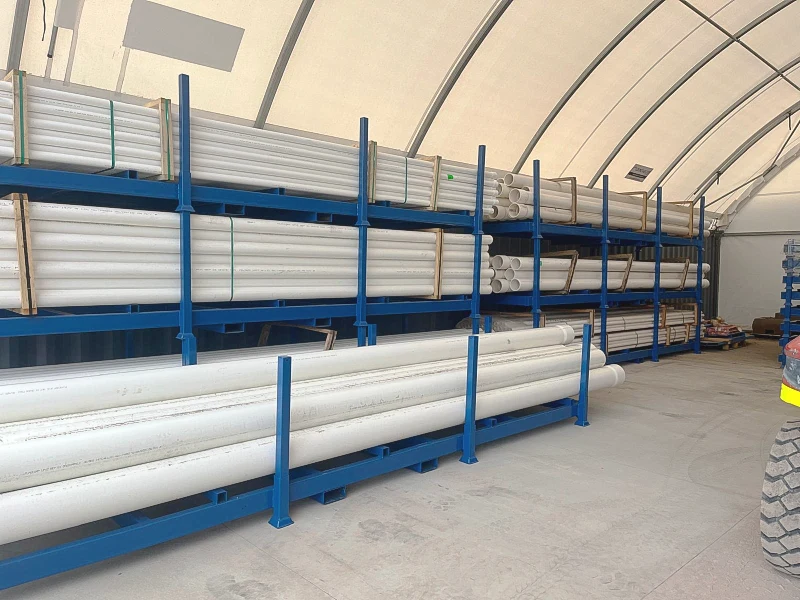
The solution is to fundamentally change the load-bearing logic. Instead of letting your valuable inventory support the weight, you introduce a dedicated steel skeleton. This is the principle behind the Derack system—a network of modular, portable stack racks that function as individual, moveable columns of a high-density warehouse.
Here’s how it directly solves the tire industry’s core challenges:
- Zero Compression: Each set of tires rests on a steel base. The weight of the layer above is transferred through solid steel posts directly to the floor. The tire at the bottom of a 5-high stack experiences zero pressure, completely eliminating the risk of bead deformation and flat-spotting.
- Density Without Damage: These industrial stacking racks allow you to safely go vertical, stacking 4 or 5 units high. This transforms your warehouse from a single-level floor plan into a multi-story storage cube, increasing your storage capacity by up to 400% within the same square footage.
- 100% Selectivity: Every single rack is an independent unit accessible by a forklift. There’s no more “digging” for product. You can pick any tire pallet, from any level, at any time. This drastically speeds up order fulfillment and simplifies inventory management, boosting accuracy from 85% in floor stacks to over 99%.
Engineered for All Tires: From PCR to Heavy-Duty TBR
A one-size-fits-all approach doesn’t work for tires. A passenger car tire (PCR) has vastly different dimensions and weight than a heavy truck or bus tire (TBR). A truly effective system must be engineered to handle this diversity. Our heavy duty stack racks are designed with specific geometries in mind:
- PCR Racks: Optimized widths and depths to hold passenger tires snugly, preventing them from shifting during transit.
- TBR Racks: Built with a reinforced base and larger-gauge steel posts to safely handle the extreme weight and diameter of commercial tires, often weighing hundreds of pounds each.
This specialized design ensures that no matter your product mix, you achieve the maximum storage density safely. The open framework also improves fire safety, allowing sprinkler systems to penetrate the stack, a critical advantage over solid, dense piles of rubber.

Beyond Storage: Optimizing Your Entire Supply Chain
These pallet stillages are not just static storage—they are a key component of a dynamic, returnable logistics system. The posts are fully removable. When a rack is empty, the posts can be stored on the base, and the bases can be “nested” or stacked together.
What does this mean for your operations?
- Reduced Return Freight Costs: Instead of shipping empty air back from a distribution center or customer, you can fit 4 to 6 nested empty racks in the space of one fully assembled one. This slashes your reverse logistics costs by up to 80%, making a returnable packaging program economically viable.
- Reduced Handling, Reduced Damage: Tires can be loaded into the rack at the manufacturing plant and stay in that same rack through the warehouse, onto the truck, and all the way to the regional distribution center. This unitized handling approach means fewer touchpoints, less labor, and a near-zero rate of handling-related damage.

Frequently Asked Questions
1. Can these racks handle the weight of large off-road or agricultural tires?
Absolutely. We design and manufacture heavy duty stack racks specifically for OTR, agricultural, and TBR applications. The load capacity can be engineered to your specifications, often exceeding 4,000 lbs per rack, by using thicker gauge steel and reinforced base structures.
2. How do stack racks improve warehouse safety compared to floor stacking?
They improve safety in several ways. First, they create stable, engineered stacks that eliminate the risk of tire pile collapses. Second, they allow forklifts to do all the heavy lifting, drastically reducing manual handling and the associated risk of musculoskeletal injuries. Finally, their open design improves visibility for forklift operators and allows for better coverage by fire suppression systems.
3. Do we need special forklift attachments to use these racks?
No. Our portable stack racks are designed with standard 4-way or 2-way fork pockets compatible with virtually all standard counterbalance or reach truck forklifts. The cup feet on top of the posts act as a guide, making stacking safe and easy for trained operators.
4. What is the lifespan of a steel tire rack compared to a wooden pallet?
There is no comparison. A wooden pallet might last for 10-15 trips before it splinters, cracks, or becomes unsafe. Our powder-coated or hot-dip galvanized steel racks are built to withstand harsh industrial environments for over 15-20 years. The total cost of ownership is significantly lower, and they retain a high scrap value at the end of their life.
5. Our warehouse layout changes seasonally. Are these a good fit?
They are the perfect fit. Unlike bolted-down pallet racking, these are portable stack racks. When your inventory levels are low during the off-season, you can nest the empty racks and consolidate them in a small corner, freeing up valuable floor space for other operations like cross-docking or quality inspection. This flexibility is impossible with fixed racking systems.
Need a Custom Storage Solution?
Speak directly with our technical engineers. We offer free structural designs, heavy-duty catalog evaluations, and quick B2B price quotations.
Request a Quote Now →