
|
Is your shop floor a bottleneck between the CNC cutting table and the tempering furnace? Are you losing valuable production time waiting for a forklift to move the next batch of glass? Every minute your multi-million dollar machinery sits idle is a direct hit to your bottom line. It’s time to stop the waiting and eliminate the risk of damage to your Work-in-Progress. |
From Production Choke Points to a Lean Glass Workflow
In any modern glass factory storage system, the most significant hidden costs don’t come from the big machines, but from the inefficient spaces between them. The journey a piece of glass takes from the cutting table, to the edging machine, and finally to the glass tempering furnace is fraught with risk. Delays, handling damage, and inefficient use of space create a drag on your entire operation. A well-designed Work-in-Progress (WIP) storage strategy transforms these chaotic transfer zones into a streamlined, value-adding part of your production line.
Unlocking Flow: The Mobile WIP Warehouse
The core problem is over-reliance on shared equipment like forklifts and overhead cranes for short-distance material transfers. When an operator at the CNC glass cutting table has to wait 10 minutes for a forklift to become available, your production schedule suffers. This is where a dedicated mobile solution becomes essential.
The Before: Static & Dependent
Cut glass sheets pile up, creating a safety hazard and a high-risk environment for scratches or chipped edges. Your team is forced to wait, breaking their workflow rhythm. The entire pace of production is dictated by the availability of heavy lifting equipment, not the capacity of your processing machines.
The Logic: Empowering the Operator
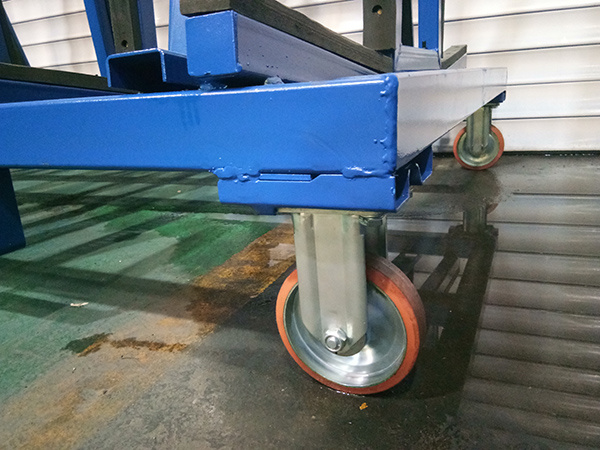
By introducing a heavy-duty a frame trolley, you create a “mobile WIP warehouse.” These carts are specifically engineered for the shop floor environment. Equipped with heavy-duty Polyurethane casters, they can be moved effortlessly by a single person without waiting for a forklift, and without damaging your concrete floors. The A-frame design provides a stable, high-density storage solution that can be positioned directly at the offloading point of one machine and then wheeled to the loading point of the next.

The After: Continuous & Efficient
The moment a piece of glass is cut, it’s placed onto a mobile cart. Once the job is complete, the cart is immediately pushed to the next station, such as the Automatic Glass Edging Machine. There are no delays. This creates a seamless, predictable flow of materials, allowing your high-value machinery to operate at its maximum potential. You’ve effectively decoupled short-distance workshop material handling from the constraints of your heavy equipment schedule.
Protecting High-Value Glass at Every Touchpoint
The financial stakes increase dramatically as glass moves through the value stream. A scratch on a raw float glass sheet is one thing; a scratch on a complex, multi-layered Low-E Insulated Glass Unit (IGU) destined for an architectural project is a catastrophic failure. The cost of that single scrapped unit can easily exceed the cost of the rack meant to protect it.
Your WIP storage solution must be more than just a conveyance; it must be a protection system. Our A-frame racks are designed with this in mind:
- Protective Surfaces: All contact points are lined with industrial-grade rubber strips. This soft-but-durable surface is critical for preventing scratches on sensitive Low-E coatings or damage to the edges of tempered glass.

- Secure Fastening: Relying on gravity alone is not enough. Our racks feature two essential securing systems. Adjustable ratchet belts firmly press the glass lites against the frame, eliminating shifting during movement. For added security, robust steel limit rods provide a rigid external barrier, preventing any possibility of tipping.

|

|
This dual-system approach ensures that whether you are moving heavy laminated glass or delicate coated panels, your assets are completely immobilized and protected, creating a safe buffer zone right before they enter your most critical production lines.
A Fully Integrated Handling System
While operator-led mobility is key for WIP, a truly effective system must integrate with your existing infrastructure. Our designs incorporate universal handling interfaces. Standardized forklift slots allow for safe and quick movement of fully loaded racks over longer distances, while integrated, load-rated lifting rings (eyebolts) are designed for use with your overhead crane, providing maximum flexibility for your entire glass sheet transport workflow.

By implementing a dedicated WIP storage solution, you’re not just buying a piece of equipment. You are investing in operational velocity, asset protection, and a safer, more organized shop floor. You are building a factory environment where your machines—and your people—can perform at their best.
Frequently Asked Questions
1. What is the typical load capacity for these mobile glass A-frame trolleys?
Our standard mobile WIP trolleys are engineered to handle significant loads, typically ranging from 2,200 Lbs to 4,400 Lbs (approx. 1000 to 2000 kgs). We also design heavy-duty versions for specialized applications, such as moving thick laminated or bullet-resistant glass, with capacities tailored to your specific needs.
2. How do your racks specifically protect coated glass like Low-E?
The key is the material at the point of contact. We use non-staining, industrial-grade rubber compound on all surfaces that touch the glass. This material is soft enough to not abrade the sensitive metallic oxide coatings on Low-E glass, yet durable enough to withstand the weight and sharp edges of glass sheets, preventing costly scratches.
3. Can these mobile racks be safely used in the high-temperature environment near a tempering furnace?
Yes. The racks are constructed from high-grade Q235 carbon steel and feature heavy-duty polyurethane or nylon casters, all of which can withstand the ambient heat in the staging areas of a glass tempering furnace. They are designed to act as a safe and stable “buffer” for glass lites waiting to be loaded.
4. Your documentation mentions a “Full Welding Process.” How does this differ from cheaper racks?
Full-seam welding is a critical safety feature. We weld continuously along the entire joint of two steel parts, making the joint as strong as the steel itself. Cheaper alternatives often use “tack welding” or “spot welding,” which are just small, spaced-out welds. Under the dynamic stress of moving a heavy, top-heavy load of glass, these tack welds can tear, leading to a catastrophic structural failure and immense safety risk.
5. How does using a mobile rack improve worker safety compared to a forklift for in-shop moves?
Using a mobile rack for short-distance WIP transfers significantly reduces forklift traffic on a busy shop floor, which is a leading cause of workplace accidents. It gives the operator direct, low-speed control over the material, eliminating the blind spots and powerful forces associated with forklifts. This creates a more predictable and safer environment for everyone working around the production line.
Need a Custom Storage Solution?
Speak directly with our technical engineers. We offer free structural designs, heavy-duty catalog evaluations, and quick B2B price quotations.
Request a Quote Now →