
The Real Costs Hiding in Your Window and Door Logistics
For window and door manufacturers, the journey from the factory floor to the job site is fraught with hidden operational costs. Standard A-frame racks or non-collapsible transport solutions create significant financial drag, not just in transit but also within your own facility. These inefficiencies manifest in three critical areas: return freight, warehouse space, and product integrity.
The “Shipping Air” Problem: Paying to Return Empty Racks
The most significant and often overlooked expense is reverse logistics. A standard, welded window transport rack occupies the same truck or container space whether it’s full or empty. This means your business is paying freight costs to “ship air” on every return trip. For operations involving closed-loop logistics—where racks are sent to distribution centers, large construction sites, or export clients and then recovered—this cost multiplies rapidly, directly impacting your bottom line.
Warehouse Gridlock: When Floor Space Limits Your Output
In a busy fabrication facility, floor space is premium real estate. Bulky, non-stackable racks create warehouse gridlock, limiting staging areas and disrupting workflow. When racks cannot be safely stacked while fully loaded, you are restricted to single-level storage. This forces you to either rent more warehouse space or artificially cap your production throughput to match your storage footprint. The result is a direct constraint on your ability to scale.

Asset Damage: The True Cost of Inadequate Protection
Windows, glass panels, and finished doors are high-value, fragile assets. A scratch, chip, or crack during storage or transport isn’t just a material loss; it represents lost labor, production time, and potential project delays. Racks with inadequate protection, such as simple wood slats or unreinforced rubber, fail under the stress of heavy loads and road vibration. The cost of a single damaged high-performance insulated glass unit (IGU) can easily exceed the cost of the rack it was transported on.
A Structural Solution to Logistical Bottlenecks
Optimizing your transport system requires a shift from viewing racks as simple containers to seeing them as engineered logistical tools. A purpose-built window transport rack directly addresses these core challenges through specific design principles.
From Bulky to Compact: The Power of a Collapsible Design
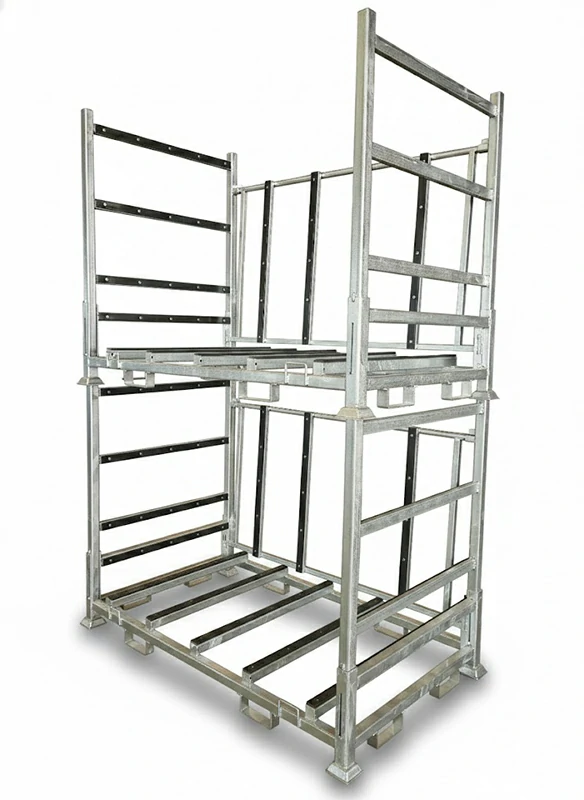
The most impactful feature is the ability to fold down when empty. A collapsible or pluggable design allows the side posts and backstops to lay flat onto the base. This simple mechanical transformation radically reduces the rack’s volume. Instead of shipping one empty rack, you can stack 7 or even 11 folded units in the same vertical space. As documented in transport optimizations for door and window exporters, this allows up to 112 empty racks to be returned in a single 40-foot shipping container, cutting return freight costs by over 80%.
Vertical Expansion: The Advantage of 3-Tier Stacking
A heavy-duty steel structure with engineered stacking feet allows for safe, stable, multi-level storage of fully loaded racks. By stacking three units high, you instantly triple your storage density without increasing your warehouse footprint. This transforms your storage capacity from a horizontal problem to a vertical solution, freeing up valuable floor space for production and staging. It eliminates warehouse gridlock and allows your output to grow without the need for expensive facility expansion.

Engineered for Protection: Beyond Simple Padding
Effective asset protection is non-negotiable. The contact points between the steel rack and your product must provide a robust, reliable cushion. The optimal solution involves thick, 10mm rubber strips that are mechanically fastened with screws, not just glued on. Crucially, these rubber strips should be internally reinforced with steel plates. This prevents heavy window units or stone sills from cutting through or tearing the rubber, ensuring a permanent protective barrier that safeguards your products from vibration and impact damage during transit.
Built for Real-World Handling: Enhanced Maneuverability
Efficiency is lost when your equipment doesn’t match your workflow. A Window and Door Transport Stacking system must be adaptable. A four-way forklift entry design is essential for maneuvering in tight spaces, such as loading a container or navigating a crowded workshop, as it allows a forklift to pick up the rack from any side. For job sites that rely on cranes, integrated lifting hooks provide a safe and efficient alternative for moving units to upper floors, ensuring seamless integration into any material handling environment.
Operational Impact: Before and After an Optimized Rack System
| Metric | Before: Standard Welded Racks | After: Collapsible & Stackable Racks |
|---|---|---|
| Return Logistics | Paying full freight cost to “ship air.” Low container/truck utilization for empty returns. | Over 80% reduction in return freight costs. Up to 112 folded racks per 40′ container. |
| Warehouse Storage Density | 1-tier storage. 100% floor space utilization for a single layer of inventory. | 3-tier storage. Storage density increased by 200%, using the same floor space. |
| Asset Protection | Risk of damage from inadequate padding (wood, thin rubber) leading to costly replacements. | Superior protection from steel-reinforced, screw-fixed rubber strips, minimizing transit damage. |
| Handling Efficiency | Limited two-way forklift access, causing delays in tight spaces. No crane handling capability. | Flexible four-way forklift entry and optional lifting hooks for crane use, speeding up loading/unloading. |
Frequently Asked Questions
What is the typical load capacity of a window transport rack?
Our heavy-duty racks are constructed from high-strength Q235 steel and are commonly engineered to handle loads from 1,000 kg (2,200 lbs) to 2,000 kg (4,400 lbs). The capacity can be customized based on the specific weight and dimensions of your window or door units.
Can the rack be customized for different handling equipment?
Yes. The base can be designed with standard two-way or enhanced four-way forklift channels for maximum maneuverability. For job sites using cranes, we can integrate certified lifting hooks at the four corners for safe and efficient vertical transport.
How does the rack protect against weather during outdoor storage?
While the standard finish is a durable powder coating, we offer a hot-dip galvanizing option for superior corrosion resistance. This treatment is ideal for racks that will be stored outdoors or used in humid environments, ensuring a long service life and preventing rust from staining your products.
What types of products can this rack hold besides windows?
This folding glass shipping racks platform is highly versatile. It is engineered for vertically storing any large, flat materials, including insulated glass units (IGUs), stone slabs, granite countertops, metal sheets, and fully assembled doors.
What is the single biggest advantage of a collapsible rack system?
The primary advantage is the dramatic reduction in return shipping costs. By folding down to a fraction of their deployed size, these racks solve the expensive “shipping air” problem, providing a clear and rapid return on investment for any company involved in closed-loop logistics.
Need a Custom Storage Solution?
Speak directly with our technical engineers. We offer free structural designs, heavy-duty catalog evaluations, and quick B2B price quotations.
Request a Quote Now →