Is your fabrication floor struggling with production bottlenecks between the CNC cutting table and your IGU line? Are micro-scratches on high-value coated glass eroding your profit margins? The constant shuffle of glass lites using inadequate A-frames creates hidden costs in labor, remakes, and safety risks.
The Real Cost of “Good Enough” In-Plant Glass Handling
In the world of wholesale glass fabrication, efficiency is measured in seconds and quality is non-negotiable. Yet, many facilities rely on storage solutions not designed for the dynamic, fast-paced environment of modern glass processing. Using traditional A-frames or L-racks for Work-in-Progress (WIP) management is a common source of inefficiency. They are excellent for bulk storage but become clumsy bottlenecks when operators need to sort and retrieve individual lites for insulated glass unit “kitting” or sequencing for a tempering furnace.
This inefficiency leads to three critical pain points for any Custom Glass Fabricator:
- Workflow Disruption: Operators waste valuable time searching for and carefully maneuvering specific glass pieces from a tightly packed A-frame, slowing down the entire production line.
- Material Damage: Every time a piece of glass is handled, moved, or leaned against another, there’s a risk of scratches, edge chips (“崩边”), or invisible micro-cracks. This is especially true for expensive materials like Low-E or laminated glass, where a single deep scratch can mean a costly remake.
- Safety & Flexibility Issues: Storing non-standard, narrow, or oddly shaped architectural glass on conventional racks is often unstable and unsafe. This not only poses a risk to personnel but also limits your shop’s ability to confidently take on more complex and profitable custom jobs.
From Static Storage to a Dynamic Workflow Tool
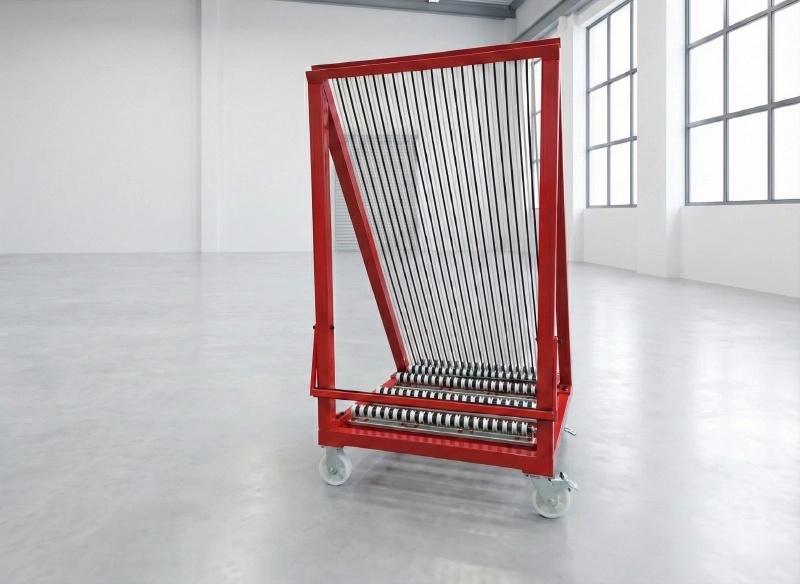
The solution isn’t just a better rack; it’s a fundamental shift in how you manage glass flow. A glass harp rack is engineered not as a passive storage unit, but as a mobile, high-density sorting station that integrates directly into your production workflow. Its design directly addresses the core challenges of in-plant glass logistics.

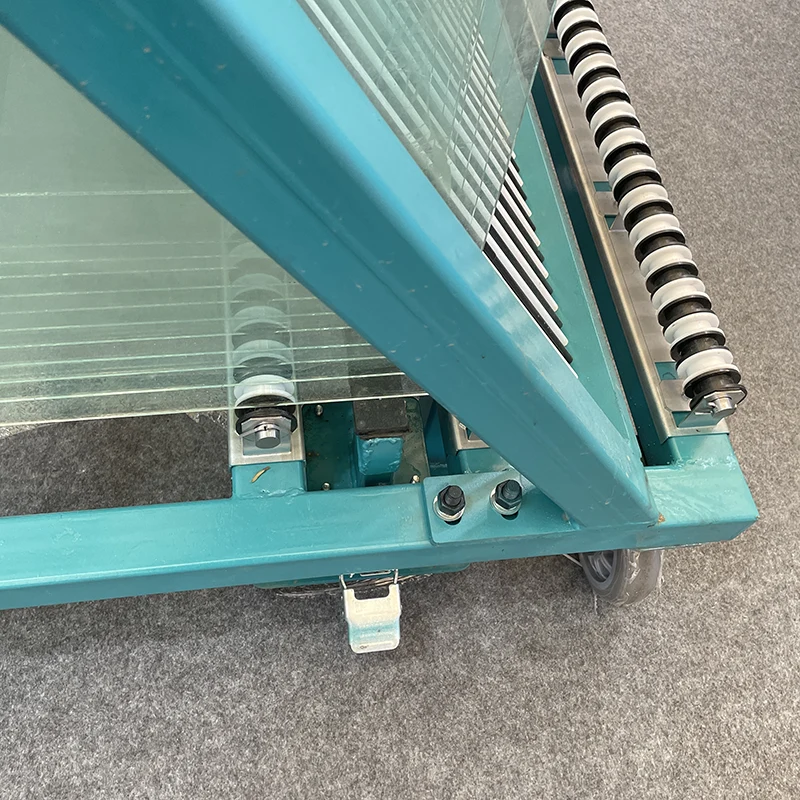
The core of its effectiveness lies in the series of vertical dividers. Each divider, typically a robust steel core sheathed in a soft, non-abrasive PVC casing, creates a dedicated slot for a single piece of glass. This simple but critical feature completely eliminates glass-to-glass contact, providing the ultimate protection for sensitive surfaces and coatings during both storage and transit.
Engineered for the Realities of a Glass Fabrication Floor
A true industrial solution understands the specific demands of its environment. Our Harp Racks are built with features directly mapped to the value chain of an Insulated Glass Unit Manufacturer or architectural glass processor.
Structure that Protects and Performs
The base of the rack is where performance is defined. We offer two primary configurations to match your specific needs:
- Full Steel Base with Slots: This design provides a continuous line of support along the entire bottom edge of the glass. It is the definitive solution for storing short, tall, or other non-standard glass sizes that would be unstable on a roller-based system. Custom-width slots can be specified to provide a snug, secure fit for thin lites (e.g., 6mm), preventing rattling and micro-fractures during movement.
- Nylon Roller Base: For operations handling large, heavy lites of glass, the low-friction nylon rollers make loading and unloading nearly effortless. This ergonomic design reduces physical strain on operators and speeds up handling times, especially when loading directly from a CNC glass cutting table.
Safety and Mobility, Integrated
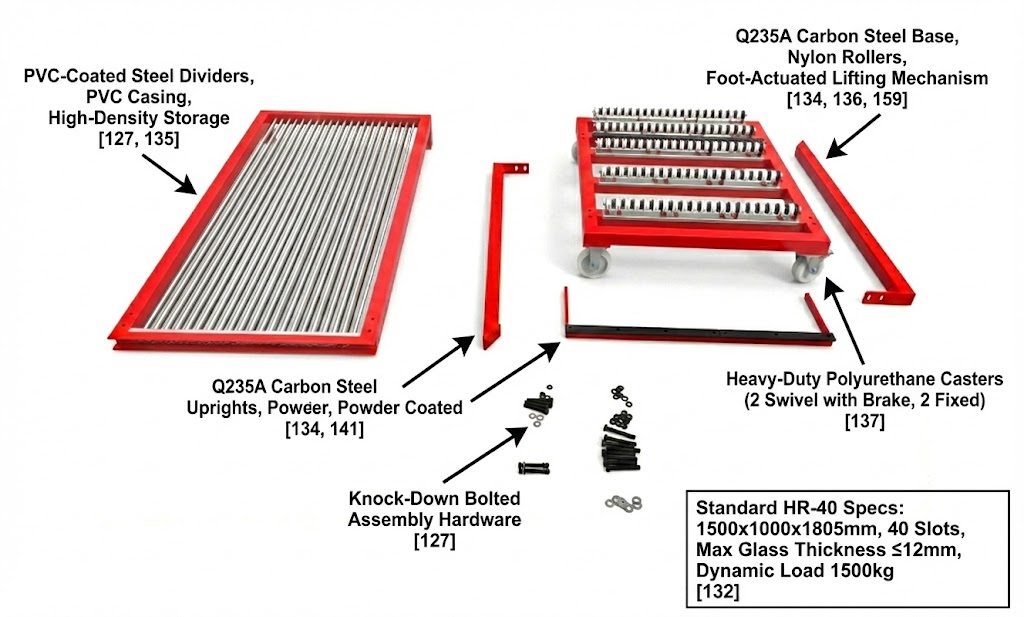
A WIP rack is useless if it’s not safe to move. Our harp rack glass trolley is built on a foundation of heavy-duty polyurethane casters (typically two fixed, two swivel with brakes) for smooth transit. Crucially, it incorporates a foot-actuated lifting mechanism. Before transport, the operator steps on a pedal, which slightly lifts the glass load off the base and locks it securely against a rubber buffer. This completely immobilizes the payload, eliminating the risk of shifting or vibration damage as the rack moves between your glass washing machine and the laminating line.
The Bottom Line: Reduced Costs, Increased Throughput
Integrating Harp Racks means transforming your shop floor. The process of “kitting” matching lites for IGU assembly changes from a scavenger hunt to a streamlined, error-free procedure. Glass is sorted into numbered slots right at the cutting station, and the entire organized cart is rolled to the next stage. This directly translates to faster cycle times and higher output.
Furthermore, the robust, knock-down bolted assembly design offers a significant, often overlooked, benefit: massively reduced shipping costs. By flat-packing the components, we can load far more units into a single container, a critical cost-saving factor for our international clients and those placing large wholesale orders.

Frequently Asked Questions
1. How is a Harp Rack different from a standard A-Frame Rack?
An A-Frame is primarily for bulk storage or transport of same-sized glass lites. A Harp Rack is a dynamic production tool designed for sorting, sequencing, and safely transporting individual, often varied, pieces of glass between workstations as part of the manufacturing process (Work-in-Progress).
2. We process very thin glass (e.g., 1/4 inch). Can your racks prevent it from rattling?
Absolutely. For thin glass applications, we highly recommend our full-base models where we can customize the slot width to provide a precise, snug fit. This eliminates movement and the risk of vibration-induced damage, which is a common problem with standard, one-size-fits-all racks.
3. What is the load capacity of a typical glass harp rack?
Our standard models, such as the HR-40, have a dynamic load capacity of 1500 kg (approximately 3,300 lbs). We also engineer larger, custom models with capacities exceeding 2500 kg (over 5,500 lbs) for heavy-duty applications.
4. How does the foot-actuated locking system improve safety?
It acts as an active safety brake for the payload. When engaged, it lifts the glass off the rollers or base and presses it firmly against a fixed buffer. This prevents the heavy glass sheets from shifting or sliding due to inertia when the cart starts, stops, or rolls over an uneven floor, protecting both the product and your personnel.
5. Are the racks delivered fully assembled? What is the assembly process?
To save you significant freight costs, our racks are shipped in a knock-down, flat-packed configuration. Assembly is straightforward: the uprights are bolted to the base, followed by the main grid. We recommend keeping bolts loose until all components are aligned, then tightening everything securely. This modular design also makes it easier to move the rack into facilities with tight access.
Need a Custom Storage Solution?
Speak directly with our technical engineers. We offer free structural designs, heavy-duty catalog evaluations, and quick B2B price quotations.
Request a Quote Now →