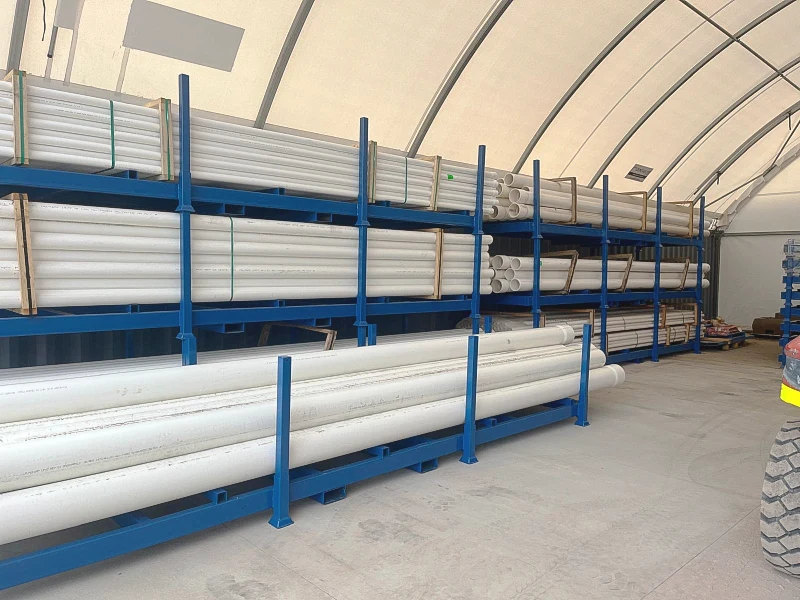

Is your warehouse floor a tangled mess of industrial hoses and PVC pipes? If you’re losing money to product damage from crushing, kinking, and “banana-ing,” you’re not facing a product problem—you’re facing a storage problem. Stop letting gravity dictate your profits and discover how to reclaim your space and protect your inventory.
The Hidden Costs of Piling Hoses: More Than Just a Mess
For manufacturers and distributors of long, flexible products like industrial hoses, hydraulic lines, or PVC conduit, traditional storage methods are a recipe for loss. Simply bundling and stacking on the floor—or on inadequate standard pallets—creates a cascade of operational headaches that directly impact your bottom line.
The Inevitable Damage: Crushing, Kinking, and “Bowing”
When hoses are piled high, the bottom layers bear the immense weight of everything above. This leads to two critical forms of damage:
- Ovalization & Kinking: The circular profile of the hose is crushed into an oval, creating weak points and compromising pressure ratings. This damage is often irreversible, turning valuable inventory into scrap.
- Bowing & Sagging: Long bundles supported only at the ends will inevitably sag in the middle over time, a phenomenon known as “bowing” or “banana-ing.” This deformation makes them difficult to install and can lead to customer rejection.

Specialized long racks provide end-to-end support, eliminating sagging and bending damage.
The Operational Nightmare: Inefficiency and Safety Hazards
A yard full of piled hoses is an inefficient and dangerous workspace. Accessing a specific SKU buried at the bottom of a pile requires manually moving tons of material, wasting hours of labor. These unstable piles are also a significant safety risk, prone to collapsing and causing serious injury to personnel.
The Stacking Rack Principle: From Bearing Weight to Cradling Value
The solution isn’t to stack better; it’s to stop stacking your product altogether. A portable stack rack system fundamentally changes the logic of your warehouse. It introduces a modular, structural steel skeleton that bears 100% of the load, allowing you to utilize vertical space without a single pound of pressure on the hoses themselves.
How It Works: Engineering for Protection and Density
Instead of your product acting as the structure, the heavy duty stack racks create a protective cradle. Here’s the simple yet powerful engineering behind it:
- Load Transfer: The weight of each level is transferred through the rack’s four (or more) steel corner posts directly to the floor. Your hoses are simply held within this protective cage.
- Vertical Stacking: Self-aligning “cup feet” on the bottom of each rack securely nest onto the top of the posts below, creating a perfectly stable stack up to 4 or 5 levels high.
- Unitized Handling: An entire rack, holding thousands of pounds of hose, becomes a single unit load. A forklift can safely and quickly pick up, move, and stack the entire unit in minutes, not hours.

The cup-and-post design allows for safe, stable stacking, turning your floor space into cubic storage capacity.
The “After” Scenario: A Revolution in Your Workflow
Implementing a system of industrial stacking racks transforms your operations from end to end. The benefits go far beyond tidy-looking storage.
From Production Line to Shipping Container in One Step
Imagine this workflow: Hoses come off the production line and are placed directly into a pipe stacking rack. That rack is then moved by a single forklift operator to the storage yard and stacked. When an order is ready, the same rack is picked up and loaded directly into a shipping container. The product is never manually handled again until it reaches the customer.
- Damage Rate Reduction: Product damage from handling and storage drops to near-zero.
- Loading Efficiency Increased by 300%: A shipping container that once took 3-4 hours for a crew to load by hand can now be loaded by one forklift operator in under 20 minutes.
- Optimized Shipping: Rack dimensions are designed to perfectly fit two-wide in standard shipping containers, maximizing freight density and preventing cargo shift during transit.

Turn Wasted Space into Revenue-Generating Capacity
By going vertical, you can store 4 to 5 times the amount of product in the same footprint. This frees up valuable floor space for other operations like staging, cross-docking, or even new production lines. When demand is low, the posts can be removed and the bases nested together, clearing huge areas of the warehouse for other uses. This flexibility is impossible with fixed racking systems.

The demountable design reduces return shipping volume by up to 80%, making reusable packaging economically viable.
Frequently Asked Questions
1. What is the typical weight capacity of these pipe stacking racks?
Our heavy-duty stack racks are typically engineered to hold between 2,000 lbs and 4,000 lbs per rack. The capacity can be customized based on your specific product weight and dimensions to ensure maximum safety and efficiency.
2. Can the racks be customized for extra-long hoses or pipes, like over 20 feet?
Absolutely. We specialize in custom solutions. For longer products, we can design racks with increased length and additional center posts (e.g., a 6 or 8-post design) to provide full support along the entire length and prevent any sagging or bowing.
3. How do you protect the surface finish of sensitive pipes or hoses from scratches?
For products with sensitive surfaces, rack bases can be equipped with protective surfaces like smooth steel decking, plywood, or rubber matting. This prevents any metal-on-metal contact and ensures your product arrives in pristine condition.
4. Are these racks weather-proof for outdoor storage yards?
Yes. While a standard powder-coated finish is durable, we highly recommend a hot-dip galvanized finish for long-term outdoor use. This provides superior protection against rust and corrosion, even in harsh weather conditions, ensuring a service life of 20+ years.
5. How do these racks improve container loading density?
Our standard racks are designed with widths of approximately 44-45 inches (1100mm-1140mm), allowing two racks to fit side-by-side snugly within a standard 92-inch (2350mm) internal container width. This eliminates empty space, prevents shifting, and maximizes your shipping cube utilization.
Need a Custom Storage Solution?
Speak directly with our technical engineers. We offer free structural designs, heavy-duty catalog evaluations, and quick B2B price quotations.
Request a Quote Now →