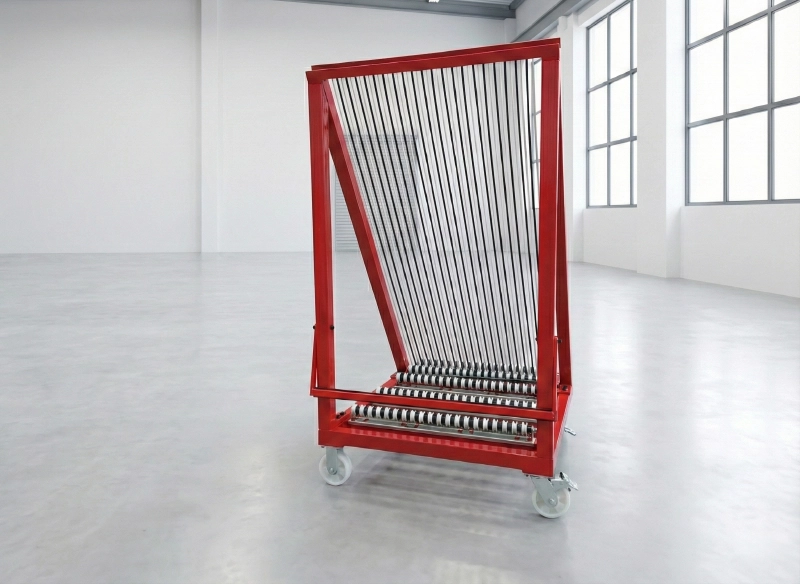

Are scratches, edge chips, and production bottlenecks between your CNC cutting table and tempering furnace costing you time and money? Handling diverse, custom-sized glass lites with generic carts creates unnecessary risk and slows down your entire workflow. It’s time for a solution engineered specifically for the dynamic environment of a modern glass fabricator.
Stamping press die storage solutions.
In today’s competitive glass fabrication market, efficiency is measured in seconds and quality is non-negotiable. For a Custom Glass Fabricator or an Insulated Glass Unit Manufacture, the journey of a glass lite from one process to the next is fraught with risk. The transition from the CNC cutting table, to the edging machine, and onward to the washing line or tempering furnace is a critical phase where value is preserved or lost. Traditional A-frame or L-frame racks, while useful for bulk storage, often fail as dynamic, in-process handling tools, creating logistical hurdles that directly impact your bottom line.
The “Before” Scenario: The Hidden Costs of Inadequate In-Plant Transfer
Picture a typical scene in a busy glass fabrication shop. A freshly cut batch of non-standard, high-narrow glass for an architectural project needs to be moved. Operators try to precariously balance these lites on a standard cart, where only one or two bottom rollers make contact, creating a severe tipping hazard. Elsewhere, thin 6mm lites intended for an insulated glass unit rattle inside oversized slots, risking micro-fractures and surface scratches with every movement. This inefficient process, repeated daily, leads to:
- Increased Spoilage: Scratches, chips (“崩边”), and stress cracks on expensive materials like Low-E glass result in direct material loss and costly rework.
- Production Bottlenecks: The slow, careful process of manually handling and securing odd-sized glass creates a logjam, starving downstream equipment like the Glass Tempering Furnace of material.
- Safety Hazards: Unstable loads pose a significant risk of injury to personnel from falling glass, a major concern for any plant manager.
- Wasted Space: Inflexible carts that can’t provide high-density storage for mixed-order batches consume valuable floor space.
The “Why It Works” Logic: The Harp Rack as a Mobile WIP Station
The glass harp rack is engineered to solve these specific challenges by functioning as a mobile Work-in-Progress (WIP) buffer station. Its design is not just about storage; it’s about optimizing material flow. Every component is designed to protect glass and empower operators within the unique workflow of a glass fabrication plant.
The magic lies in its core structure:
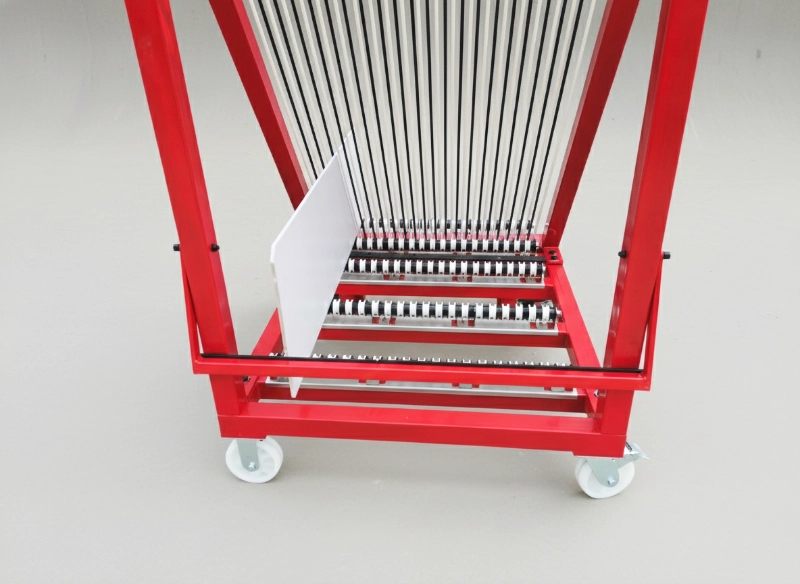
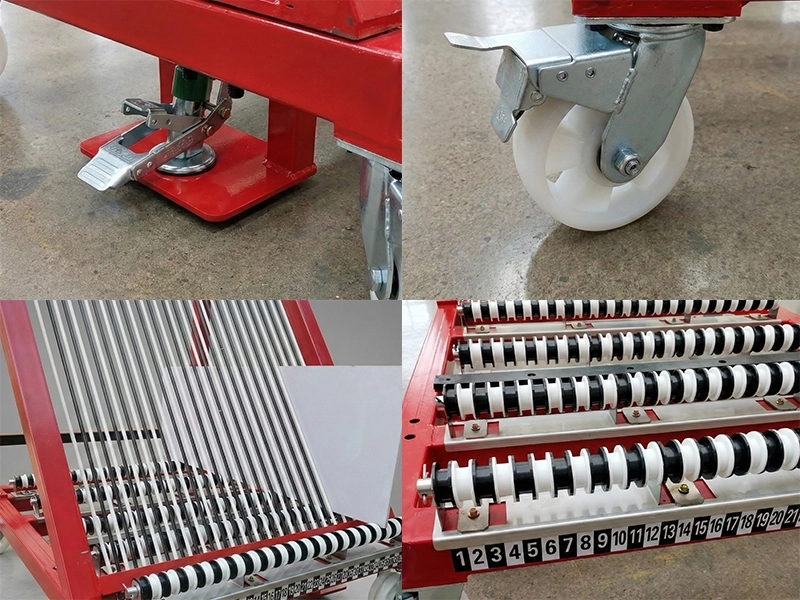
- Full-Support Base Options: Unlike traditional roller carts, our full steel base with slots provides a continuous line of support along the entire bottom edge of the glass. This completely eliminates stability issues with non-standard sizes, allowing you to confidently handle any custom order. For heavier lites, our Nylon roller base makes loading and unloading effortless.
- Protective PVC-Coated Dividers: Each glass lite is separated by a robust steel divider encased in a soft, non-abrasive PVC casing. This design provides the rigidity to support heavy glass while ensuring the delicate surfaces and coatings of high-value products like Low-E glass are never compromised.
- Foot-Actuated Lifting Mechanism: For ultimate safety during in-plant transfer, a simple foot pedal lifts the entire payload slightly, locking it securely against a fixed rubber buffer. This prevents any movement or vibration during transit, protecting both the product and your personnel.
- Knock-Down Bolted Assembly: Our racks are designed for flat-pack shipping. This modular, bolted design dramatically reduces freight volume, offering significant savings on shipping costs, especially for international container loading.
The “After” Impact: A Streamlined, High-Yield Workflow
Integrating Harp Racks transforms your factory floor. The result is a more fluid, predictable, and profitable operation. This is particularly evident in complex processes like IGU assembly, where precision and organization are key.
- Optimized IGU “Pairing”: The process of sorting glass units (known as “组队” or “pairing”) for IGU assembly becomes radically efficient. Numbered slots allow operators to quickly sort, match, and stage pairs of glass lites, pushing the entire organized batch to the assembly line at once.
- Enhanced Business Agility: You can now confidently bid on projects with diverse or unusual glass dimensions, from custom shower glass doors to complex architectural panels, knowing your internal logistics can handle the variation without new capital investment.
- Measurable Reduction in Scrap: By preventing the primary causes of in-process damage—vibration, impacts, and surface abrasion—Harp Racks directly contribute to a higher yield and lower scrap rate, boosting your profitability on every job.

Built for the Demands of Your Facility
Our Harp Racks are constructed from high-strength Q235A Carbon Steel and built to withstand the rigors of an industrial environment. We offer a range of standard models and full customization to meet your specific needs.
| Model / SKU | External Dims (L×W×H, approx. in) | Slot Count | Applicable Glass Thickness (in) | Dynamic Load (Lbs) |
|---|---|---|---|---|
| HR-40 | 59″ × 39.4″ × 71″ | 40 | ≤ 0.47″ | 3300 |
| HR-84 (Thin Glass) | 59″ × 47.2″ × 70.9″ | 84 | 0 – 0.31″ | 3300 |
| Custom Large Model | 102.4″ × 94.5″ × 74.8″ | 80 | ≤ 0.98″ | > 5500 |
Finishes are available in any color via RAL color cards, applied with a durable electrostatic spray (powder coating). All manufacturing adheres to strict GB/T1804-m tolerance standards, ensuring a high-quality, long-lasting solution for your facility.
Frequently Asked Questions
1. Can your Harp Rack be customized for thin glass, like 6mm (1/4″), used in IGU production?
Absolutely. This is one of our key strengths. We can customize the slot width of our full-base models to perfectly match the thickness of your glass, typically to an 8-10mm gap. This provides a snug fit that eliminates rattling and the risk of micro-fractures during transport, which is critical for IGU quality.
2. How exactly does the “knock-down” assembly save us money?
The rack is shipped disassembled and flat-packed. This dramatically reduces the cubic volume of the shipment compared to a fully welded unit. For domestic shipping, this means lower freight class charges. For international clients, it means you can fit significantly more racks into a single shipping container, drastically reducing the per-unit cost of transportation.
3. What is the maximum weight capacity of a standard Harp Rack?
Our standard models, like the HR-40 and HR-84, have a rated dynamic load capacity of 1500 kg (approximately 3300 lbs). We also build larger, heavy-duty custom models that can exceed 2500 kg (>5500 lbs) to handle jumbo lites or other demanding applications.
4. How does the foot-actuated locking system improve safety?
The locking mechanism provides active safety. When engaged, it lifts the load off the main casters and rests it on a solid footing while simultaneously bracing it against a fixed stopper. This makes the rack completely immobile, preventing any chance of it rolling or shifting while operators are loading or unloading heavy, valuable glass sheets. It’s a crucial feature for operator safety and product protection.
5. We handle a lot of architectural glass with non-standard dimensions. Are Harp Racks a good fit?
They are the ideal solution. Traditional carts often fail to support short but tall or narrow glass lites. Our full-base Harp Racks provide continuous support along the entire bottom edge, regardless of the lite’s length. This makes them perfectly suited for custom glass fabricators who need the flexibility to handle a wide variety of dimensions without compromising on safety or stability.
Need a Custom Storage Solution?
Speak directly with our technical engineers. We offer free structural designs, heavy-duty catalog evaluations, and quick B2B price quotations.
Request a Quote Now →