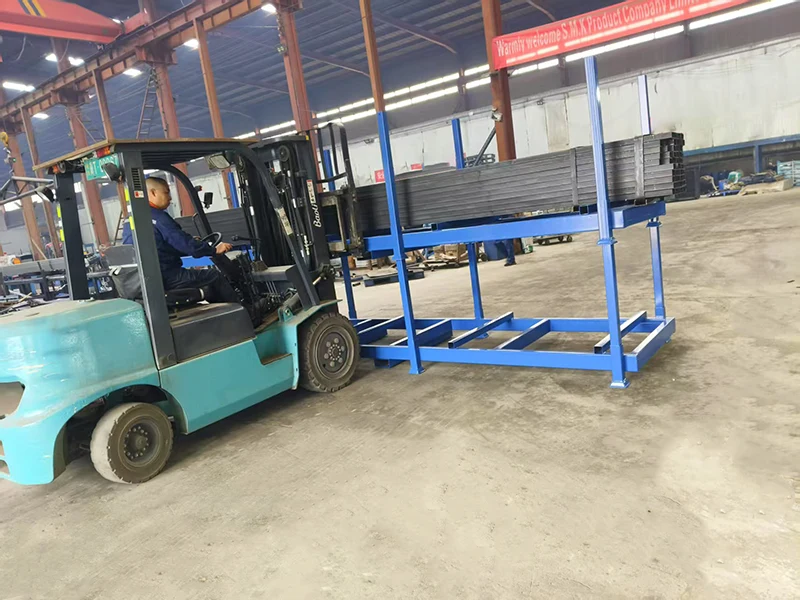

Stop “Lacing” Tires on the Floor. It’s Killing Your Inventory.
In high-volume tire logistics, floor stacking (lacing) is a silent profit killer. It causes bead deformation in the bottom layers, creates a nightmare for inventory picking (LIFO), and is a massive red flag for Fire Marshals. Switch to a dynamic stackable tyre rack system that converts vertical air space into revenue while ensuring zero compression on the tire sidewalls.
The Structural Flaw of Traditional Tire Warehousing
For decades, tire distributors have relied on “barrel stacking” or “lacing” (interlocking tires like a zipper) to maximize container loads. While this works for shipping, it is disastrous for warehousing. Rubber is a viscoelastic material. When a PCR (Passenger Car Radial) tire sits at the bottom of a 20-high laced stack for months, the multi-directional pressure causes flat-spotting and bead deformation. This results in tires that won’t seal properly on the rim, leading to returns and warranty claims before the tire even hits the road.
Furthermore, fixed aisle racking (Selective Racking) is often too expensive and rigid for the seasonal fluctuations of the tire industry. You need a solution that bridges the gap between bulk stacking density and racking selectivity.

Figure 1: Maximizing vertical cube utilization up to 5 layers high without fixed installation.
Engineering the Solution: PCR vs. TBR Configurations
A “one-size-fits-all” pallet does not exist in tire logistics. The geometry of a low-profile sports car tire differs fundamentally from a heavy-duty truck tire. Our heavy duty stack racks are engineered based on the specific Diameter (D) and Section Width of your inventory.
1. PCR (Passenger Car Radial) Storage Logic
For PCR tires, the challenge is volume. These tires are lighter but numerous. The rack design focuses on storage density.
- Structure: We utilize a “fishbone” or interlaced pattern on the rack base to maximize the number of tires per square foot (typically 40-50 tires per rack depending on size).
- Protection: The four removable posts bear 100% of the load of the racks above. The bottom tire supports zero weight from the upper tiers.
- Accessibility: Racks can be moved by forklift to the loading dock, eliminating manual “lumping” of tires.

Figure 2: PCR tires stored horizontally with zero compression weight from above.
2. TBR (Truck & Bus Radial) Storage Logic
TBR tires are heavy (often 100 lbs+ each) and rigid. Manual handling is a major injury risk. The rack design here focuses on load capacity and stability.
- Structure: These racks typically hold tires vertically (tread on the deck) to facilitate easy rolling on/off, or barrel stacked for maximum density.
- Capacity: Reinforced steel bases handle dynamic loads of 2400 lbs (1100 kg) per rack, stackable 4-high.
- Safety: Prevents the “domino effect” of loose vertical storage.

Figure 3: Heavy-duty TBR racks engineered for high weight capacity.
Fire Safety and Insurance Compliance
One of the most critical aspects of tire warehousing is fire code compliance (NFPA 13 in the US/International standards). Large piles of rubber are high-challenge fire hazards.
- Permeability: Unlike solid wood pallets, our metal stack racks feature open mesh or perforated decking. This allows water from overhead ESFR (Early Suppression, Fast Response) sprinklers to penetrate through the stack to the bottom layer.
- Flue Spaces: The inherent design of the posts creates natural flue spaces, preventing the creation of a solid, impenetrable block of fuel.
The Economics of Reverse Logistics (Nesting)
The tire supply chain is circular. You ship full, but what comes back? In a dedicated fleet or closed-loop system, shipping “air” is expensive. Our portable stack system is fully demountable.
Once the tires are unloaded at the retailer or distribution center, the posts are removed, and the bases nest into each other. You can fit the empty racks of 5 trailers into a single return trailer, slashing reverse logistics costs by 80%.

Figure 4: Ratio of 1:5 return efficiency. Empty bases nest tightly to save freight costs.
Technical Specifications: Tire Rack Series
| Feature | PCR Specification | TBR Specification |
|---|---|---|
| Load Capacity | 1,500 – 2,200 lbs (approx. 1000kg) | 2,200 – 3,000 lbs (approx. 1300kg) |
| Stacking Height | 4-5 High (Warehouse), 2-3 High (Transit) | 4 High (Warehouse), 2 High (Transit) |
| Finish | Powder Coated (High Visibility Orange/Blue) | Hot-Dip Galvanized (Outdoor/Weather Proof) |
| Base Design | Perforated Deck / Wire Mesh (Sprinkler safe) | Reinforced Steel Fork Guides |
| Tire Capacity (Approx) | 30-50 units (laced) | 8-14 units (tread vertical) |
Frequently Asked Questions (Tire Warehousing)
1. How does racking prevent “Flat-Spotting” compared to floor stacking?
Floor stacking places the weight of the entire pile (often 15+ feet high) onto the sidewalls of the bottom tires. This static load causes the rubber to creep and deform permanently. Our racks bear the load through the steel posts, meaning the bottom tire in a stack of 5 racks carries no more weight than if it were sitting alone.
2. Can these racks accommodate different tire diameters in the same stack?
Yes, but with operational discipline. The “footprint” of the rack is standard. You can stack a rack full of 15-inch tires on top of a rack full of 19-inch tires. However, within a single rack, it is best to store similar sizes to maximize density and stability.
3. Are these racks compatible with automated tire handling systems?
We can manufacture to tight tolerances suited for AS/RS (Automated Storage and Retrieval Systems), but the standard units are designed for standard forklift operations. The cup-feet design allows for “self-centering” stacking, which speeds up manual forklift handling significantly.
4. Do I need Powder Coating or Galvanized finish?
If your operation is strictly indoors (climate controlled distribution center), Powder Coating is sufficient and allows for color-coding (e.g., Blue for PCR, Orange for TBR). If you store tires outdoors or in humid environments, Hot-Dip Galvanized is non-negotiable to prevent rust from contaminating the tire rubber.
5. What happens to the racks during the “Snow Tire” season rush?
This is the beauty of the system. During peak inventory season (Winter prep), you stack them to the ceiling. In the off-season when inventory levels drop, you dismantle and nest the empty racks, freeing up 80% of your floor space for cross-docking or other revenue-generating activities. Fixed racking cannot do this.
Need a Custom Storage Solution?
Speak directly with our technical engineers. We offer free structural designs, heavy-duty catalog evaluations, and quick B2B price quotations.
Request a Quote Now →