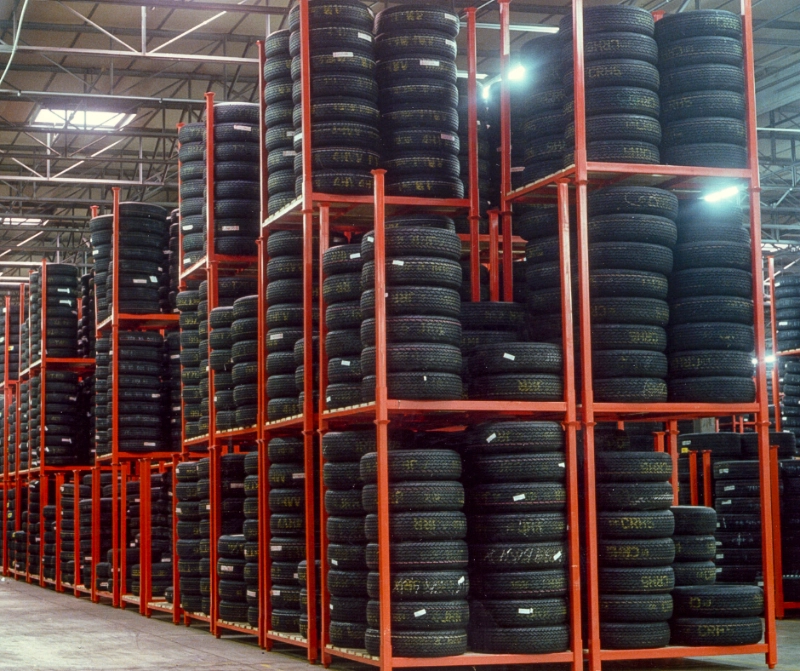

Is your warehouse floor a chaotic maze of interlaced tires? Are you writing off profits due to the irreversible bead deformation and flat-spotting caused by traditional barrel stacking? It’s time to stop compressing your assets and start leveraging your vertical space. The structural integrity of your tires—and your bottom line—depends on it.
The Hidden Costs of Traditional Tire Warehousing: Beyond Just Floor Space
In the tire industry, the method of “lacing” or “barrel stacking” tires has long been a common practice to maximize floor space. However, this seemingly efficient method introduces severe, often hidden, costs. When tires are interlaced, the bottom layers bear the immense weight of the entire stack, leading to two critical types of product damage: Bead Deformation and Flat-spotting. A deformed bead can compromise the tire’s seal to the wheel rim, rendering it unsafe and unsellable. This isn’t just a loss of inventory; it’s a direct hit to your reputation.
Furthermore, this method creates a logistical nightmare. Retrieving a specific SKU from the bottom of a stack requires manually moving hundreds of tires, a process that is not only brutally inefficient but also a major cause of back injuries for warehouse staff. The dense, uncontrolled pile also poses a significant fire hazard, obstructing sprinkler systems and creating a high fire load. Your warehouse isn’t just storing tires; it’s accumulating risk.

The Engineering Shift: How a Tire Storage Rack Eliminates Product Damage
The solution lies in a fundamental paradigm shift: moving from a “cargo-bearing” to a “structure-bearing” storage model. Our stackable tire storage racks, also known as pallet stillages, are engineered to carry 100% of the load through their steel posts. This means the tires stored inside, even at the very bottom of a 5-level stack, experience zero compression.
Zero Compression, Zero Deformation
Each tire rests on a sturdy steel base or crossbars, completely isolated from the weight above. The upper racks lock securely into the posts of the lower ones, creating a stable, self-supporting structure. This design completely eradicates the risk of bead damage and flat-spotting, ensuring every tire you ship meets factory specifications for dynamic balance and safety.
A System Built for Tires: The Diameter-Based Approach
A one-size-fits-all approach doesn’t work for tires. Our solutions are based on a proven diameter classification algorithm:
- Class A (PCR/Light Truck): For tires with a diameter under 800mm, racks are designed to hold a set number of tires (e.g., 4 across) either horizontally or vertically, with dimensions optimized to prevent rolling and maximize density.
- Class B (TBR/OTR): For heavy-duty truck, bus, and off-road tires with diameters over 800mm, the heavy duty stack racks feature a reinforced base and stronger posts to handle the extreme weight and dimensions, as seen with large commercial tires.

From Chaos to Control: Quantifiable Gains with a Modular Portable Stack Rack System
Implementing a modular rack system transforms more than just your storage method; it revolutionizes your entire workflow, delivering measurable improvements in efficiency, accuracy, and cost savings.
Reclaim Your Airspace: Increase Storage Density by Over 60%
By safely stacking tires 4 to 5 levels high, you convert unused vertical airspace into valuable storage capacity. Instead of measuring your warehouse in square feet, you start thinking in cubic feet. This allows you to store significantly more inventory in the same footprint, or to consolidate operations and reduce overhead from multiple facilities. The result is a dramatic increase in storage density, often exceeding 60% compared to floor stacking.

Achieve 99.9% Inventory Accuracy
When each tire pallet is a standardized unit holding a fixed quantity of a specific SKU, inventory management becomes incredibly simple. Your team no longer needs to manually count loose tires. Instead, they count racks. This unitized approach integrates seamlessly with any WMS (Warehouse Management System) and boosts inventory accuracy from an industry average of 85% for floor-stacked tires to over 99.9%.
Slash Reverse Logistics Costs by 75-80%
Our portable stack racks are designed for the entire supply chain, not just the warehouse. For return trips, the posts can be quickly detached and stored in the base. The empty bases can then be nested together. This ingenious design means a single truck can transport 4 to 5 times more empty racks than fully assembled ones, drastically reducing return shipping costs and making a closed-loop, returnable packaging system economically viable.

Frequently Asked Questions
1. How many tires can one stackable rack hold?
Capacity is customized based on the tire type. A standard PCR rack is often designed to hold 16-25 passenger car tires, depending on the arrangement. For larger TBR tires, the rack is engineered for lower quantities (e.g., 4-8 tires) to manage the weight and size safely.
2. Can these racks be used for both PCR and TBR tires?
Yes, but not typically the same rack. We design specific models for the different weight classes and dimensions. A heavy-duty TBR rack is built with thicker steel and a more robust base to handle the load, while a PCR rack is optimized for higher density with lighter tires.
3. Are the racks safe to stack 4 or 5 high?
Absolutely. They are engineered for vertical stacking. The key is the “cup feet” design, where the feet of the upper rack nest securely over the posts of the lower rack. This creates a positive-locking, stable column that is safe for forklift handling and high-density storage, provided the floor is level and load-rated.
4. What is the advantage over fixed pallet racking?
The primary advantage is flexibility. Fixed racking creates permanent aisles, locking up your floor space. Our portable stacking pallet racks are not bolted down. This allows you to reconfigure your entire warehouse layout in hours to adapt to seasonal demand shifts (e.g., winter vs. summer tires) or to create open space for staging and cross-docking operations.
5. How do we handle the empty racks in our supply chain?
This is a key strength. The demountable posts can be removed and the bases nested or stacked. A stack of 5-6 nested empty racks takes up the same footprint as one fully loaded rack. This massive reduction in volume makes return shipping highly efficient and cost-effective, perfect for a returnable transport packaging (RTP) program.
Need a Custom Storage Solution?
Speak directly with our technical engineers. We offer free structural designs, heavy-duty catalog evaluations, and quick B2B price quotations.
Request a Quote Now →