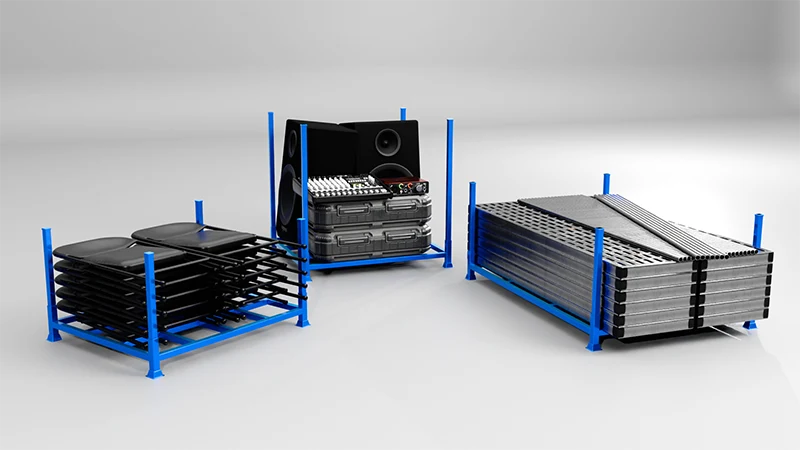

Stop letting floor-stacked castings dictate your production floor’s efficiency. The endless cycle of shifting bins, damaged machined surfaces, and wasted vertical space is costing more than you think. There is a more robust, streamlined, and space-efficient way to handle your work-in-progress and finished castings.
The Foundry Floor Dilemma: Beyond a Cluttered Workspace
In any foundry or metal fabrication shop, floor space is prime real estate. Yet, it’s often consumed by disorganized piles of raw castings, semi-finished parts, and final products stored in flimsy wooden crates or steel bins. This “system” isn’t just messy; it actively hinders your workflow and inflates operational costs.
The “Before” State: Daily Headaches in Casting Storage
Before implementing a structured solution, the daily reality often involves:
- Wasted Vertical Cube: Castings are heavy and often irregularly shaped, making them impossible to stack safely beyond one or two levels. This forces you to spread them out, consuming valuable square footage that could be used for new machinery or production lines.
- Product Damage & Rework: When heavy castings are dumped into bins or stacked directly, critical machined surfaces, threads, and delicate features are easily nicked or dented. This leads directly to costly rework, increased scrap rates, and potential rejection by the customer.
- Inefficient Material Handling: Moving individual castings or small batches with overhead cranes and slings is a slow, labor-intensive process. It creates bottlenecks, tying up both equipment and personnel, and significantly slows down the flow from shakeout to finishing to shipping.
- Safety Hazards: Unstable stacks, splintered wooden pallets, and the constant need for manual handling create a high-risk environment for trips, falls, and crush injuries.
The Derack Logic: From Dead Weight to Dynamic Units
The core issue with traditional storage is that the castings themselves are expected to bear the load of whatever is on top. Our stackable steel stillages fundamentally change this equation. Think of them not as a container, but as a modular, structural skeleton for your products.

The weight of each upper level is transferred directly through the solid steel posts to the floor, completely bypassing the valuable castings stored within. This simple but powerful principle, executed with heavy-gauge Q235 steel, unlocks a new level of efficiency.
The “After” State: Transforming Your Operations
By converting your castings into secure, stackable unit loads, you can achieve immediate, measurable improvements.
1. Reclaim Your Floor: Multiply Storage Capacity by 400%
Instead of being limited to the ground, you can now safely and easily stack your castings 4 or 5 levels high. A single forklift can create dense, organized storage blocks wherever you need them. This instantly frees up vast areas of your floor for more value-added activities. What was once a sprawling WIP area can become a new CNC cell.
2. Eliminate Handling Damage: Protect Machined Surfaces
Each casting is securely held within the robust steel frame of the metal post pallet. There is no metal-on-metal impact during transit and no crushing force from the weight above. This drastically reduces the need for secondary dunnage and virtually eliminates damage-related scrap and rework, ensuring parts reach the next stage or the customer in perfect condition.

3. Accelerate Your Workflow: The Power of Unit Load Handling
Imagine moving 2,000 Lbs of castings from one end of the plant to the other in a single, swift operation. That’s the power of these heavy duty stack racks. A forklift operator can pick up, transport, and stack an entire unit in minutes—a task that could take an hour with a crane. This mobility transforms your storage from a static problem into a flexible, fluid part of your production line, enabling a true lean manufacturing environment.

Built for the Foundry Environment
These aren’t warehouse shelves. Our industrial stacking racks are engineered for the harsh realities of metalworking. The all-welded steel construction withstands impacts from forklifts and heavy parts, while the optional hot-dip galvanized finish provides superior resistance to rust and corrosion from cutting fluids and outdoor storage. The system is your long-term asset for a safer, leaner, and more productive operation.
Frequently Asked Questions
1. What is the typical weight capacity of these stillages?
Standard models are engineered to handle loads from 2,000 to 4,000 Lbs per rack. However, we specialize in heavy-duty custom designs and can engineer solutions for much heavier casting applications based on your specific part weight and handling requirements.
2. Can the stillage design be customized for our uniquely shaped castings?
Absolutely. Customization is a key advantage. We can modify the base with V-saddles, cradles, or specific dunnage to securely hold irregular shapes. We can also adjust the post height and overall dimensions to perfectly match your product and maximize storage density.
3. How do they hold up against rust and corrosion in a typical machine shop?
While our standard powder coat finish is durable, we highly recommend a hot-dip galvanized finish for environments with coolants, wash-down areas, or outdoor storage. This process provides a thick, metallurgically-bonded zinc coating that offers decades of rust-proof performance.
4. How much safer is using a forklift with these racks compared to a crane and slings?
The safety improvement is significant. Forklift handling of a contained, stable unit load eliminates the risks associated with swinging loads, insecure rigging, and the need for personnel to be in close proximity to the lift. It standardizes the handling procedure, making it faster, more predictable, and dramatically safer.
5. What happens when we don’t need the racks? How much space do empty ones take up?
Our stillages feature removable posts. When not in use, the posts can be taken off and stored on the base. The empty bases can then be nested or stacked together, reducing their storage footprint by up to 80%. This is ideal for managing seasonal production fluctuations or for cost-effective return shipping.
Need a Custom Storage Solution?
Speak directly with our technical engineers. We offer free structural designs, heavy-duty catalog evaluations, and quick B2B price quotations.
Request a Quote Now →