
Are unstable, floor-stacked pyramids of bagged goods crushing your profits? This outdated method limits your capacity, causes compression damage to your inventory, and makes batch access a logistical nightmare. It’s time to reclaim your warehouse floor and protect every single bag of flour, seed, or animal feed.
In the world of food production and animal feed milling, warehouse space is a constant battle. You’re tasked with storing thousands of 50 Lbs bags, each with its own batch code and expiration date. The default method—stacking pallets of bags directly on top of each other—seems simple, but it creates a cascade of costly problems that silently eat away at your bottom line.
The Hidden Costs of Floor-Stacking Bagged Goods
The traditional “block stacking” or “pyramid stacking” approach is fraught with inefficiencies that managers in flour mills and feed production facilities know all too well. These aren’t just minor inconveniences; they are significant operational drains.
Product Damage and Lost Revenue
Soft-packaged goods like flour, grains, and livestock feed are not designed to bear weight. When you stack them three or four pallets high, the bottom layer bears the entire load. This leads to product compression, hardened clumps, and torn bags from the sheer pressure. The result is unsellable product, customer complaints, and a direct hit to your revenue. Furthermore, bags stacked directly on a concrete floor can wick moisture, leading to spoilage and potential pest issues.
The LIFO Nightmare & Wasted Labor
Floor stacking creates a rigid Last-In, First-Out (LIFO) inventory system. Need to access a specific batch of layer mash from two weeks ago that’s buried at the bottom of a stack? Your team has to undertake a time-consuming and labor-intensive process of moving the top three pallets just to get to the one they need. This double-handling slows down order fulfillment, increases the risk of worker injury, and makes a true First-In, First-Out (FIFO) rotation practically impossible.
Inefficient Space Utilization
How high can you safely stack bags before the pile becomes dangerously unstable? Two pallets? Maybe three? In a warehouse with a 20-foot ceiling, you are paying for a massive volume of vertical air that you simply can’t use. Your warehouse footprint becomes the absolute limit of your storage capacity, forcing costly expansions or off-site storage.
The Solution: A Steel Skeleton for Every Pallet
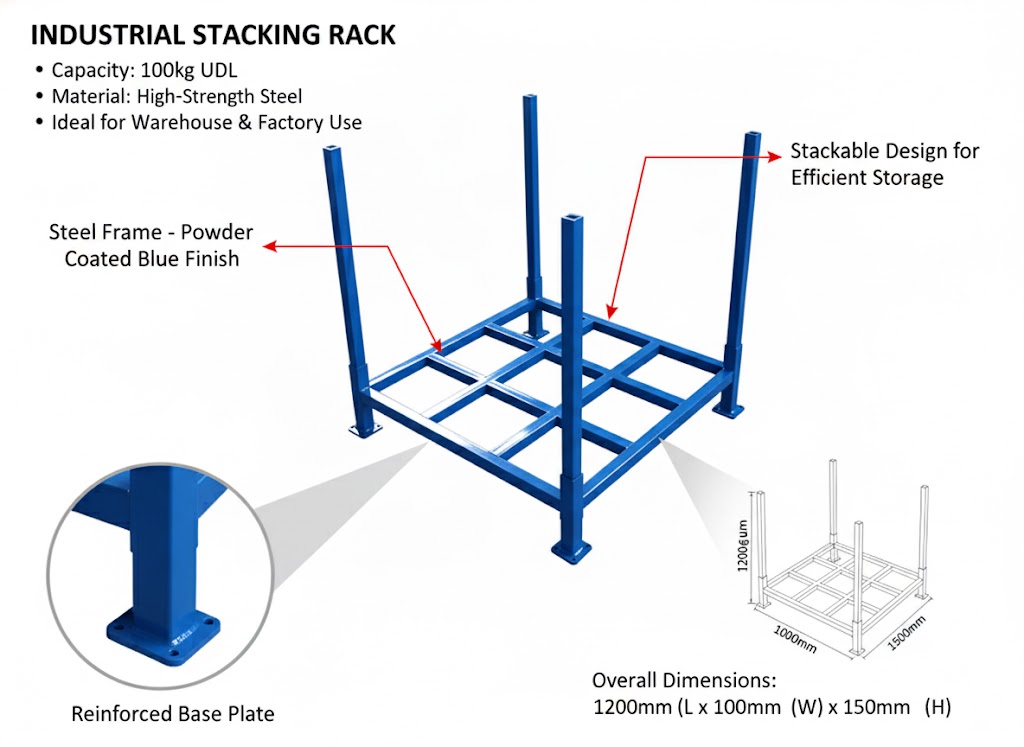
Instead of relying on your product to support the load, what if each pallet had its own structural frame? That is the simple genius behind industrial stacking racks. These are not just simple pallets; they are modular, mobile rack bays that transform how you handle and store bagged goods.
How It Works: Shifting Weight from Product to Structure
A metal post pallet consists of a robust steel base and four removable corner posts. You place your standard pallet of bagged goods onto this base. When you stack another unit on top, its cup-shaped feet lock securely onto the tops of the posts below. 100% of the weight is transferred through the steel posts to the floor, completely bypassing your valuable product. The bags on the bottom pallet experience zero compression.

The Results: Vertical Space Unlocked
With the product protected, you can now safely go vertical. Stack your bagged goods four, or even five units high, all the way to the ceiling. This simple shift in logic can instantly increase your warehouse storage density by 400-500%. A facility with a 10,000 sq. ft. footprint can suddenly accommodate the inventory of a 40,000 sq. ft. warehouse, without a single construction permit.
Beyond Storage: Creating a Truly Flexible Warehouse
The greatest advantage of portable stacking pallet racks is their inherent flexibility, a crucial asset in the dynamic food and feed industries.
Dynamic Layouts for Seasonal Demand
Unlike traditional racking that is bolted to the floor, these racks can be picked up and moved by any standard forklift. This allows you to reconfigure your warehouse layout on the fly. Use an area for inbound receiving in the morning and convert it to high-density storage in the afternoon. During a slow season, you can remove the posts, nest the empty bases together, and free up a massive amount of floor space for equipment maintenance or other operations.

Streamlined Logistics from Production to Shipping
These racks become your unit of handling throughout the entire workflow. Load your bags onto the pallet stillages right at the end of the packaging line. A forklift then moves the entire, protected unit into storage and, when the time comes, directly onto an outbound truck. This eliminates manual re-palletizing, drastically reduces handling time, and ensures your product arrives at the customer’s door in pristine condition.
The Financial Case: Lowering TCO and Boosting ROI
The investment in a stack rack system pays for itself through reduced waste, increased capacity, and superior logistical efficiency.
The Power of Nesting in Reverse Logistics
Empty racks can be a logistical headache. Our pallet stillages steel design features demountable posts. Once removed, the bases can be nested together. This innovative feature means you can fit 4 to 6 empty racks in the same footprint as one assembled unit, slashing return shipping costs by up to 80% and making a closed-loop, returnable packaging system highly profitable.

Frequently Asked Questions
1. How much weight can these stack racks hold?
Our standard heavy duty stack racks are typically engineered to hold between 2,000 to 4,000 Lbs per unit. We can also custom-engineer solutions for heavier loads. A typical pallet of 50 Lbs bags is well within this capacity, allowing you to stack 4-5 units high safely.
2. Are the racks safe and stable when stacked?
Absolutely. The racks feature specially designed “cup feet” or “post saddles” that nest securely over the post of the rack below. This self-aligning design uses gravity to ensure a stable, positive connection, making it easy and safe for forklift operators to stack them precisely.
3. Can these racks be used in a humid feed mill or a food-grade facility?
Yes. While our standard finish is a durable powder coating, we highly recommend a hot-dip galvanized finish for environments with high humidity, frequent wash-downs, or strict hygiene standards. The galvanized coating provides superior rust and corrosion protection, ensuring a long, safe service life and preventing contamination.
4. What is the main advantage of these racks over traditional, fixed pallet racking?
The key advantage is flexibility. Portable stack racks require no installation, no bolting to the floor, and create no permanent aisles. You can change your entire warehouse layout in a single afternoon to adapt to changing inventory levels. This “liquid” warehouse approach maximizes your space and operational agility in a way fixed racking cannot.
5. How do stack racks help with managing inventory with expiration dates?
By eliminating the LIFO problem of floor stacking. Since every rack is a self-contained unit accessible by forklift, you have 100% selectivity. This means you can easily implement a true First-In, First-Out (FIFO) system, picking the oldest batches first to minimize spoilage and waste. This is crucial for managing perishable goods like animal feed and food ingredients.
Need a Custom Storage Solution?
Speak directly with our technical engineers. We offer free structural designs, heavy-duty catalog evaluations, and quick B2B price quotations.
Request a Quote Now →