
Your PVC and PE pipes are bowing on the warehouse floor. Every day they sit, the sagging gets worse, leading to costly scrap and customer rejections. Standard pallets offer no support, and bulk stacking is a recipe for damage and handling nightmares. It’s time to stop storing pipes and start engineering their protection from production to installation.
The Hidden Cost of “Simple” Pipe Storage: Bowing, Damage, and Inefficiency
For manufacturers of PVC, PE, or other extruded profiles, the challenge doesn’t end when the product comes off the line. Storing and transporting long, flexible materials presents a constant battle against gravity. The common practice of bundling pipes and stacking them directly on the ground or on inadequate wooden pallets inevitably leads to “bowing” or “sagging.” This isn’t just a cosmetic issue; it’s a critical defect that can make installation difficult or impossible, resulting in rejected shipments and wasted material. Furthermore, ground storage exposes valuable inventory to dirt, moisture, and potential damage from passing forklifts.

The Flaw in Traditional Methods
Pyramid-stacking or simple bundling fails because the pipes themselves become the load-bearing structure. Their low rigidity and high slenderness ratio mean they are susceptible to creep deformation over time. This leads to a permanent curvature, often called “banana-ing,” which compromises the product’s integrity. The manual labor required to load and unload these loose bundles is not only slow and costly but also carries a high risk of worker injury.
Engineered Support: How a Multi-Post Rack Design Eliminates Sagging
The solution lies in shifting the load from the product to a purpose-built structure. A specialized pipe stacking rack, particularly one with an 8-post design, fundamentally changes the physics of pipe storage.

The “Suspension Bridge” Principle for Your Pipes
Unlike a standard 4-post pallet that only supports the ends, our 6-post and 8-post heavy duty stack racks introduce intermediate support points along the length of the pipe. This drastically shortens the unsupported span, providing a continuous cradle that prevents any deflection. The weight of the entire bundle, and any racks stacked above it, is transferred directly through the vertical steel posts to the floor. Your pipes are simply held in a zero-stress position, ensuring they maintain perfect straightness from your factory to the job site.
From Warehouse Chaos to a Streamlined Logistical Asset
Adopting this system is more than just buying a rack; it’s re-engineering your entire material flow for maximum efficiency and zero waste.
Benefit 1: Slash Unloading Times from Hours to Minutes
Stop the dangerous and time-consuming process of manually unloading a shipping container pipe by pipe. With a unitized system, your pipes are pre-loaded into the racks at the end of the production line. A single forklift operator can unload an entire container in under 20 minutes, a task that previously took a team 3-4 hours. This translates to faster turnaround, lower labor costs, and reduced risk of injury.

Benefit 2: Reclaim Your Warehouse by Going Vertical
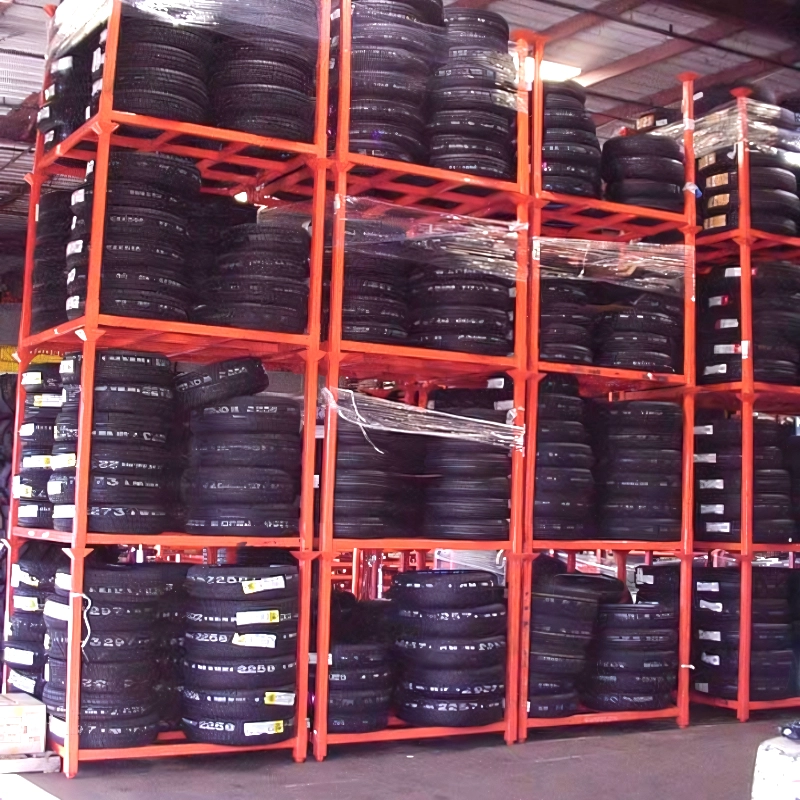
Floor space is your most valuable asset. Stacking loose pipes is limited and unsafe. Our portable stack racks are engineered to be safely stacked up to 4 or 5 units high. This immediately multiplies your storage capacity by 400-500% without expanding your footprint. You convert costly horizontal square footage into highly efficient vertical cubic storage.

Benefit 3: Protect Your Product, Protect Your Profit
Every pipe that sags, gets scratched, or is crushed during transport is pure loss. The robust all-steel construction of a metal post pallet acts as a protective cage throughout the supply chain. This dramatic reduction in product damage means fewer customer complaints, a lower scrap rate, and a stronger bottom line.
Frequently Asked Questions
1. What is the maximum length of pipe these racks can handle?
Our pipe storage racks are custom-fabricated to your specific needs. We commonly design racks for pipes ranging from 10 feet (approx. 3 meters) to over 40 feet (approx. 12 meters) in length, ensuring the number of posts and base structure provide optimal support for your product’s dimensions and weight.
2. How does the 8-post design specifically prevent sagging compared to a standard 4-post rack?
A standard 4-post rack only supports the very ends of the pipes. For long, flexible materials like PVC, the center remains unsupported and will sag under its own weight. By adding intermediate posts (creating a 6 or 8-post rack), we reduce the unsupported span by 50% or more. This provides the continuous support necessary to completely eliminate bowing and maintain the pipe’s straightness.
3. Are these racks suitable for outdoor storage of PVC pipes?
Yes. We recommend a hot-dip galvanized finish for any racks intended for outdoor use or in high-humidity environments. This process provides a thick, durable zinc coating that protects the steel from rust and corrosion for 20+ years, ensuring a long and reliable service life for your investment.
4. Can these portable stack racks be loaded directly into shipping containers?
Absolutely. We specifically design the width of the racks (e.g., 1100mm-1140mm) to fit perfectly side-by-side in standard shipping containers (internal width of approx. 2350mm). This ensures a tight, secure fit, maximizing container space utilization and preventing cargo from shifting during transit.
5. How many empty racks can be returned in a single truck?
The posts are removable. Once removed, the empty bases can be nested or stacked into each other. Typically, 4 to 6 empty bases can be consolidated into the footprint of one assembled rack. This dramatically reduces the space needed for return shipping, lowering reverse logistics costs by up to 75-80% and making the system highly economical for closed-loop supply chains.
Need a Custom Storage Solution?
Speak directly with our technical engineers. We offer free structural designs, heavy-duty catalog evaluations, and quick B2B price quotations.
Request a Quote Now →