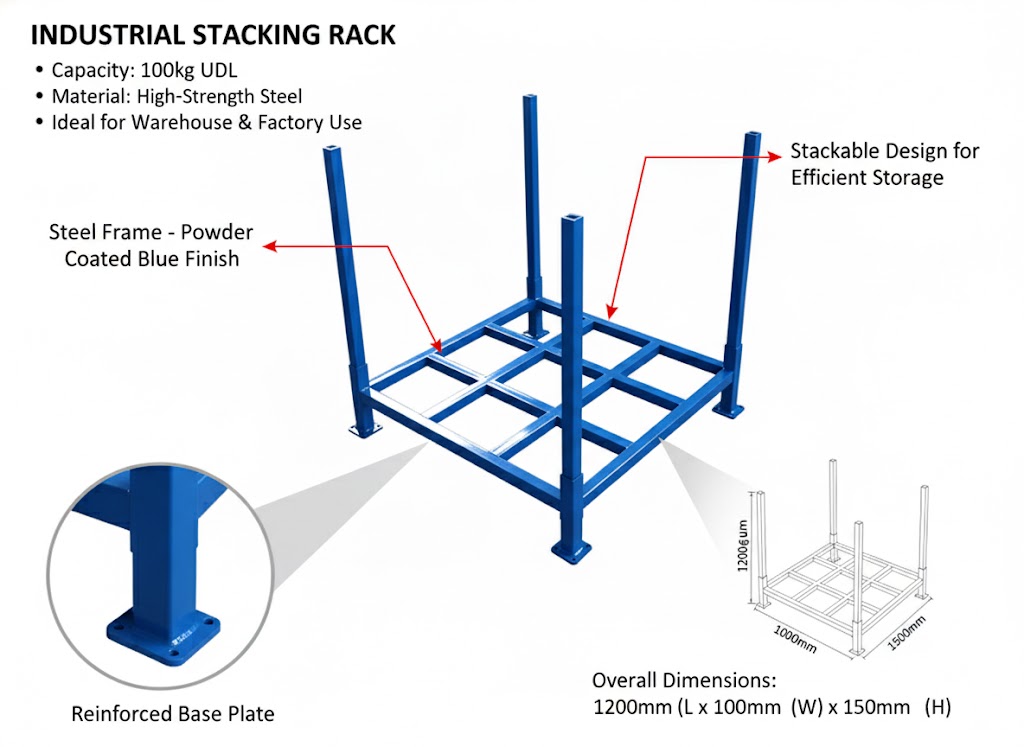

Are you losing profit to crushed bags of flour, feed, or ingredients? The bottom layers of your floor stacks are a graveyard for product integrity and warehouse space. Stop compressing your assets and start stacking smart with a system that protects every single bag, from the floor to the ceiling.
The Real Cost of “Pyramid Stacking” in Your Mill or Food Plant
In any facility handling bagged goods—be it a flour mill, an animal feed production plant, or a bakery ingredient warehouse—the sight is all too familiar: pyramids of palletized bags rising from the floor. While seemingly efficient, this traditional method of warehouse storage silently drains your profitability. The weight of the upper pallets inevitably compresses the bottom layers, leading to caked product, broken bags, and unsaleable goods. This isn’t just a minor inconvenience; it’s a direct hit to your bottom line.
Before: A Warehouse Constrained by Product Weakness
Let’s examine the daily reality of a warehouse reliant on floor stacking:
- Product Damage: The lower 10-20% of your inventory is at constant risk. A single ton placed on top exerts immense pressure, compromising the quality of your flour, feed, or grains. This leads to customer rejections and wasted product.
- Wasted Vertical Space: Your stacking height is limited not by your building’s ceiling, but by the crush strength of your bags. You’re paying for cubic feet of air, with most warehouses utilizing less than 40% of their available vertical space.
- Inefficient Operations: Accessing a specific batch or SKU at the bottom of a stack is a labor-intensive nightmare. It requires de-stacking and re-stacking multiple pallets, wasting man-hours and increasing the risk of handling errors and worker injuries.
- Inventory Management Hurdles: With “Last-In, First-Out” (LIFO) becoming the default, proper stock rotation (FIFO) is nearly impossible. This is a critical failure for products with expiration dates.
The result is a chaotic, inefficient, and costly storage environment where your own product becomes the weakest link in your operation.

The Shift: Building a “Steel Skeleton” for Your Inventory
The solution is to decouple storage density from the product’s own strength. Portable staging storage stillages, also known as metal post pallets or stack racks, provide an independent, load-bearing steel frame for each palletized unit. The logic is simple yet revolutionary: the weight of the upper levels is transferred through the steel posts directly to the floor, completely bypassing the goods stored below.
After: A Dynamic, Protected, and High-Density Warehouse
By integrating a system of portable stack racks, your warehouse transforms instantly:
- Zero Product Compression: Stack 4 or 5 levels high with absolute confidence. The load of a 2,000 Lbs pallet is supported by the steel structure, not the bags underneath. Product damage from crushing is eliminated.
- Maximize Cubic Volume: Immediately unlock the full height of your warehouse. Increase your storage capacity by 300-400% within the same square footage, delaying or eliminating the need for costly expansions.
- 100% Selectivity & FIFO Compliance: Every single pallet stillage is an independent unit accessible by a forklift. Retrieve any batch, any time, without disturbing other pallets. This makes true First-In, First-Out inventory management a simple reality.
- Ultimate Flexibility: These are not bolted-down, permanent fixtures. Reconfigure your entire warehouse layout in a single afternoon to accommodate seasonal peaks in production or create temporary staging areas. When not in use, the posts are removed and the bases nest together, consuming minimal floor space.
Beyond Storage: Streamlining Your Entire Logistics Chain
The value of these systems extends beyond the warehouse walls. Because they act as both storage and transport units, you can load finished goods into the stillages directly off the production line. These units can then be loaded onto trucks for distribution, protecting your product throughout transit. For return logistics, the demountable posts allow the empty bases to be nested, dramatically reducing the cost of shipping them back. One truck can return 4-5 times the number of empty units compared to fixed-frame cages.

Frequently Asked Questions
1. Are these storage stillages food-grade or suitable for a clean environment like a flour mill?
Absolutely. Our heavy duty stack racks are available with a hot-dip galvanized finish. Unlike painted surfaces that can chip and rust, galvanizing provides a durable, corrosion-resistant surface that is easy to clean and holds up to wash-down procedures, ensuring it won’t contaminate your product packaging.
2. How much weight can a single portable stack rack hold?
Standard units are typically rated for capacities from 2,000 Lbs to 4,000 Lbs per rack. We also engineer custom solutions for heavier or unusually shaped loads. The key is that they can be safely stacked up to 4 or 5 units high, even when fully loaded to capacity.
3. Our mill produces bags of varying sizes. How adaptable is this system?
The system is highly adaptable. The base of the stillage is designed to hold a standard pallet (e.g., 48″ x 40″). As long as your bags are stabilized on a pallet, they will fit perfectly. The open frame design also accommodates bulk bags (FIBCs) with ease, providing support and preventing bulging.
4. How do these racks improve safety compared to block stacking?
They significantly enhance safety. Each rack interlocks with the one below via specially designed “cup feet” that self-align, creating a stable, secure column. This eliminates the risk of unstable floor stacks collapsing, which is a major hazard for both personnel and product.
5. What is the impact on forklift operator efficiency?
Operators become much more efficient. The self-aligning feet make stacking faster and safer, reducing the time needed to perfectly position a pallet. Furthermore, since any pallet can be accessed directly, the time spent searching for and reshuffling inventory is virtually eliminated, directly boosting productivity.
Need a Custom Storage Solution?
Speak directly with our technical engineers. We offer free structural designs, heavy-duty catalog evaluations, and quick B2B price quotations.
Request a Quote Now →