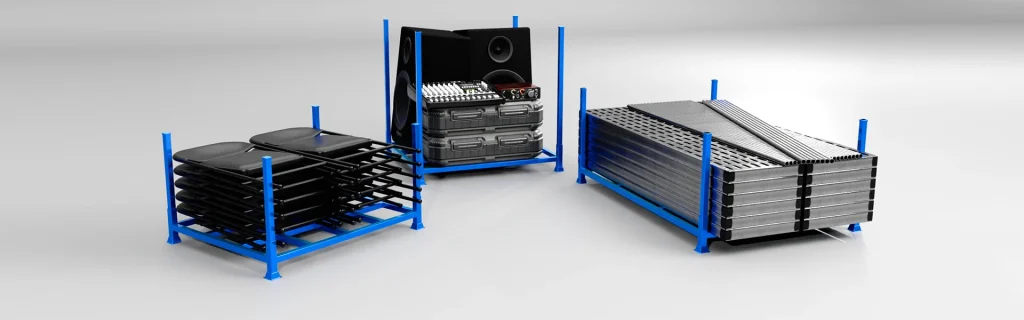

Determining the exact price of custom galvanized stack racks without a detailed consultation is challenging. However, understanding the key factors that influence the cost is the first step toward making a smart investment. This guide breaks down the pricing structure, moving beyond the initial quote to reveal the total cost of ownership and long-term value, especially for demanding cold storage and outdoor applications.
Beyond the Sticker Price: The True Cost of Warehouse Racking
When evaluating the cost of portable stack racks for cold storage or outdoor use, focusing solely on the upfront purchase price is a common mistake. A lower initial cost often leads to higher long-term expenses through frequent replacement, maintenance downtime, and product damage. The true cost is a combination of the initial investment (CapEx) and the ongoing operational expenses (OpEx). A properly specified hot-dip galvanized system, while having a higher initial price tag than painted alternatives, is designed to drastically reduce OpEx over a service life that can exceed 20 years.
Key Factors Driving the Cost of Custom Galvanized Stack Racks
The final price of your custom rack is determined by a combination of physical specifications, manufacturing processes, and design complexity. Here are the primary cost drivers:
1. Dimensions, Steel Specification, and Load Capacity
The most fundamental cost factor is the amount and grade of steel used. A rack designed to hold 2,500 lbs of dense materials will require thicker steel tubes (e.g., Q235 structural steel) and more reinforcement than one designed for 1,000 lbs of lighter goods. Key parameters that increase steel consumption, and therefore cost, include:
- Base Size: A larger footprint (e.g., 48″ x 60″ vs. 40″ x 48″).
- Post Height: Taller posts for accommodating bulky items.
- Load Capacity: The maximum weight the rack must safely support, both individually and when stacked 4-5 units high. This dictates the wall thickness of the steel and the need for under-deck reinforcements.
2. The Hot-Dip Galvanization Process: A Critical Investment for Harsh Environments
Surface treatment is a major cost differentiator and the most critical feature for cold storage or outdoor use. Unlike a simple layer of paint or powder coating, hot-dip galvanizing is a metallurgical process.
- Process: The fully fabricated steel rack is submerged in a bath of molten zinc. This creates a series of zinc-iron alloy layers, topped with a pure zinc layer, typically exceeding 60μm in thickness.
- Value Proposition: This process provides dual protection. It creates a physical barrier against moisture and offers cathodic (sacrificial) protection. If the surface is deeply scratched, the surrounding zinc will corrode first, “healing” the wound and protecting the steel base. This is why galvanised stillages are the only viable long-term solution for environments with constant condensation (cold rooms) or exposure to rain and snow. It prevents rust contamination on food or pharmaceutical packaging, ensuring compliance with standards like HACCP/GMP.

3. Customization Complexity: Tailored for Your Product
A standard four-post pallet rack is the baseline. Custom features designed to solve specific material handling challenges will add to the cost but deliver a significant return on investment through reduced product damage and improved handling efficiency.
- Specialized Cradles: U-shaped or V-shaped cradles for storing fabric rolls or steel coils, preventing them from rolling and developing flat spots.
- Extra Posts: 8-post designs for long, flexible items like PVC pipes, providing full-length support to prevent sagging and deformation (“Banana-ing”).
- Decking Options: Steel mesh decking for improved airflow in cold storage and compliance with fire safety sprinkler regulations, versus a solid steel deck or simple frame.
- Forklift Guides & Feet: Special enclosed forklift pockets or conical “cup feet” for self-aligning stacking, which speeds up handling and improves operator safety.
4. Order Quantity and Production Batches
Like most industrial manufacturing, economies of scale play a significant role. A larger order (e.g., a full container load of 200+ units) allows the manufacturer to optimize material purchasing, fabrication line setup, and the galvanizing process. This results in a lower per-unit cost compared to a small batch order of 20-30 units.
Calculating the ROI: An Investment, Not an Expense
To truly understand the cost, compare the long-term value of a galvanized metal post pallet against its alternatives. The total cost of ownership (TCO) reveals a clear winner.
| Feature | Hot-Dip Galvanized Stack Rack | Painted Steel Rack | Wood Pallets (Block Stacking) |
| Initial Cost | High | Medium | Low |
| Lifespan in Cold/Outdoor Use | 20+ Years | 3-5 Years (before significant rust) | 1-2 Years (prone to rot, mold) |
| Maintenance Requirement | Minimal (occasional cleaning) | Frequent touch-ups, rust removal | Constant replacement, disposal costs |
| Product Damage Risk | Near-Zero (Structure bears the load) | Near-Zero (Structure bears the load) | High (Crushing bottom layers, splinters) |
| Food Safety Compliance | Excellent (Inert, cleanable surface) | Poor (Paint chips, rust flakes) | Unacceptable (Mold, bacteria, pests) |
| Vertical Space Utilization | Excellent (Stack 4-5 high) | Excellent (Stack 4-5 high) | Poor (Limited by product integrity) |
| Long-Term TCO | Lowest | Moderate to High | Highest |
The Hidden Savings: Operational Efficiency Gains
Beyond durability, these systems fundamentally change your workflow. They serve as a combination of storage racking, shipping container, and work-in-process carrier. This eliminates multiple handling steps, a major source of labor cost and product damage. Furthermore, the ability to nest the demountable posts and bases for return shipment can reduce reverse logistics costs by up to 80%, making a closed-loop supply chain economically feasible.

Conclusion: Invest in a System, Not Just a Rack
The cost of custom galvanized stack racks is not a simple line item. It’s an investment in operational resilience, product integrity, and long-term financial health. For cold storage and outdoor warehouses, where moisture and temperature fluctuations are constant threats, the superior performance and extended lifespan of a hot-dip galvanized finish provide a return on investment that far outweighs the initial price difference. By focusing on total cost of ownership, you equip your facility with a flexible, durable, and cost-effective storage solution built to last for decades.
Frequently Asked Questions (FAQ)
1. What is the typical lifespan of a hot-dip galvanized stack rack in a cold storage environment?
With proper handling, a hot-dip galvanized rack can easily last over 20 years, even in the high-moisture, condensing environment of a cold storage facility. The zinc coating provides robust protection against rust and corrosion.
2. Why is galvanizing superior to paint or powder coating for outdoor use?
Paint and powder coating are simple barrier layers. Once scratched by a forklift, moisture gets underneath and rust begins to spread. Galvanizing creates a self-healing, sacrificial layer. The zinc corrodes before the steel, actively protecting the rack from weather, rain, and snow even if the surface is damaged.
3. Can these racks really improve my warehouse space utilization?
Absolutely. By allowing you to safely stack non-stackable or crushable items up to 4 or 5 levels high, you can transform unused vertical air space into valuable storage. This can increase your storage density by 300-400% compared to simple floor stacking.
4. Are custom stack racks difficult for forklift drivers to handle?
No, they are designed for standard forklift operations. Features like self-aligning cup feet act as guides, making it faster and safer for operators to stack units accurately without needing perfect alignment on the first try.
5. How does the “nesting” feature save money on return shipping?
The posts are removable. For return trips, you can remove the posts from multiple racks and nest the empty bases into a dense, compact stack. This means a single truck can carry 4-5 times more empty racks compared to non-nesting designs, drastically cutting return freight costs.
Need a Custom Storage Solution?
Speak directly with our technical engineers. We offer free structural designs, heavy-duty catalog evaluations, and quick B2B price quotations.
Request a Quote Now →