
|
Is Your “Dead Space” Eating Your Margins?In the float glass industry, square footage is currency. Traditional A-frames and wooden crates dominate your floor even when empty, choking your workflow. Our High density storage racks for float glass sheets utilize a revolutionary L-shaped nesting design that compresses volume by 70% during return trips or storage. Stop paying to store air. |
The Logistics Paradox: Why Traditional Racks Fail the Density Test
Every Operations Manager in a glass fabrication plant knows the drill: You ship out 10 trucks of insulated glass units (IGU) or raw float sheets to a glazing contractor. Once installed, you are left with a mountain of empty A-frames. These empty racks take up the exact same footprint coming back as they did going out. You are effectively paying full freight for “ghost cargo.”
Furthermore, inside the warehouse, static wooden crates or non-stackable racks create a rigid, inefficient layout. You cannot adapt your line-side storage to fluctuating inventory levels of tempered or laminated glass.

Figure 1: Empty L-racks nesting efficiently like shopping carts, reclaiming valuable warehouse floor space.
The “Nesting” Solution: 70% Volume Compression
The defining feature of our High density storage racks for float glass sheets (often called the “Grack” or L-Buck) is the geometric nesting capability. Unlike A-frames which require disassembly to save space, our L-shaped design allows empty racks to slide into one another.
- Logistics Efficiency: You can stack up to 7 empty racks in the space of 2 full ones.
- Container Optimization: For international distributors, we can fit up to 98-112 units in a single 40HQ container using inverted stacking techniques.
- Floor Management: When production slows or specific glass sizes are out of stock, the empty racks can be nested and pushed to a corner, instantly widening your forklift channels.
Preventing the “Million Dollar Sound”: Eliminating Breakage
High density means nothing if the glass chips or cracks. The most terrifying sound in a glass factory is the “pop” of a tempered sheet exploding or the crunch of a raw float sheet edge. The culprit is almost always Metal-on-Glass contact caused by worn-out protection.
Cheap racks use rubber strips glued to the steel. After a few weeks of exposure to cutting fluids, heat, and the sheer shearing force of loading heavy glass packs, that glue fails. The rubber slides off, and your glass rests directly on the steel beam.

Figure 2: Steel-core rubber profile mechanically fixed with screws to prevent detachment under heavy load.
The Steel-Core Rubber Standard
We don’t use glue. Our glass transport rack systems utilize a Steel-Core EPDM Rubber profile.
- Mechanical Fixation: The profile is anchored to the rack frame using self-tapping screws through the internal steel core. It cannot peel off.
- Edge Protection: The specific hardness (Shore A 70-80) absorbs the shock when a crane lowers a 3,000 lb pack of float glass, preventing the micro-fractures that lead to catastrophic failure later.
- No “Ghosting”: The rubber compound is formulated to be non-marking, ensuring your high-performance Low-E coatings remain pristine.
Built for the Rigors of the Stone & Glass Yard
Whether you are handling standard 96″ x 130″ float sheets or custom heavy IGU panels, structural rigidity is non-negotiable. A rack that flexes during forklift transport is a rack that breaks glass.
We utilize Q235 Carbon Steel (equivalent to ASTM A36) with a Full Seam Welding process. We do not “stitch weld” critical joints. The main load-bearing posts are typically 50x50mm or 60x60mm square tubes with a wall thickness of 2.5mm to 3.0mm.

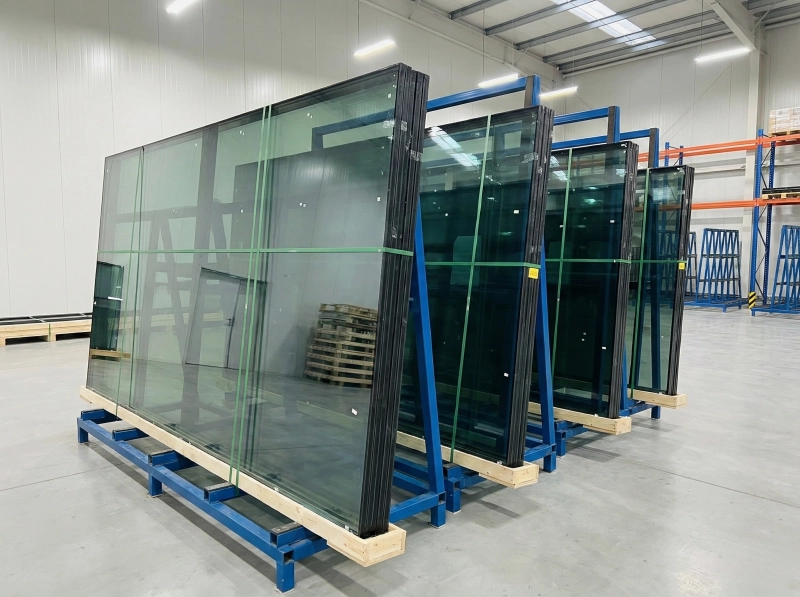
Figure 3: Heavy-duty construction supporting massive glass packs, coated in RAL 5010 for corrosion resistance.
This heavy-duty engineering allows for a Safe Working Load (SWL) of 1.5 to 4 tons depending on the model. Furthermore, the base is designed with a specific 3-5° tilt angle. This geometric lock utilizes gravity to keep the sheets stable against the backboard, eliminating the risk of sheets tipping forward during sudden forklift braking.
Frequently Asked Questions (FAQ)
Q: Can these racks handle “Jumbo” size float glass sheets?
A: Yes. While our standard L-rack is optimized for container loading (1600mm length), we manufacture custom “Jumbo” racks (up to 2032mm x 1220mm base) specifically for large architectural glass and wall panels.
Q: How do you prevent the racks from tipping over when loaded?
A: Stability is achieved through a calculated base-to-height ratio and a 3-5 degree tilt angle. For single-sided L-racks, we also integrate heavy-duty back counterweights (Balance Blocks) to ensure the Center of Gravity remains safe, even when handling tall loads.
Q: Are these racks compatible with overhead cranes?
A: Absolutely. All our racks come standard with reinforced “Crane Eyes” or Lifting Pins on the top beam, allowing for safe 4-point lifting via overhead cranes or hoists in the factory.
Q: What is the lifespan of the rubber protection?
A: Because we use screw-fixed steel-core rubber, it typically lasts 3-5 years under heavy industrial use. If a section is damaged by a glass shard, it can be easily unscrewed and replaced without scrapping the whole rack.
Q: Do you offer galvanized options for outdoor storage?
A: Yes. For glass or stone yards stored outdoors, we recommend Hot-Dip Galvanizing over powder coating. This provides a metallurgical bond that prevents rust for 10+ years, even in wet climates.
Need a Custom Storage Solution?
Speak directly with our technical engineers. We offer free structural designs, heavy-duty catalog evaluations, and quick B2B price quotations.
Request a Quote Now →