
Are crushed bags of flour and feed eating into your profits? Is your warehouse floor a chaotic maze of pyramid stacks, making inventory counts and order picking a nightmare? It’s time to stop letting gravity dictate your storage capacity and start protecting your valuable bagged goods.
The Daily Challenge in Flour and Feed Mills: The Unstable Pyramid
If you’re in the flour or animal feed business, you know the scene well. Your warehouse is filled with thousands of bags—layer mash for chickens, hog starter feeds, premium siopao flour. The only way to store them is by floor stacking. This “pyramid” method is a constant source of operational headaches:
- Product Compression Damage: The bottom layers of bags bear the weight of the entire stack. This leads to compacted, hardened product, burst seams, and significant financial write-offs. Your quality control is compromised before the product even leaves your facility.
- Wasted Vertical Space: You pay for every cubic foot of your warehouse, but you can only stack as high as the bags themselves allow, typically just 5-6 feet. The valuable space between the top of the stack and your ceiling is pure wasted potential.
- Inventory Gridlock: Accessing a specific batch or SKU at the bottom or in the middle of a stack is a labor-intensive nightmare. It requires unstacking and re-stacking dozens of other bags, killing efficiency and creating a safety risk for your team. This makes a true First-In, First-Out (FIFO) system nearly impossible to maintain.
- Hygiene and Pest Risks: Bags stacked directly on the floor or on porous wood pallets are susceptible to moisture from the concrete, pests, and contamination.

Each stack rack protects its contents, ensuring the weight of upper tiers is borne by the steel frame, not the product below.
The Solution: A Steel Skeleton for Your Inventory
The core problem is simple: you’re asking your product to act as the storage structure. Our heavy duty stack racks, also known as pallet stillages, fundamentally change this dynamic. They introduce a robust, independent steel frame around your palletized goods.
Here’s the logic: A full pallet of feed or flour bags is placed into the base of the rack. The four strong steel posts then support the weight of the next rack stacked on top. The load is transferred directly from post to post, all the way to the floor. Your bagged goods bear zero weight. This simple principle unlocks a new level of efficiency and protection for your operations.
Benefit 1: Quadruple Your Storage in the Same Footprint
By removing the physical limitations of the bags, you can now safely go vertical. Instead of a single-level floor stack, you can stack 4 or even 5 racks high. This immediately transforms your warehouse from a measure of square feet to a measure of cubic feet, often increasing your storage capacity by 300-400% without leasing a single extra foot of space.

Transform your floor space into high-density vertical storage, maximizing every cubic foot of your warehouse.
Benefit 2: Drive Product Damage Rates to Near-Zero
With the steel frame bearing all the weight, product compression is completely eliminated. The bags on the bottom rack are as perfect and saleable as the ones on the very top. This directly translates to a reduction in damaged product, fewer returns, and a healthier bottom line. Furthermore, the metal base keeps your goods off the floor, protecting them from ground moisture and making cleaning underneath easier.
Benefit 3: Create a Flexible, Accessible Warehouse
Think of each portable stack rack as a modular, movable “storage cube.” Unlike fixed racking, you are not locked into a permanent layout.
- Total SKU Accessibility: Your forklift driver can access any pallet in any rack at any time. Need to ship the chick booster feed that’s on the bottom level? No problem. Simply pick up the racks above it, retrieve the target pallet, and restack. No manual handling of individual bags is required.
- Adaptable Layout: Reconfigure your warehouse on the fly. During slow seasons, the removable posts allow the empty rack bases to be nested together, freeing up huge areas of floor space for other operations like staging or cross-docking.
Benefit 4: Optimize Your Logistics Loop
These racks aren’t just for storage; they are also returnable transport units. Ship your goods to a distributor in the rack, and once unloaded, the posts can be removed and the bases nested for the return trip. This “nesting” capability means a single truck can carry back 4-5 times the number of empty racks, making a closed-loop, reusable packaging system incredibly cost-effective and environmentally friendly.

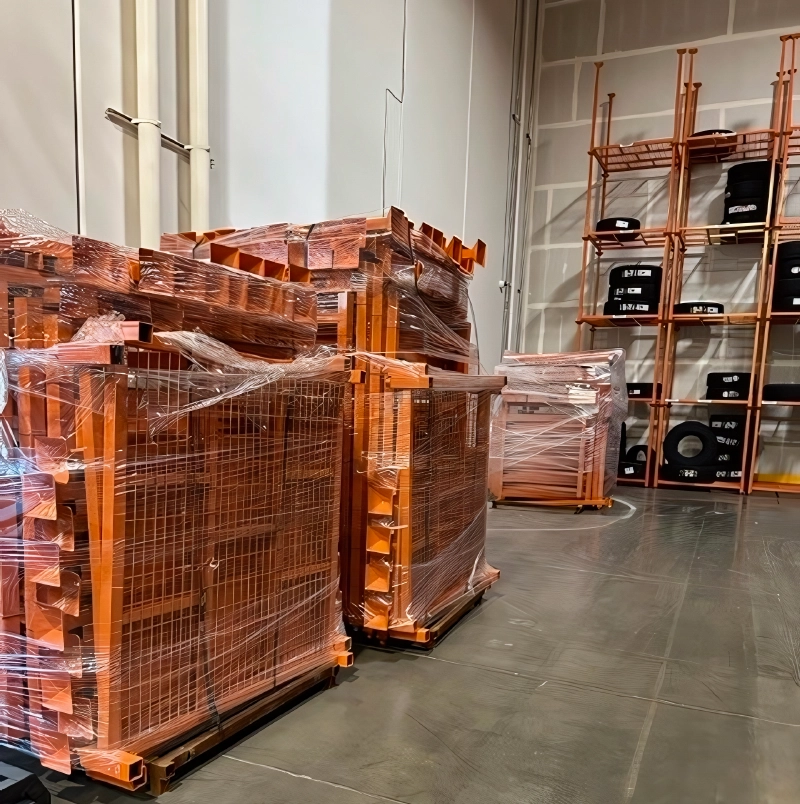
Empty racks nest compactly, drastically reducing return shipping costs and storage space.
Stop accepting product damage and inefficient space utilization as the cost of doing business. By integrating industrial stacking racks into your workflow, you create a safer, denser, and more flexible storage environment that protects your product and boosts your operational efficiency.
Frequently Asked Questions for Flour & Feed Mills
1. How much weight can a single stack rack hold for bagged goods?
Our standard heavy duty stack racks are typically engineered to hold between 2,000 lbs and 4,000 lbs (approx. 900 to 1800 kg). This is more than sufficient for a standard pallet of 50 lb or 25 kg bags of flour or feed. We can also custom-engineer racks for heavier loads based on your specific requirements.
2. Are these racks suitable for food-grade environments like a flour mill?
Absolutely. Unlike wood pallets that can harbor moisture, mold, and pests, our steel racks are non-porous and easy to clean. For environments requiring high levels of sanitation or those with temperature fluctuations (like cold storage), we recommend a hot-dip galvanized finish, which provides superior rust and corrosion protection for decades.
3. How do portable stack racks improve our FIFO (First-In, First-Out) system?
By making every single pallet individually accessible. With floor stacking, the first bags in are always the last out. With our racks, you can organize your warehouse by production date. When you need to ship the oldest stock, your forklift operator can retrieve that specific rack—even if it’s on the bottom level—by simply and safely moving the newer racks stacked on top of it. This ensures proper stock rotation.
4. Can our existing forklifts handle these racks?
Yes, they are designed to be fully compatible with standard forklifts. The base of each rack features 4-way or 2-way fork pockets, allowing for easy and secure lifting from multiple directions, just like a standard pallet.
5. What’s the main advantage of these over permanent pallet racking for our business?
Flexibility. Permanent racking is bolted to the floor, locking you into a fixed layout. As a flour or feed producer, your inventory levels and product mix can fluctuate seasonally. Portable stacking pallet racks allow you to change your warehouse layout in a matter of hours, not weeks. You can create picking aisles when you need them and open up bulk storage space when you don’t. This adaptability is a significant operational advantage.
Need a Custom Storage Solution?
Speak directly with our technical engineers. We offer free structural designs, heavy-duty catalog evaluations, and quick B2B price quotations.
Request a Quote Now →