Your CNC cutting table is running non-stop, but your tempering furnace is waiting. Between stations, valuable glass sheets—especially custom, thin, or coated lites—are at risk of scratches, micro-cracks, and costly breakage. This bottleneck isn’t just inefficient; it’s a direct drain on your profitability. It’s time to bridge the gap in your production flow with a purpose-built solution.
From Bottleneck to Superhighway: Optimizing Glass Flow with a Heavy Duty Harp Rack
In modern industrial settings, the term “heavy duty rack” often evokes images of storing massive molds or dies. But the core principles—precision engineering, robust load-bearing capacity, and specialized design—are most critical where the materials are both heavy and fragile. Nowhere is this truer than in the fast-paced environment of a glass fabrication facility.
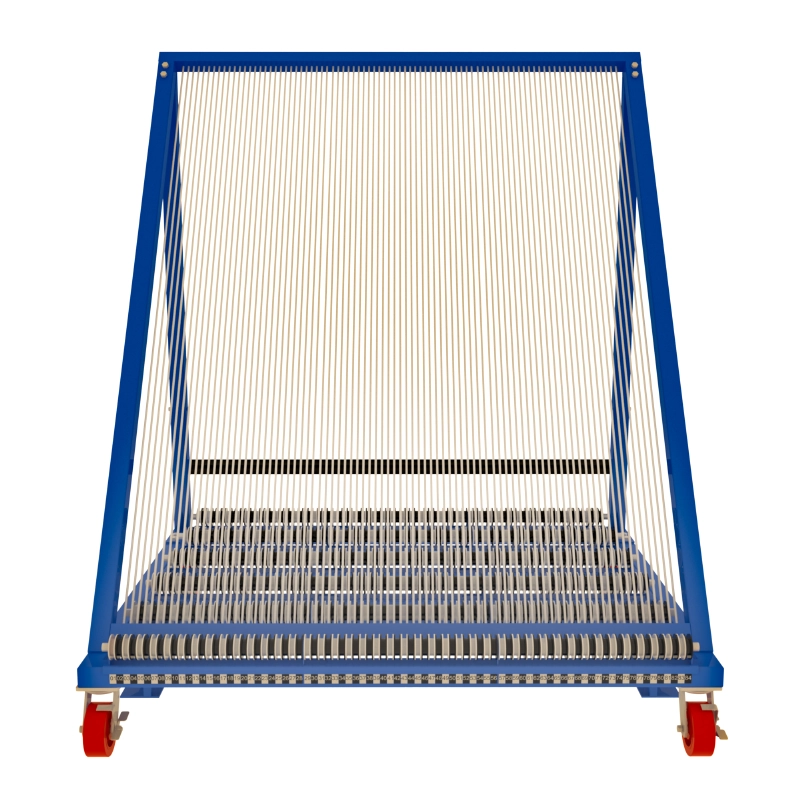
The journey of a glass sheet from a CNC glass cutting table to the washing machine, tempering furnace, or IGU assembly line is fraught with risk. Traditional A-Frame or L-Frame racks, excellent for bulk storage, become inefficient and unsafe for managing the dynamic flow of in-process lites. This is where the Harp Rack, a specialized harp rack glass trolley, transforms your workshop floor.
The Challenge: Inefficient Sorting and Material Damage in WIP
For any Insulated Glass Unit Manufacture or custom fabricator, the process of “pairing” or sorting cut lites is a major pain point. Using the wrong equipment leads to:
- Scratches and Edge Chips: Expensive Low-E coatings and polished edges are easily damaged when lites are leaned against each other or handled multiple times.
- Micro-Cracks in Thin Glass: Transporting thin glass (e.g., ≤6mm) on standard carts with wide gaps causes vibration and flexing, introducing invisible stress fractures that lead to failure in the tempering furnace.
- Safety Hazards: Manually sorting and moving heavy, awkwardly sized glass sheets increases the risk of worker injury and catastrophic breakage.
- Wasted Space and Time: Disorganized WIP lites consume valuable floor space and create a chaotic workflow, forcing operators to waste time searching for matching pieces.
Engineered for Glass Fabrication: A Component-by-Component Solution
A Harp Rack isn’t just another cart; it’s an engineered system designed to solve specific glass handling problems. Its value is built into every component.
Protecting High-Value Surfaces with PVC-Coated Dividers
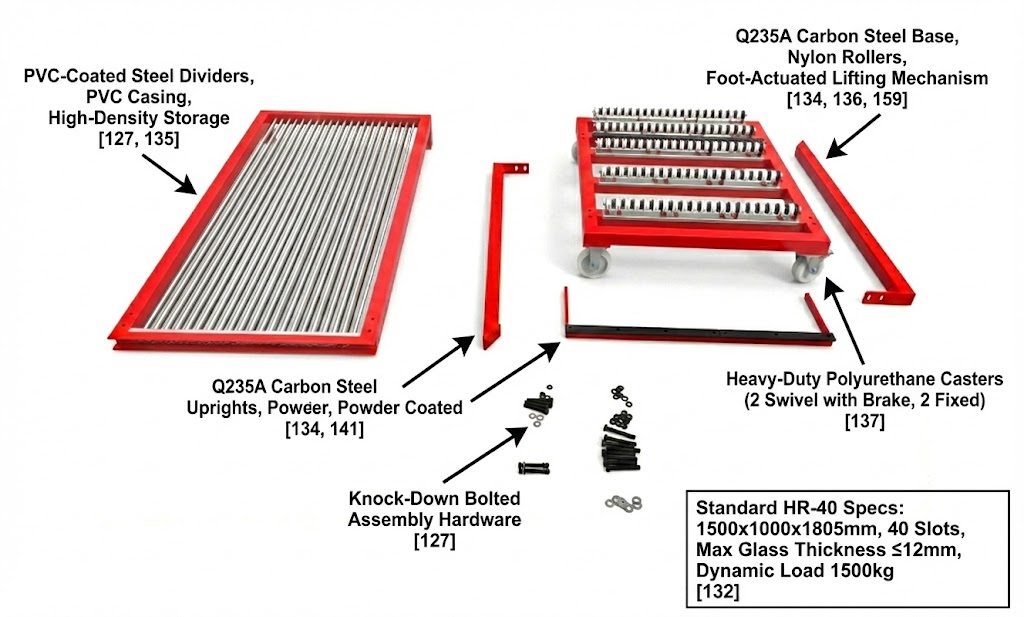
Each glass lite slides into its own dedicated slot, separated by a robust steel divider fully encased in a soft, non-abrasive PVC casing. This design provides the rigidity to support heavy glass while ensuring that delicate surfaces, like Low-E coatings or decorative finishes, never make hard contact. The result is a dramatic reduction in surface scratches and rejects.

Mastering Non-Standard & Thin Glass with Specialized Bases
The one-size-fits-all approach fails with custom glass. We offer two factory-direct base solutions:
- Nylon Roller Base: Ideal for heavy lites, low-friction nylon rollers allow operators to effortlessly slide glass into place, reducing physical strain and the risk of chipping edges during loading. The numbered slots ensure precise sorting glass units.
- Full Steel Slotted Base: This is our game-changing solution for non-standard, short, or thin glass. Unlike roller bases where short pieces can fall through or be unstable, our full base harp racks provide continuous bottom support. We can custom-cut the slot width to precisely match your typical glass thickness, eliminating vibration and securing thin lites perfectly.

Ensuring Ultimate Safety with a Foot-Actuated Locking Mechanism
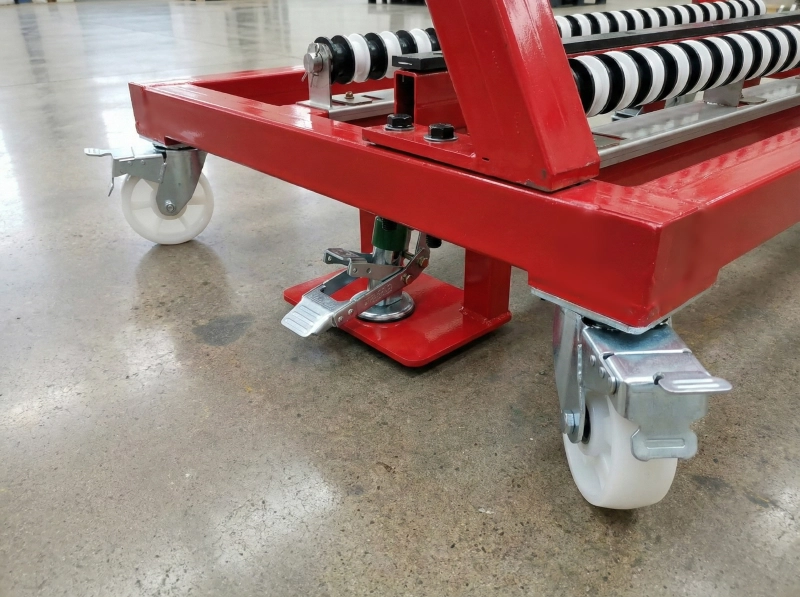
A loaded rack in motion is a significant safety concern. Our racks feature a unique Foot-Actuated Lifting Mechanism. Before moving, the operator simply steps on a pedal, which slightly lifts the glass load off the base and presses it securely against a fixed rubber buffer. This completely immobilizes the lites during in-plant transfer, preventing any shifting or rattling, even on uneven floors. This simple action protects both your product and your people.
The Factory-Direct Advantage: Quality, Customization, and Cost-Efficiency
As a factory-direct provider, we control every aspect of production, from raw material to final coating. This translates into tangible benefits for our clients.
Robust Construction for a Demanding Environment
We build our racks from high-grade Q235A Carbon Steel, using a full welding process for maximum structural integrity, unlike inferior spot-welded alternatives. The durable powder coating, customizable to any RAL color, withstands the harsh conditions of a fabrication plant. Heavy-duty polyurethane casters (two fixed, two swivel with brakes) ensure smooth mobility and stable positioning. This is a tool built to last.
| Model | External Dimensions (L×W×H, Inches) | Slot Count | Dynamic Load (Lbs) |
| HR-40 | 59″ x 39.4″ x 71″ | 40 | 3300 |
| HR-84 | 59″ x 47.2″ x 70.9″ | 84 | 3300 |
| Custom | Built to your specifications | Customizable | Up to 5500+ |
Lowering Your Landed Cost with Smart Logistics
International shipping costs are a major factor. Our Harp Racks feature a knock-down, bolted assembly design. We ship them flat-packed, drastically reducing transport volume. This design allows for more units to fit into a single container, significantly lowering your per-unit shipping costs and making on-site handling and assembly straightforward.

Frequently Asked Questions
1. How does the Harp Rack handle very thin glass, like 1/4″ (6mm), compared to our current A-frames?
Our Full Steel Slotted Base model is the perfect solution. Unlike A-frames where thin lites can wobble, we can factory-cut the slots to a precise width (e.g., 3/8″ or 10mm) that provides snug, secure support, eliminating vibration and the risk of micro-cracks during transport.
2. Can a forklift move the rack when it’s fully loaded?
Absolutely. The base is engineered with forklift entrances, allowing for safe and efficient movement of fully loaded racks (up to 3300 lbs dynamic load for standard models) across larger facilities. For manual movement, the heavy-duty casters and handles make it easy to maneuver.
3. How difficult is the on-site assembly process?
Assembly is very straightforward. The rack is designed for simple bolted assembly. Key components (base, uprights, divider grid) are modular. A two-person team can typically assemble a rack in under 30 minutes with standard tools. We recommend loosely fitting all bolts first, then tightening them once all components are aligned.
4. We need our racks in a specific color to match our branding. Is that possible?
Yes. As a factory-direct manufacturer, we offer full customization. You can choose any color from the RAL color chart to match your company’s branding or to color-code racks for different production lines or stages.
5. What is the difference between the dynamic load and static load capacity?
The dynamic load (e.g., 3300 lbs) is the maximum weight the rack can safely handle while being moved. The static load, which is significantly higher, is the maximum weight it can support when stationary. Always adhere to the dynamic load rating for all transport operations.
Need a Custom Storage Solution?
Speak directly with our technical engineers. We offer free structural designs, heavy-duty catalog evaluations, and quick B2B price quotations.
Request a Quote Now →