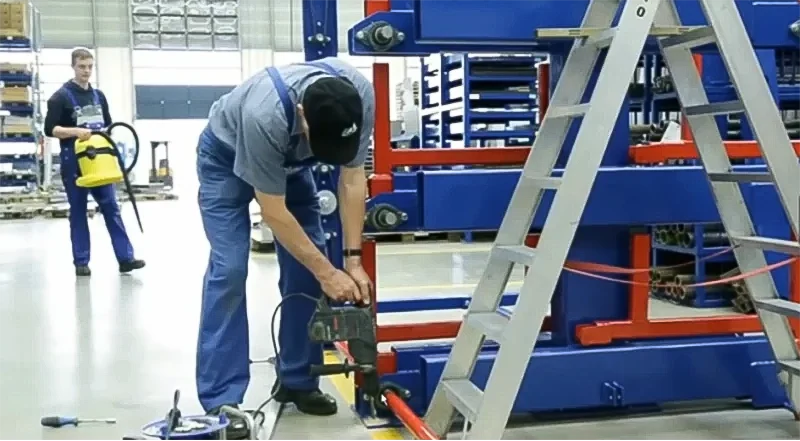

Tired of the daily battle with buried inventory? The endless cycle of moving five bundles of steel just to get to the one you need is a drain on time, a risk to your materials, and a danger to your team. A crank out cantilever rack transforms this chaotic process into a streamlined, safe, and efficient workflow by bringing the exact material you need directly to your overhead crane.
The Real Cost of “Business as Usual” in Material Storage
In any steel service center or metal fabrication shop, the way raw materials are stored dictates the pace of the entire operation. Traditional static cantilever racks or floor stacking might seem like a straightforward solution, but they create hidden operational taxes that you pay every single day. These aren’t abstract financial risks; they are concrete, measurable losses in productivity and material value.
The “Dig-Out” Tax: Wasting Time to Find Your Stock
The most common issue with static storage is the lack of selectivity. When the specific grade or dimension of steel pipe or bar stock you need is at the back or bottom of a rack, a costly process begins. Operators must first remove the “blocking” materials in front. This secondary handling involves multiple steps: locate, remove, temporarily store, retrieve the target, and finally, re-stack the blocking materials. This sequence can easily consume 15 to 25 minutes, during which your expensive laser cutter or CNC machine sits idle, waiting for its next job. This isn’t just lost labor time; it’s lost machine uptime and production capacity.
Material Integrity: When a Scratch Becomes Scrap
For businesses handling high-value or specialized materials, such as the high-purity stainless steel tubes used in pharmaceutical or food processing industries, surface finish is not a cosmetic feature—it’s a critical specification. A single deep scratch from a forklift tine dragging across a polished tube can violate ASME BPE standards, creating a potential harbor for bacteria and rendering a $2,000 piece of material worthless. This damage often occurs during the clumsy process of sliding heavy bundles in and out of tight, static rack bays. The cost of protecting these assets during storage is fractional compared to the cost of replacing them due to preventable handling damage.
The Workflow Revolution: Bringing the Rack to the Crane
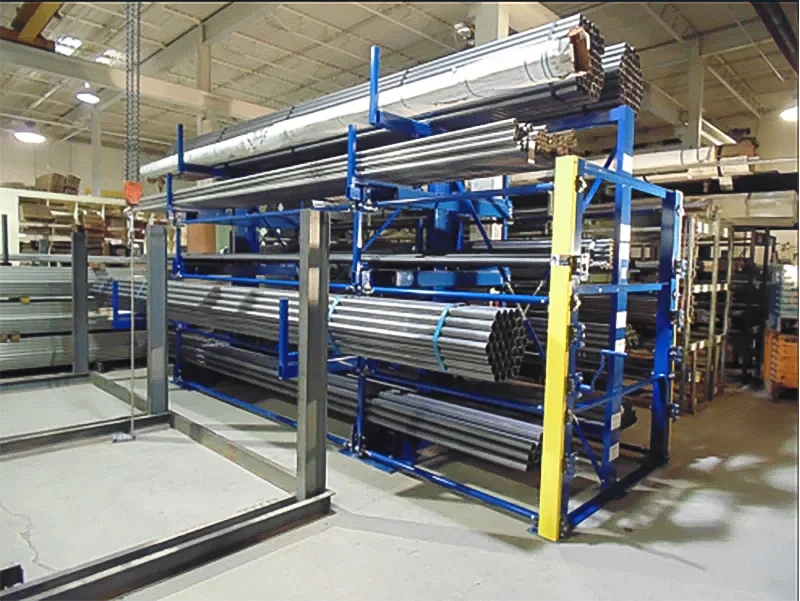
A crank out cantilever rack fundamentally alters the relationship between your inventory, your handling equipment, and your operators. Instead of forcing a forklift into a confined storage structure, the rack itself extends into an open aisle, presenting the material for safe and easy access from above. This simple mechanical advantage creates a cascade of operational improvements.
100% Extension: The Key to Unobstructed Access
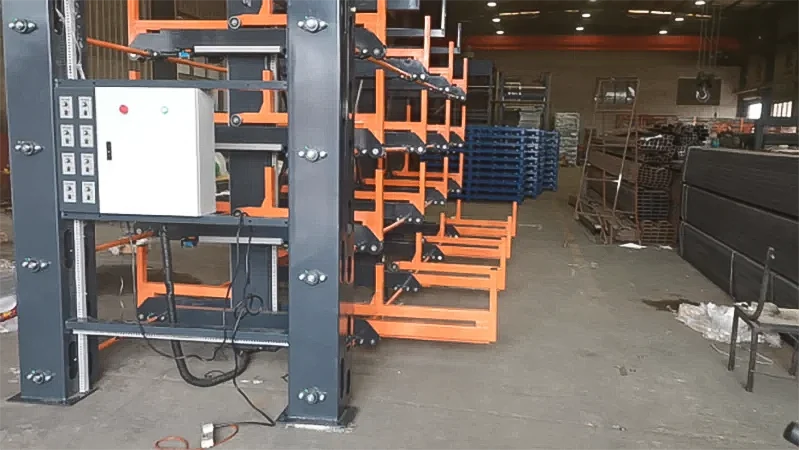
The core of the system is the ability for each storage level to extend fully—100% of its depth—out from the main frame. Using a simple manual crank or a powered motor, a single operator can smoothly roll out a level carrying several tons of material. This action completely exposes the stored contents, eliminating any overhead obstruction from the rack levels above. Your overhead crane now has a clear, vertical path to the entire bundle, not just the front edge. It allows for the use of wide nylon slings or vacuum lifters that support the material properly and prevent damage.
Overhead Crane Integration: The End of Aisle Congestion
By making your inventory fully accessible to an overhead crane, you effectively remove the forklift from the storage and retrieval equation. This is a game-changer for both safety and space efficiency. Cranes operate above the floor-level chaos, providing operators with a clear line of sight and precise control over heavy loads. There are no blind corners to navigate and no risk of a swinging 20-foot load hitting another rack, a machine, or a person. Furthermore, since you no longer need 15-foot-wide aisles for forklift turning radiuses, you can condense your storage footprint by up to 50%, reclaiming valuable floor space for more production machinery.
At a Glance: Static Forklift Storage vs. Dynamic Crane Storage
The operational differences are not subtle. Shifting to a crank-out, crane-fed system is a strategic upgrade that directly impacts your daily workflow, safety record, and bottom line.
| Dimension | Traditional Static Rack with Forklift | Crank Out Cantilever Rack with Overhead Crane |
| Material Access | Limited selectivity. Requires moving front items to access back items (“Dig-Out”). | 100% selectivity. Any level can be accessed directly without moving others. |
| Retrieval Time | Slow and unpredictable (15-25 minutes), depending on inventory position. | Fast and consistent (2-5 minutes). |
| Material Protection | High risk of scratches, dents, and damage from forklift tines and sliding friction. | Extremely low risk. Vertical lift with soft slings or vacuum lifters prevents contact damage. |
| Space Efficiency | Poor. Requires wide aisles (12-20 ft) for forklift maneuvering. | Excellent. Aisle width is determined by load size, not vehicle size, saving up to 50% of floor space. |
| Operator Safety | High risk due to forklift traffic, blind spots, and potential for dropped or swinging loads. | High safety. The operator stands clear of the load, controlling it remotely with the crane. |
Investing in a crank out cantilever rack system is more than just buying a piece of equipment. It’s a fundamental decision to stop wasting time, to protect the value of your inventory, and to create a safer, more organized, and significantly more productive work environment.
Frequently Asked Questions
1. How much force does it take to operate the manual crank?
The crank mechanism is designed with a gear ratio that provides significant mechanical advantage. A single operator can extend a fully loaded shelf, often carrying several thousand pounds, with minimal physical effort, typically equivalent to applying 45-65 lbs (20-30 kg) of force.
2. Can a crank out rack really save that much floor space?
Yes. The primary space saving comes from drastically reducing or eliminating the wide aisles required for forklifts. A traditional setup might need a 15-foot aisle. A crane-serviced system only needs an aisle wide enough for the material itself to extend into, often just 4-5 feet. This reclaimed space can be used for additional storage or value-added production equipment.
3. What is the typical weight capacity of these racks?
These are heavy-duty systems built from structural steel. Capacities are scalable based on the application, but it is common for each individual extendable level (shelf) to hold anywhere from 2,000 lbs to over 10,000 lbs (approx. 1 to 5 metric tons).
4. Is an electric-powered version available for heavier loads?
Absolutely. For applications involving extremely heavy loads (like injection molds or large steel plates) or high-frequency access, motorized systems are ideal. These are operated via a simple push-button control panel or a handheld remote, further improving speed and ergonomics.
5. What industries benefit most from this type of storage?
Any industry handling long, heavy, or valuable bar, tube, or profile stock sees significant benefits. This includes steel service centers, metal fabricators, aerospace suppliers (storing titanium and aluminum), high-purity tube manufacturers (stainless steel), and facilities managing heavy tooling or molds.
Need a Custom Storage Solution?
Speak directly with our technical engineers. We offer free structural designs, heavy-duty catalog evaluations, and quick B2B price quotations.
Request a Quote Now →