
The Cold Chain’s Hidden Enemies: Inefficient Storage & Contamination Risks
For any facility handling bagged goods like flour, grains, animal feed, or other perishable ingredients, the warehouse floor itself can be the biggest threat. Traditional storage methods in temperature and humidity-controlled environments present a daily battle against product loss and compliance failures.
The “Pyramid Scheme” That Crushes Your Bottom Line
Floor stacking, or “pyramid stacking,” seems like a simple solution, but it creates a cascade of costly problems. Bags at the bottom of a stack bear the full weight of everything above them, leading to compaction, breakage, and spoilage. This method also creates a strict “Last-In, First-Out” (LIFO) inventory trap, making proper stock rotation nearly impossible. Accessing a specific batch means manually de-stacking and re-stacking hundreds of bags, wasting labor and increasing the risk of damage.
When Standard Racking Fails the Hygiene Test
Conventional painted steel racks are not a viable solution for cold or humid environments. The constant condensation causes paint to chip, peel, and flake, leading to rust formation. These rust particles can contaminate product packaging, resulting in costly recalls and violating critical food safety standards like HACCP and GMP. Similarly, wood pallets are a major liability; they absorb moisture, harbor mold and bacteria, and can introduce splinters into a clean production environment.

The Solution: A Steel Skeleton for Your Inventory
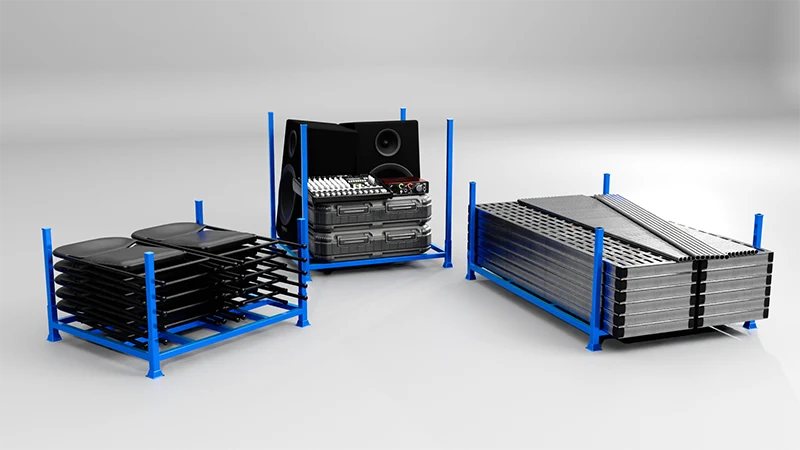
The answer is to separate the load-bearing function from the product itself. Our metal post pallet system provides a protective “steel skeleton” around your goods. A full pallet of bags can be placed inside the base, and the vertical posts bear 100% of the weight, allowing you to stack up to 4 or 5 units high with zero pressure on the products below.
Built for Hygiene: The Hot-Dip Galvanizing Advantage
Unlike painted systems, our galvanised stillages are specifically engineered for the rigors of the cold chain. The entire unit is submerged in molten zinc, creating a thick, metallurgically bonded coating that offers two layers of defense:
- Physical Barrier: A tough zinc-iron alloy layer completely seals the steel from moisture and oxygen.
- Sacrificial Protection: Even if the surface is deeply scratched by a forklift, the surrounding zinc will corrode first, “healing” the wound and protecting the steel base. This ensures a rust-free service life of over 20 years.
This finish is smooth, non-porous, and can be easily cleaned with high-pressure water or steam, making it fully compliant with the strictest food and pharmaceutical safety standards.
Transforming Your Warehouse Operations from the Ground Up
Adopting portable stack racks is more than just an equipment upgrade; it’s a fundamental shift in how you manage your space, inventory, and logistics.

Maximize Your Cube, Not Just Your Square Footage
By safely utilizing vertical space, you can increase your warehouse storage density by 300-400% without adding a single square foot of real estate. Because these racks aren’t bolted to the floor, your warehouse layout becomes completely dynamic. You can reconfigure storage areas to accommodate seasonal inventory peaks and then clear the space for other operations during slower periods—a level of flexibility impossible with fixed racking.
Slash Costs in Your Reverse Logistics
The posts are fully demountable. For return shipments, the posts can be removed and a stack of 4-6 empty bases can be nested together in the same footprint as a single assembled unit. This simple feature drastically reduces return shipping volume by up to 80%, making a closed-loop returnable transport packaging system highly profitable.

Frequently Asked Questions
| 1. Aren’t these hot-dip galvanized steel pallets more expensive than wood or plastic pallets? |
| While the initial capital expenditure (CAPEX) is higher, the Total Cost of Ownership (TCO) is significantly lower. A galvanized steel rack has a service life of over 20 years, compared to just a handful of trips for a wood pallet. They eliminate recurring costs from product damage, contamination write-offs, and constant replacement, delivering a rapid return on investment. |
| 2. How do these racks handle the constant high humidity in our cold storage facility? |
| They are purpose-built for it. The hot-dip galvanization process creates a thick, robust zinc-iron alloy that provides both a physical barrier and electrochemical (sacrificial) protection. This means they are impervious to rust, even in the event of scratches from daily operations. |
| 3. Can we store different SKUs, like various types of flour and animal feed, in these racks? |
| Absolutely. Each pallet stillage functions as an independent, mobile unit. This is ideal for segregating products by batch, type, or allergen status, enabling true First-In, First-Out (FIFO) inventory management and preventing cross-contamination. |
| 4. Is the open-mesh or steel-plate base strong enough for a full pallet of heavy feed sacks? |
| Yes. The base is engineered with reinforced steel to safely handle dynamic loads, typically ranging from 2,000 to 4,000 Lbs. The open design is a critical feature in cold chains, as it promotes uniform cold air circulation around the product, improving cooling efficiency and preventing moisture pockets. |
| 5. How difficult is it to assemble or disassemble the posts for return shipping? |
| The process is tool-free and can be completed by a single worker in under a minute. The posts simply slot into reinforced corner sockets. This quick-change capability is key to their operational flexibility and the cost savings realized in return logistics. |
Need a Custom Storage Solution?
Speak directly with our technical engineers. We offer free structural designs, heavy-duty catalog evaluations, and quick B2B price quotations.
Request a Quote Now →