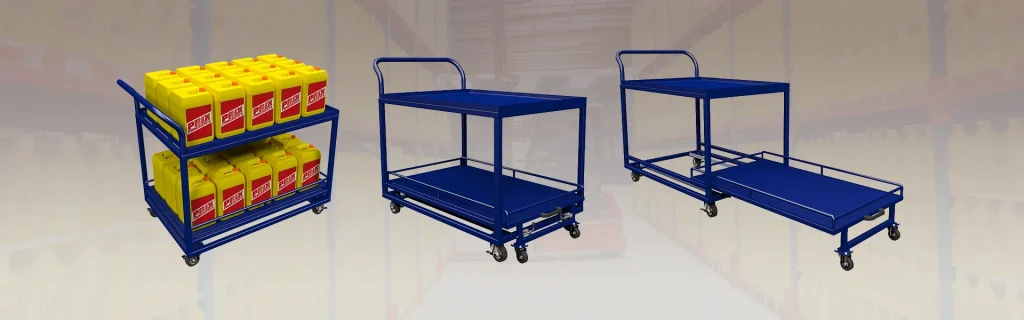

Standard two-tier trolleys force operators into inefficient and strenuous postures to access the lower level. Our design features an innovative pull-out bottom layer with an independent rail system, enabling effortless, vertical access to heavy loads. This transforms workflow, increases picking speed, and significantly reduces the risk of workplace injuries and product damage.
The Critical Question: Beyond Weight Rating to Usable Capacity
When selecting an industrial 2 tier tool cart, the specification sheet often highlights a total load capacity. However, the real question for any seasoned operations manager is not just “How much can it hold?” but “How much can it hold *accessibly and safely*?” A 300kg rating per layer is meaningless if accessing that weight on the bottom tier requires awkward maneuvering that risks employee injury or damages valuable components. The true test of a heavy-duty trolley lies in its ability to make its full capacity functional. An independent rail system is the engineering answer to this challenge, but its effectiveness depends entirely on the design’s integrity, materials, and stability mechanics.
Deconstructing the 300kg Pull-Out Capability: A System of Integrated Engineering
Achieving a stable 300kg load capacity on a fully extended pull-out layer is not the result of a single oversized component. It is the outcome of a purpose-built system where each part works in concert to manage forces and ensure stability. This moves beyond the limitations of standard drawer slides and fundamentally redefines the trolley’s mechanics.
The Core of Motion: V-Wheel and Angle Steel Rail Engagement
The primary mechanism enabling smooth, heavy-duty extension is the V-wheel running on an angle steel rail. Unlike conventional flat rollers or ball-bearing slides that can jam with debris or deform under point loads, this system provides two distinct advantages:
- Self-Centering Guidance: The V-shaped groove of the wheel naturally seats itself on the peak of the angle steel rail. This ensures the tray tracks perfectly straight without lateral play, even when loaded unevenly. This prevents the crabbing and jamming common with lesser designs under heavy loads.
- Debris Tolerance: The open design of the rail means dust, metal shavings, or other workshop debris are pushed aside by the V-wheel rather than being trapped in a closed channel. This maintains smooth operation in demanding industrial environments with minimal maintenance.

The Principle of Stability: Front Auxiliary Casters as a Force Decoupler
The most critical innovation for handling a 300kg extended load is the integration of auxiliary casters at the front of the pull-out layer. When the layer is extended, these casters contact the floor, fundamentally changing the physics of the trolley.
- Tipping Moment Elimination: Without these casters, pulling out a 300kg load would create an immense tipping force on the main frame. The auxiliary casters transfer the vertical load of the extended tray directly to the ground. This transforms the pull-out layer into an independent, stable 4-wheeled platform, effectively creating a temporary “six-wheeled” trolley.
- Load Independence: The weight on the extended layer is supported by its own wheels, not cantilevered off the main frame. This means the structural integrity of the main frame is not compromised, and the entire unit remains balanced and safe, preventing catastrophic tipping failures.
The Foundation: Material Strength and Validated Structural Design
The system’s capacity is ultimately underpinned by the materials and construction of the frame and trays. The use of Q235 carbon structural steel provides the necessary balance of strength, toughness, and weldability. Finite Element Analysis (FEA) using ANSYS software confirms this design’s robustness. In simulations with a 300kg distributed load on each layer, the maximum stress recorded was 214 MPa, well below the material’s yield strength. This computational validation provides a high degree of confidence that the structure can handle repeated heavy-duty cycles without fatigue or deformation.
Translating Engineering to Operational Efficiency
A trolley capable of safely handling 300kg on an extendable lower level directly impacts day-to-day operations by solving deep-rooted ergonomic and efficiency problems.
From a “Blind Zone” to Full Visual Access
Standard two-tier trolleys create a “geometric blind zone” on the lower shelf. Operators cannot see where they are placing heavy items like brake discs, tooling dies, or electronic modules. This leads to “blind dropping,” which causes product damage and disorganized loading. The pull-out system transforms this process:
- Top-Down Visibility: With the layer fully extended, the operator has a complete, unobstructed top-down view. They can place items precisely, organizing the space for mixed-SKU picking and preventing heavy components from crushing delicate ones.
- Improved Accuracy: For industries like industrial hardware, where distinguishing between similar parts (e.g., M8x20 vs. M8x25 bolts) relies on reading small labels, full visibility under ambient light is crucial for preventing picking errors.

The Ergonomic Shift: Replacing Bending with Vertical Placement
The most significant operational change is the elimination of hazardous bending and reaching motions. Accessing the lower level of a standard cart forces operators into deep trunk flexion while handling heavy objects—a primary cause of musculoskeletal disorders (MSDs).
The pull-out design changes the required body mechanics entirely. The operator stands upright, pulls the tray out, and then places the item vertically downwards. This action keeps the load close to the body and uses major muscle groups, dramatically reducing strain on the lower back and shoulders. For high-frequency order picking, this ergonomic improvement translates directly to reduced employee fatigue, higher sustained productivity throughout a shift, and a safer work environment.
Summary of Load-Bearing Features
The ability of this 2 Tier Order Picking Trolley to handle 300kg per layer is a verified capability rooted in a comprehensive engineering approach. The following table breaks down the core components and their contribution:
| Component | Specification / Feature | Contribution to 300kg/Layer Capacity |
| Main Frame & Tray | Q235 Carbon Steel, 30x30mm Rectangular Tubing, 1.2mm Steel Plate | Provides the foundational rigidity and strength to prevent bending or structural failure under a 600kg total load. |
| Pull-Out Mechanism | V-Wheel and Angle Steel Rail System | Ensures smooth, jam-free extension and retraction of the 300kg load without buckling or lateral failure. |
| Stability System | Front Auxiliary Casters on Pull-Out Layer | Negates the tipping force by transferring the extended load directly to the ground, guaranteeing stability. |
| Design Validation | ANSYS Finite Element Analysis (FEA) | Computationally proves that stresses within the structure remain safely below the material’s limits under maximum load. |
Conclusion: Engineered for Accessible Strength
So, can a 2 tier tool trolley with an independent rail system handle 300kg per layer? The answer is an emphatic yes, provided it is engineered as a complete system. The combination of a robust steel frame, a self-guiding V-wheel rail system, and the critical addition of load-bearing auxiliary casters creates a tool that doesn’t just store heavy loads but makes them fully and safely accessible. This design directly addresses the core deficiencies of standard trolleys, transforming a simple material carrier into a high-efficiency tool for modern order fulfillment and industrial workshops.
Frequently Asked Questions
1. What is the total maximum load capacity for the entire trolley?
The trolley is engineered for a total safe working load of 600kg. This is distributed as 300kg for the fixed top layer and 300kg for the pull-out bottom layer.
2. Will the trolley tip over if I pull out the bottom layer when it’s fully loaded with 300kg?
No, it will not. The pull-out layer is equipped with two front auxiliary casters. When extended, these casters make contact with the floor, creating a stable six-point base that transfers the load directly to the ground and prevents any risk of tipping.
3. What materials are used to ensure it can handle such heavy weights?
The main frame is constructed from welded Q235 carbon structural steel rectangular tubing, and the layers are made from 1.2mm thick steel plate. The casters are high-strength polyurethane (PU) for durability and smooth, quiet operation on industrial flooring.
4. How is the pull-out rail system different from a standard drawer slide?
It uses a heavy-duty V-wheel and angle steel rail system. This industrial design is superior to standard slides as it is self-guiding, highly resistant to jamming from debris found in workshop environments, and engineered specifically for heavy, repeated loads.
5. Is this trolley suitable for environments that might have oil or metal shavings on the floor?
Yes. The entire steel structure is protected by an electrostatic powder coating (≥60μm thick) over a phosphated surface, making it resistant to corrosion, oils, and chemicals. The open design of the V-wheel rail system is also far less susceptible to jamming from debris than enclosed ball-bearing slides.
Need a Custom Storage Solution?
Speak directly with our technical engineers. We offer free structural designs, heavy-duty catalog evaluations, and quick B2B price quotations.
Request a Quote Now →